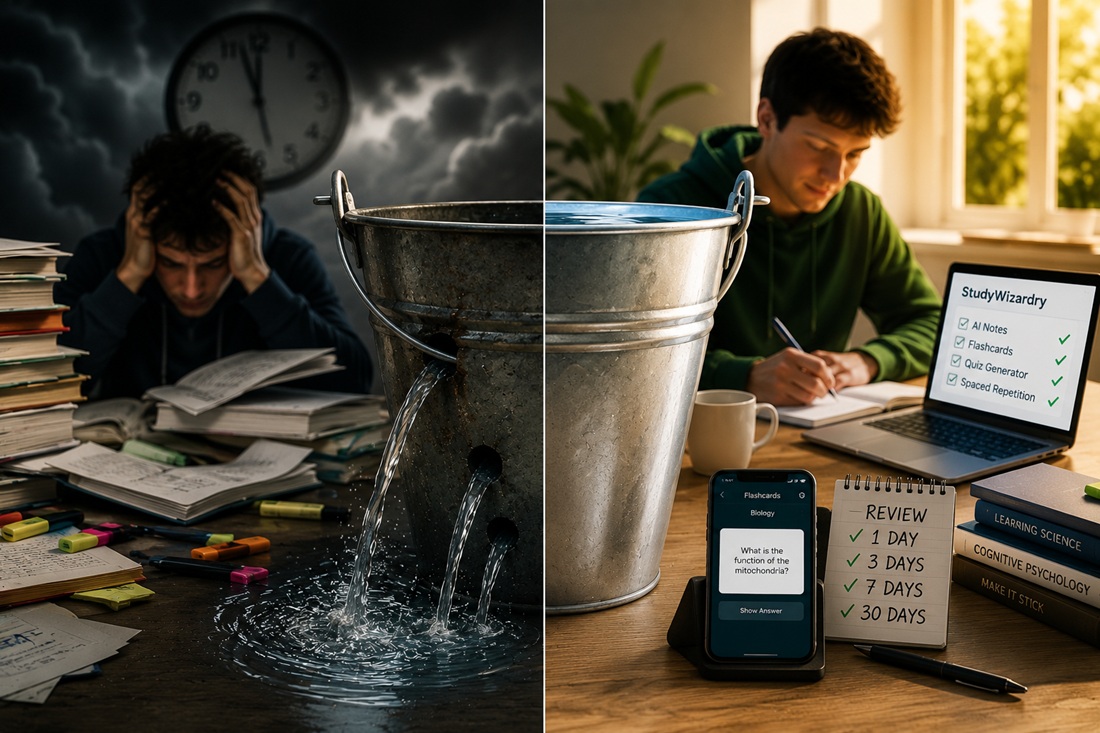
The Leaky Bucket: Why You Forget Almost Everything You Learn (And How to Finally Fix It)
It’s Sunday night. Your textbook is open to the same page it was open to three hours ago. You’ve read this paragraph six times. You still don’t remember what it says.
Your phone is at 12%. Your coffee is cold. Your highlighters have formed a small mountain on your desk. And somewhere in the back of your mind, you know you’re going to fail tomorrow’s exam.
You promise yourself next week will be different.
Next week isn’t different. Somehow, every Sunday ends the same way.
This isn’t laziness. This is a system failure.
🪣 The Leaky Bucket Theory
Every lecture you attend is like water poured into a leaky bucket.
The knowledge stays for a moment. You understand it in the room. You nod along. You take notes. You feel confident.
Then the leaks begin.
Over the next few days, the information quietly drains away. By Sunday night, you’re trying to fill a bucket that has been empty for days.
Here’s what’s actually happening: Without review, much of what you learn begins to fade surprisingly quickly—a pattern often illustrated by the forgetting curve. It’s not a personal failure. It’s how your brain works.
But here’s the thing: the lecture didn’t disappear. You just never told your brain it was worth keeping.
The Moment Most Students Lose the Lecture
It happens every time.
You walk out of class at 2 PM feeling confident. You understood the material. You highlighted the key points. You feel like you’ve done the work.
At 7 PM, you still remember most of it.
By the next morning, half of it is gone.
By Friday, almost nothing remains.
The lecture didn’t disappear overnight. It slowly leaked away, day by day, because you never gave your brain a reason to hold onto it.
Students often think they remember things they’ve actually already forgotten. They look at their notes and feel a sense of familiarity. But familiarity is not recall. It’s a dangerous illusion.
Your brain is designed to forget things that don’t seem important. From an evolutionary perspective, forgetting is efficient. You don’t need to remember where you parked your car three years ago. But that same system makes learning difficult.
Every time you successfully retrieve information from memory, your brain receives a signal:
“This matters. Keep it.”
Every time you don’t retrieve it, your brain assumes:
“This wasn’t important.”
Without retrieval, your brain discards information like yesterday’s news.
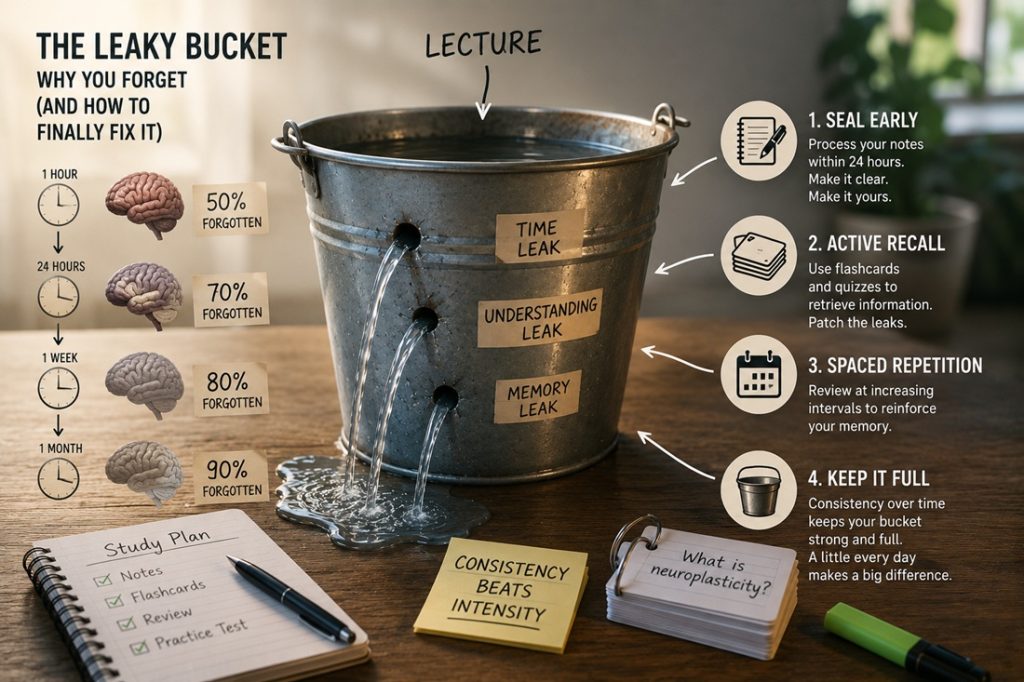
The Three Leaks
Every student’s bucket has three distinct holes.
The Time Leak
You learn something on Tuesday, but you don’t review it until Sunday. Five days of forgetting. The material was there—you just let it drain away.
The Understanding Leak
You think you understand the material because you recognize it. But recognition is not recall. You can’t explain it without looking. The understanding was never actually there.
The Memory Leak
Your brain doesn’t see the information as important. Without reinforcement, it treats the knowledge as irrelevant and discards it. You never told your brain it was worth keeping.
Two Students, Two Buckets
Let’s see how this plays out in real life.
Student A attends their Monday lecture. They take notes. They understand everything. They feel good about it. Then they close their notebook and don’t open it again until Sunday night.
Sunday arrives. The bucket is almost empty. They spend hours trying to refill it. They reread, highlight, and panic. By midnight, they’re exhausted and defeated. The information still doesn’t stick.
Student B attends the same Monday lecture. They take notes. Then, within 24 hours, they upload the lecture recording. Within seconds, they have a clear set of structured study notes with the main concepts already organized.
On Tuesday, they spend ten minutes actively engaging with the notes. They rewrite one section in their own words. They write questions in the margins.
On Wednesday, they turn their processed notes into flashcards.
On Thursday and Friday, they review those flashcards for five to ten minutes each day.
On Saturday, they take a practice quiz.
On Sunday, they spend a few minutes reviewing instead of several hours cramming. They don’t panic. The bucket is already full.
Same lectures. Same material. Completely different experience.
🪢 Plugging the Leaks
The workflow is simple.
-
Seal the first hole within 24 hours. Before you forget, turn your notes into something usable. Rewrite one section in your own words. Write questions in the margins. Summarize each part without looking.
-
Patch new leaks with active recall. Flashcards and quizzes force retrieval. Every time you successfully recall something, you strengthen the signal: “This matters.”
-
Reinforce the bucket walls with spaced repetition. Review at increasing intervals: one day, three days, seven days, thirty days.
-
Keep the bucket full. Review consistently. A little every day beats a lot once a week.

The Workflow That Replaces Sunday Panic
Here’s what this looks like in practice.
On Monday afternoon, a student leaves their biology lecture with eighteen pages of messy notes. They know that if they don’t do something soon, this information will leak away by the weekend.
They upload the lecture recording to StudyWizardry’s AI Note Maker. Within seconds, they have a clear set of study notes with the main concepts already organized. The first leak is sealed.
On Tuesday, they spend ten minutes actively engaging with the notes. They rewrite one section in their own words. They write questions in the margins. They summarize each part without looking.
On Wednesday, they turn their processed notes into flashcards using StudyWizardry’s Flashcards. They don’t have to write questions from scratch. The leaks are being patched.
On Thursday and Friday, they review their flashcards for five to ten minutes each day using spaced repetition. Cards they know appear less frequently. Cards they struggle with appear more often. This is where the bucket gets reinforced.
On Saturday, they take a practice quiz generated by StudyWizardry’s Quiz Generator. They identify what they still don’t understand. They review those concepts. The bucket is still full.
On Sunday, they don’t study. They don’t panic. The bucket is already full.
The workflow didn’t make them smarter. It made them more consistent. And consistency beats intensity every time.
Why This Actually Works
Every successful retrieval reinforces the memory, making it easier to recall in the future.
Repeated retrieval increases the brain’s expectation that this knowledge will be needed again.
This is why flashcards and practice quizzes are so effective. They force retrieval. They tell your brain this information is worth keeping.
Rereading and highlighting don’t do this. They feel productive, but they don’t send the same signal. They keep the bucket full for a moment—but they don’t patch the holes.
Cognitive science consistently shows that retrieval practice produces better long-term retention than passive review. The effort of pulling information from memory strengthens the neural pathways associated with that information. Every successful recall makes future recall easier.
The students who succeed aren’t the ones who pour in the most water. They’re the ones who build a bucket that can finally hold it.
What Changed
Now, students finish each week with clarity instead of confusion. The material stays with them. When exam week arrives, they don’t panic because they’ve already done the work.
Every lecture fills their bucket. Every day they ignore it, the bucket leaks. Every review patches another hole.
Learning isn’t about pouring in more water. It’s about building a bucket that can finally hold it.
Start Plugging Your Own Leaks
You don’t need to overhaul your entire study routine. Just change one thing: process your next lecture within 24 hours.
Your next lecture will fill the bucket. What you do in the next 24 hours determines whether it stays full.
Upload your lecture to StudyWizardry‘s AI Note Maker, personalize the notes, turn the key ideas into flashcards, and review them over the following days.
You don’t need to study longer. You need to stop letting your learning leak away.
Build a bucket that can finally hold what you learn.
📚
More from StudyWizardry
📄 Your Notes Are Raw Material
A three-step system that turns passive notes into active knowledge.
📄 Stop Highlighting. Start Blurting.
A cognitive science approach to reliable recall.
📄 44% of Students Say AI Is Making Their Brains Rot
Why students are worried about AI’s impact on their thinking—and how to use it intentionally.
✨ AI can handle the logistics. You focus on the thinking. Let StudyWizardry‘s tools support your study workflow from start to finish.
Because studying isn't the same as remembering. Simply reading, highlighting, or recognizing information doesn't strengthen memory. Your brain needs retrieval—actively pulling information back from memory—to signal that it's worth keeping. Without that, even hours of studying can slowly leak away.
Less than most students expect. Around 20–30 minutes a day is usually enough: a few minutes to process your notes, a short flashcard review, and a quick practice quiz. The goal isn't studying longer—it's studying consistently.
Not at all. Missing one day won't empty the bucket. Simply pick up where you left off instead of trying to cram everything at once. Consistency over weeks matters far more than perfection every day.
Yes. Whether you're studying biology, psychology, engineering, history, literature, or calculus, the learning principles stay the same. Active recall and spaced repetition work because they're based on how memory works—not on what you're studying.
No. You can absolutely do it with handwritten notes, flashcards, and a notebook. AI simply removes the repetitive work—organizing lectures, generating notes, creating flashcards, and building quizzes—so you can spend more time learning instead of preparing to learn.
Waiting too long before reviewing it. The first 24 hours are when the biggest leaks begin. Spending just a few minutes processing your notes shortly after class can make a much bigger difference than hours of cramming the night before an exam.