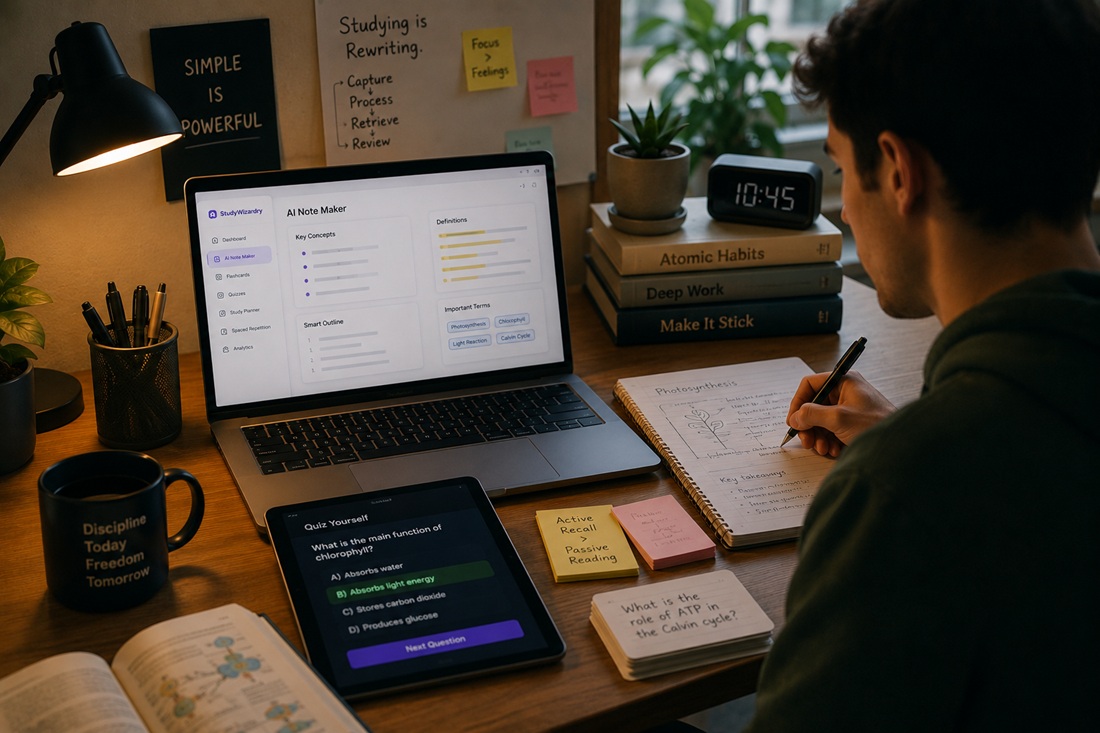
The Note Concept: Why Your Brain Needs More Than Just Notes
You spend hours making beautiful, organized notes. Color-coded headings. Perfect bullet points. Clean margins. You close your notebook feeling accomplished.
Three days later, you open it again. Everything looks familiar—but you can’t remember what any of it actually means.
Here’s the problem: notes have limited value if you can’t retrieve what’s in them later.
Most students treat note-taking as the finish line. You write it down, and you’re done. But notes aren’t knowledge. They’re raw material. And raw material doesn’t become useful until you process it.
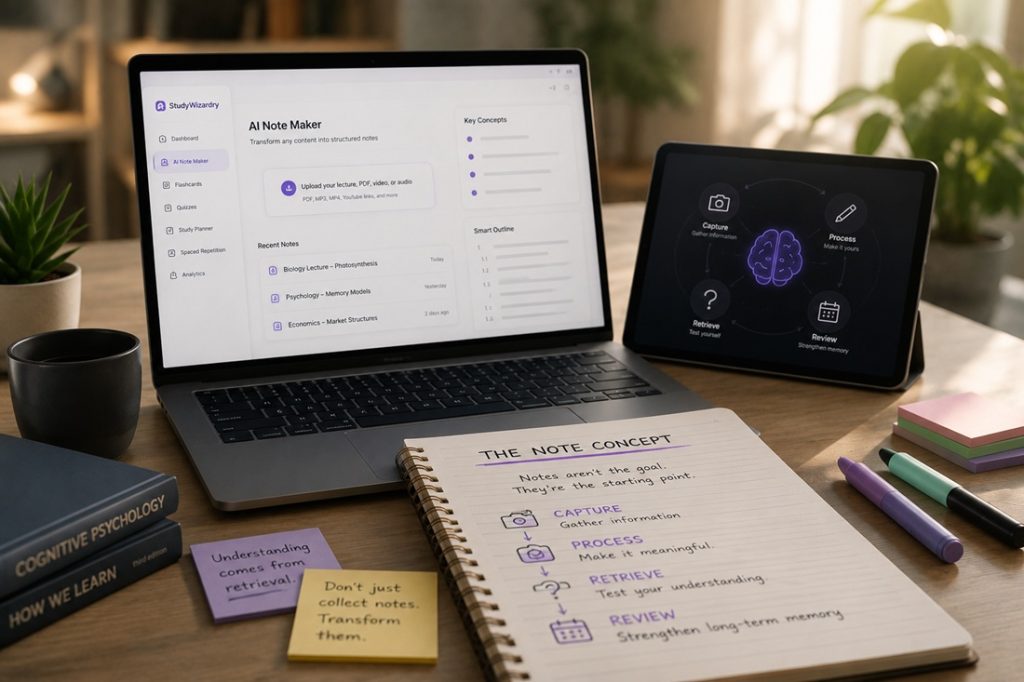
The Note Concept is simple: Notes are not the goal. They’re the starting point of learning.
🧠 Moving Beyond Information Collection
Think of your notes like ingredients in a kitchen. Having a fully stocked fridge doesn’t mean you’ve cooked a meal. You need to combine, transform, and prepare those ingredients before they become something you can actually use.
The same applies to your notes. Writing down information is just the first step. The real work—and the real learning—happens when you actively engage with what you’ve captured.
That’s the Note Concept in action: capture, process, retrieve, and review. Notes aren’t the destination—they’re the starting point.
✍️ Why Processing Matters More Than Collecting
There’s a reason handwritten notes are still powerful. Research supports the idea that writing by hand forces your brain to process, summarize, and paraphrase in real time. You can’t transcribe everything. You have to decide what matters. That cognitive effort is what builds understanding.
A 2025 study of university students found that those who used longhand note-taking demonstrated significantly higher overall cognitive scores, superior information processing speed, working memory, and better visual memory compared to those who used stylus-based digital methods.
But here’s the key insight: the advantage comes from the processing, not the format.
The same principle applies to digital notes—if you use them actively. The problem isn’t the tool. It’s passivity.
📝 Common Note-Taking Mistakes That Slow Down Learning
One of the biggest misconceptions about studying is that more notes automatically mean more learning. In reality, the way you use your notes matters far more than the number of pages you fill.
Here are some of the most common mistakes students make:
Writing everything down.
Trying to capture every sentence in a lecture often leaves little mental energy for understanding what’s actually being said. Good notes prioritize ideas over transcripts.
Highlighting without thinking.
A page covered in yellow isn’t necessarily a page you’ve learned. Highlighting becomes useful only when it helps you identify concepts you’ll revisit and test yourself on later.
Never revisiting notes.
Many students spend hours creating notes that they rarely open again. If your notes stay in a notebook or folder until exam week, they aren’t supporting long-term learning.
Mistaking familiarity for understanding.
Reading your notes over and over can create the illusion that you know the material because it looks familiar. The real test is whether you can explain the concept without looking.
These habits aren’t signs of being a bad student—they’re simply common study habits that don’t make the most of your effort.
The Note Concept encourages a different mindset. Instead of asking, “How can I create better notes?” ask, “How can these notes help me think, remember, and retrieve information later?” That small shift changes the entire purpose of note-taking.
🔄 The Note Concept Workflow
Instead of treating your notes as a finished product, treat them as raw material for a learning system.
Here’s the workflow:
Capture information → Create structured notes → Process and personalize → Generate flashcards → Test with quizzes → Review with spaced repetition
This is how notes become knowledge.
Step 1: Capture and Organize
The first step is simple: get information into a usable form.
Instead of spending an hour organizing information, you can spend that hour understanding it. Tools like StudyWizardry‘s AI Note Maker let you upload PDFs, lecture recordings, YouTube videos, or class slides and quickly turn them into structured study notes with outlines and highlighted concepts.
You’re not skipping the work—you’re removing the friction.

Step 2: Process and Personalize
This is where the real learning begins. After you get your notes, spend five minutes engaging with them.
- Rewrite one section in your own words.
- Write questions in the margins.
- Summarize each part without looking.
Research shows that students who create and use retrieval practice materials from their own notes retain significantly more information than those who simply re-read. The learning benefit comes from processing information, not simply recording it.
Step 3: Turn Notes into Active Study Materials
Your processed notes become the foundation for everything else.
-
Create flashcards from key concepts
-
Generate practice quizzes from your notes
-
Schedule spaced repetition reviews to combat the forgetting curve
StudyWizardry‘s Flashcards and Quiz Generator handle this automatically. You don’t have to create questions from scratch. The AI does it for you.
📖 What This Looks Like in Practice
Imagine finishing a 90-minute biology lecture feeling overwhelmed. You recorded the session, but your notes are incomplete. You’re not sure where to even begin reviewing.
Instead of spending another hour rewriting your notes, you upload the recording to AI Note Maker. Within seconds, you have a clear set of study notes with the main concepts already organized.
The next day, you review the AI-generated notes. You spend five minutes rewriting one section in your own words—because that’s where the learning happens. You create five flashcards from the concepts you struggled with. Then you take a short quiz generated from your notes.
A week later, you review the flashcards with spaced repetition. You take another quiz to check retention.
You spent maybe 30 minutes actively engaging with the material. You’ll remember more than if you spent three hours passively re-reading.
🎯 The Honest Truth
Here’s what successful students know: notes aren’t knowledge. They’re raw material.
The students who perform well aren’t the ones with the most organized notes. They’re the ones who actively engage with their notes—turning them into flashcards, creating practice tests, reviewing at spaced intervals. They treat notes as the beginning of learning, not the end.
AI doesn’t make you learn faster because it thinks for you. It helps you learn faster because it gives you more time to think for yourself.
AI can gather the ingredients, organize the kitchen, and even prepare the recipe. But you’re still the one who has to cook. Learning works the same way.
That’s the Note Concept: capture, process, retrieve, review. Notes aren’t the destination—they’re where learning begins.
Your next study session, try this:
Start with the next lecture you already have. Upload the recording or slides, generate structured notes, spend a few minutes personalizing them, and turn them into practice questions. You’ll spend less time organizing information—and more time actually learning it.
That’s the Note Concept in practice: use notes to start learning, not to finish it.
📚
More from StudyWizardry
Note-taking is just the beginning. Explore these guides to build a complete study system.
📄 Your Notes Are Raw Material
A three-step system that turns passive notes into active knowledge.
📄 What If You Could “Google” Your Own Brain?
How to build a Second Brain—a digital system that never forgets.
📄 Stop Highlighting. Start Blurting.
A cognitive science approach to reliable recall.
✨ Notes are raw material. Active recall is the forge. Let StudyWizardry handle the creation and scheduling so you can focus on the real work: thinking, retrieving, and understanding.
The Note Concept is the idea that taking notes is only the first step in learning. Notes become valuable when you actively process them, test yourself on what you've learned, and review them over time. In other words, notes are the starting point—not the finish line.
Not by itself. AI becomes a problem only if you stop after generating notes. When you use AI to organize lectures or PDFs and then personalize those notes, create practice questions, or review them with active recall, you're still doing the thinking that leads to long-term learning.
Treat AI-generated notes as a first draft. Rewrite key ideas in your own words, identify concepts you don't fully understand, turn important points into flashcards or practice questions, and review them using spaced repetition. The learning happens during this process—not when the notes are first created.
Handwriting can encourage deeper processing because it naturally requires summarizing and selecting important information. However, digital notes can be just as effective when you actively engage with them instead of simply collecting or rereading them.
Instead of cramming, review your notes several times over increasing intervals. Many students find a schedule such as 1 day, 3 days, 7 days, and then weekly or monthly reviews helps reinforce long-term memory. Spaced repetition works best when combined with active recall rather than passive rereading.
Yes. Modern AI note-taking tools can organize lecture recordings, PDFs, YouTube videos, and other study materials into structured notes. The biggest benefit isn't replacing your thinking—it's reducing the time spent organizing information so you can focus on understanding and remembering it.
Many students assume that writing something down means they've learned it. In reality, simply collecting notes rarely leads to strong memory. The biggest gains come from revisiting your notes, explaining ideas in your own words, testing yourself, and reviewing over time.