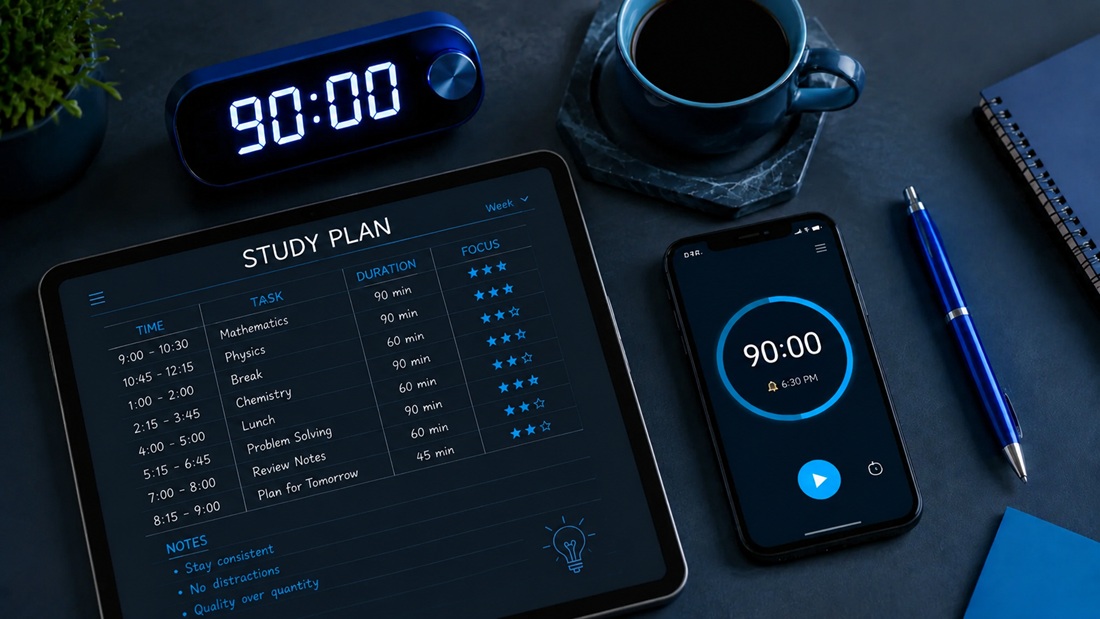
The 90-Minute Study Block: Why Your Brain Works Better in Cycles
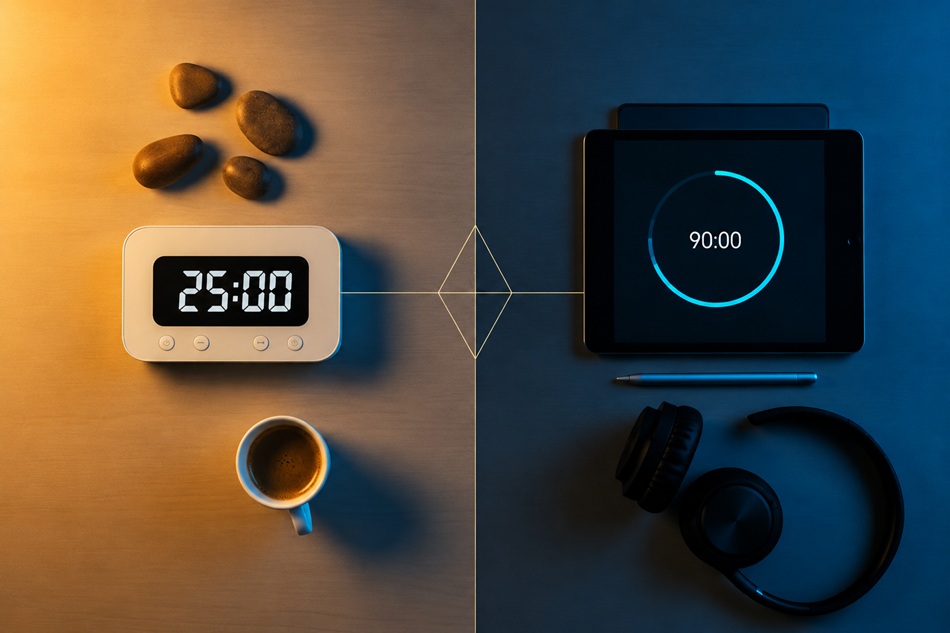
You’ve heard it a thousand times: study for 25 minutes, take a 5-minute break. Repeat four times. Then take a longer break.
It’s simple. It’s popular. It’s everywhere.
But here’s what many students don’t realize: your brain naturally operates on longer cycles. Research on ultradian rhythms suggests that the brain works in natural 90‑minute cycles, and aligning study sessions with these rhythms can improve focus and reduce mental fatigue.
The Pomodoro Technique is a great way to start building focus, but it’s not the only approach. For deep, sustained learning, there’s another method that works with your brain’s natural rhythm—the 90‑minute study block.
This article explains why the 90‑minute study block works, how to use it effectively, and why combining it with modern AI tools can take your learning to the next level.
🧠 Part 1: Your Brain’s Natural Rhythm
Your body runs on cycles. You sleep in 90‑minute cycles (REM cycles). You eat in cycles. And you focus in cycles.
These are called ultradian rhythms—natural biological cycles that repeat throughout the day. During each 90‑minute cycle, your brain moves through periods of high alertness, followed by periods of lower energy.
Research suggests that during the first 60–90 minutes of focused work, your brain is at its peak performance. After that, cognitive function may begin to decline. You might start making more errors. Your attention may drift. You’re no longer learning as efficiently—you might just be going through the motions.
This is why sometimes, when you’re really focused and in the zone, a short timer can feel like an interruption—just when your brain is hitting its stride.
The concept of aligning work with these natural rhythms—often called the Basic Rest-Activity Cycle (BRAC) —is widely discussed in chronobiology and productivity literature. While direct experimental evidence on long-term retention is still emerging, many experts recommend structuring focused work in 90‑minute blocks followed by short breaks to sustain concentration and reduce mental fatigue.
⏰ Part 2: Why the 90‑Minute Approach Works
The Pomodoro Technique was invented by Francesco Cirillo in the late 1980s. He used a tomato-shaped kitchen timer (pomodoro is Italian for tomato) to track his study sessions. It worked well for him and has helped millions of students build consistent study habits.
The 25-minute interval was a practical choice—it’s short enough to feel manageable and long enough to get something done. It’s an excellent tool for getting started.
Your brain, however, also operates on a different rhythm. Research on ultradian rhythms—the natural cycles that regulate alertness and energy throughout the day—suggests that humans experience peaks and troughs of focus approximately every 90 minutes. This concept, known as the Basic Rest-Activity Cycle (BRAC), was first identified by sleep researcher Nathaniel Kleitman and has been supported by decades of research.
The 90‑minute approach gives your brain time to fully engage with complex material. It allows you to reach a flow state and maintain it. And when you take a real break afterward, your brain has time to consolidate what you’ve learned.
Both methods have value. The Pomodoro Technique is great for building momentum and tackling shorter tasks. The 90‑minute block is ideal when you need to dive deep into challenging material. Many students find that using both—depending on the task—gives them the best results.

🛠️ Part 3: How to Use the 90‑Minute Study Block
Here’s a system that actually works.
Step 1: Identify Your Peak Focus Window
Pay attention to when you naturally feel most alert. Are you a morning person? An evening person? Your peak focus window is different from everyone else’s.
How StudyWizardry helps: The Study Planner helps you track your energy levels and identify your most productive hours. You don’t have to guess—you can see patterns over time.
Step 2: Block 90 Minutes for Deep Work
Schedule uninterrupted study blocks that align with your natural cycles. Use a timer to track your 90-minute session. No checking your phone. No tabs open that aren’t related to your task.
How StudyWizardry helps: The Timer can be adjusted to 90-minute sessions. Set it and forget it—you focus, it tracks.
Step 3: Take Real Breaks
When the 90 minutes are up, stop. Take a 20–30 minute break. Not a break where you scroll through Instagram. A real break: walk outside, stretch, eat something, close your eyes.
Research shows that breaks between ultradian cycles are essential for consolidating memory. Without them, the information doesn’t stick.
Step 4: Repeat 2–3 Times a Day
You can usually fit 2–3 focused 90-minute blocks into a day before your brain is genuinely tired. That’s 3–4.5 hours of deep, high-quality work. Most students study for 6–8 hours but only get 2–3 hours of real focus. This method can help you get more out of the time you spend studying.
📊 Part 4: Comparing the Two Approaches
Both methods have their place. Here’s how they compare—so you can choose the right tool for the right job.
| Pomodoro (25/5) | 90‑Minute Block |
|---|---|
| Designed for quick tasks | Designed for deep learning |
| Great for building study habits | Matches natural focus cycles |
| Works well for shallow work | Ideal for complex subjects |
| Perfect for getting started | Builds long‑term retention |
| Low barrier to entry | Sustained concentration |
Which one should you use?
The Pomodoro Technique is an excellent starting point. It’s simple, approachable, and proven to help students build a consistent study habit. It’s especially useful for shallow tasks like replying to emails, organizing notes, or light reading.
The 90‑minute block is designed for deep learning. When you’re working on complex subjects like math, physics, coding, or essay writing, matching your brain’s natural 90‑minute focus cycles can help you sustain concentration and retain more information.
You don’t have to choose one forever. Use Pomodoro when you’re building momentum or working on lighter tasks. Use the 90‑minute block when you need to dive deep into challenging material. They complement each other.
🔬 Part 5: The Science of Rest
Here’s why the 90‑minute block works so well.
During deep work, your brain builds new neural connections. But those connections don’t become permanent until your brain has time to process them. That happens during rest.
Research on ultradian rhythms and the Basic Rest-Activity Cycle (BRAC) shows that the brain naturally cycles through periods of high and low alertness throughout the day. Working with these cycles—rather than against them—can improve focus, reduce mental fatigue, and support long-term retention.
In other words: rest isn’t wasted time. It’s part of the learning process.
The 20–30 minute break between 90‑minute blocks isn’t just about resting your eyes. It’s about giving your brain time to consolidate what you just learned. Without that rest, the information doesn’t stick as well.
🤖 Part 6: How to Make This Work with StudyWizardry
The 90‑minute block is simple in theory, but hard to execute. You need to track your time, remember to take breaks, and stay focused during the block.
StudyWizardry makes all of this easier.
-
The Timer can be customized to 90 minutes. You set it, start your work, and the app handles the rest.
-
The Study Planner helps you schedule your 90‑minute blocks during your peak focus hours. You don’t have to guess when to study.
-
The Progress Tracking shows you how many blocks you’ve completed and how your focus is improving over time.
-
Smart Flashcards and the Quiz Generator help you make the most of your focused time by turning passive review into active recall.
The app doesn’t replace the method. It makes it easier to execute.
🎯 The Honest Truth
Here’s what research suggests: the students who succeed aren’t necessarily the ones who study the most hours. They’re the ones who study in cycles that match their brain’s natural rhythms.
The 90‑minute study block isn’t a new idea. It’s how your brain is wired to work. The Pomodoro Technique is useful for building a study habit, and the 90‑minute block can be a great complement when you need to tackle challenging material.
If you want to understand complex material deeply, working in 90‑minute cycles can help. You can respect your brain’s natural rhythm. And you can take real breaks.
Your next study session, try this: Instead of using a 25‑minute timer, set it for 90 minutes. Work on one task. When the timer goes off, take a 20‑minute break. Walk outside. Stretch. Eat something. Then do it again.
You might be surprised at how much you actually get done.
📚
More from StudyWizardry
The 90‑minute study block is just one piece of the puzzle. Explore these guides to build a complete, science-backed study system.
📄 Stop Trying to Focus. Start Designing for It.
A 5‑layer system that makes distraction difficult and focus inevitable.
📄 Why Studying Feels Impossible with Adult ADHD
Let AI break down overwhelming tasks and make studying easier.
📄 Why Your Brain Freezes on Hard Problems
A neuroscience‑backed strategy for breaking through mental paralysis.
✨ Three guides, one system: Read them in any order—each one builds on the science of focus, productive struggle, and active recall to help you study smarter.
For most people, 90 minutes is the upper limit of sustained concentration. That's why it's called a cycle. You work for 90 minutes, then you take a real break. The key is matching the block to your natural rhythm—if 60 minutes feels better for you, use that. The principle is the same.
You'll notice a few things: you'll feel more focused during the session, you'll remember more of what you studied, and you'll feel less tired at the end of the day. If you're constantly distracted during the block, shorten it to 60 minutes or adjust the length based on your attention span.
The Pomodoro Technique is useful for shallow work—replying to emails, organizing notes, light reading. The 90‑minute block is for deep work—complex subjects that require sustained concentration. Use both, but for different purposes.
Yes. Sleep cycles also operate on 90‑minute rhythms—that's why waking up at the end of a sleep cycle feels better than waking up in the middle. A 2025 paper on ultradian rhythms in Frontiers in Physiology confirmed that sleep efficiency is closely tied to circadian and ultradian cycles.
The 90‑minute block is ideal for any subject that requires deep, sustained concentration—math, physics, coding, essay writing, studying for exams. For subjects that require light review or memorization, shorter blocks may work better.