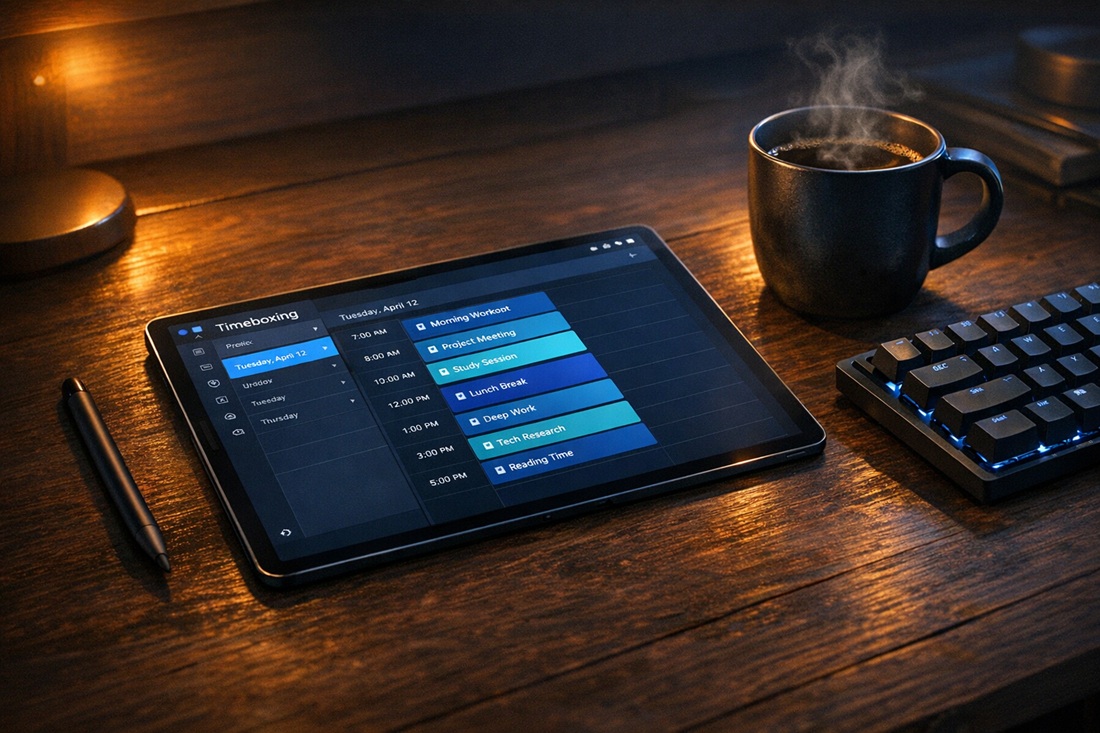
Timeboxing: The Simple Scheduling Trick That Transforms How You Study
You’ve tried everything. Color-coded calendars. Detailed to-do lists. Motivational apps. Yet somehow, at the end of the day, you look back and wonder: where did all the time go?
Here’s the problem: most students plan what to do, but they don’t plan when they’ll do it. And without a time anchor, tasks expand to fill the space you give them—a phenomenon known as Parkinson’s Law.
There’s a simple fix. It’s called timeboxing: assigning a fixed time window to each task and treating that window as non-negotiable. When the time is up, you stop—whether you’re finished or not.
This isn’t just productivity advice. It’s a technique backed by cognitive science, used by some of the most successful people in the world, and proven to help students like you get more done in less time.
🧠 Part 1: Why Your To-Do List Is Failing You
You write down your tasks. You feel organized. But when it’s time to actually do them, you procrastinate. Or you start one task, get distracted, and then rush to finish everything at the last minute.
Here’s what’s happening: your brain doesn’t respond well to vague plans.
When you write “study biology” on your to-do list, your brain sees a vague, open-ended task. It doesn’t know when to start, when to stop, or how to measure progress. So it avoids the task altogether.
Timeboxing solves this by giving your brain a clear structure: “I will study biology from 10:00 to 10:45 AM.” Suddenly, the task has a defined beginning and a definite end. Your brain can prepare for it. And once you’re in the timebox, you know exactly how long you have to focus.
“A to-do list tells you what to do. A timebox tells you when to do it—and when to stop.”
🔬 Part 2: The Science Behind Timeboxing
Timeboxing isn’t just a productivity buzzword—it’s backed by solid research. Here’s why giving yourself a fixed window of time for a task works so well.
It lowers the barrier to starting. One of the key reasons we procrastinate is that tasks feel overwhelming. Timeboxing reduces the mental hurdle by breaking a large task into a time-bound, manageable chunk. You know you only have to focus for 25 minutes, not the entire afternoon. This makes starting feel possible.
It creates healthy deadline pressure. Research shows that specific, short-term deadlines can significantly reduce procrastination. Timeboxing essentially creates a micro-deadline for yourself. This time pressure sharpens your focus, helping you stay on task and avoid the trap of letting tasks expand indefinitely.
It reduces decision fatigue and multitasking. When you decide in advance what you’ll work on during a specific time slot, you eliminate the need to make that decision in the moment. This saves mental energy that can be redirected to the task itself. Timeboxing also discourages multitasking by dedicating a specific block of time to a single task.
It aligns with proven time management principles. While specific studies on “timeboxing” are limited, its core principles are well-supported by research on time management in academic settings. For example:
-
Planning and organization: A 2025 meta-analysis found that time management, as a self-regulated learning strategy, is positively correlated with academic achievement. Another meta-analysis found that time management is significantly associated with lower academic procrastination.
-
Reducing procrastination and improving performance: A 2025 systematic review found that structured time management instruction can significantly improve students’ academic performance and reduce procrastination.
-
Parkinson’s Law: This well-known observation states that “work expands to fill the time available for its completion.” Timeboxing directly counteracts this tendency by forcing you to complete a task within a fixed timeframe.

🛠️ Part 3: How to Use Timeboxing for Studying
Here’s a simple system that works.
Step 1: List Your Tasks
Write down everything you need to do. Don’t organize yet—just get it all out of your head.
Step 2: Estimate Time for Each Task
How long will each task take? Be realistic. If you think a task will take one hour, give it one hour and 15 minutes—because tasks almost always take longer than expected.
Step 3: Schedule Your Timeboxes
Open your calendar (or a study planner) and block out specific times for each task. Start with your most important tasks first. Give yourself breaks between timeboxes.
How StudyWizardry helps: The Study Planner automatically creates timeboxes based on your tasks and deadlines. You don’t have to figure out the schedule yourself—the app does it for you.
Step 4: Protect Your Timeboxes
When a timebox starts, treat it like a meeting you can’t skip. Put your phone away. Close unnecessary tabs. Focus only on the task at hand.
How StudyWizardry helps: The Timer keeps you focused during each timebox. You set it, you work, and the timer keeps you honest.
Step 5: Stop When the Timebox Ends
When the timer goes off, stop working. Even if you haven’t finished. This is the hardest part—but it’s also the most important. If you keep working past the time, you’re training your brain to ignore time limits.
If you haven’t finished, schedule another timebox for later. But for now, move on to your next task or take a break.

📊 Part 4: Timeboxing vs. To-Do List
| To-Do List (Without Timeboxing) | Timeboxing (With Timeboxing) |
|---|---|
| Tasks feel open-ended | Tasks have a clear start and end |
| You procrastinate easily | You focus during the timebox |
| You don’t know how long tasks take | You build realistic time estimates |
| You feel overwhelmed | You feel in control |
| You often work past when you should stop | You stop when the time is up |
🤖 Part 5: How StudyWizardry Makes Timeboxing Effortless
Timeboxing is simple in theory, but it can be hard to stick with. You need to plan your schedule, set timers, and track your progress.
StudyWizardry makes all of this easier.
-
The Study Planner creates a timeboxed schedule for you based on your tasks and deadlines. You don’t have to decide when to study—the app does it.
-
The Timer keeps you focused during each timebox. Set it and work until it rings.
-
The Progress Tracking shows you how many timeboxes you’ve completed and how your focus is improving over time.
-
Smart Flashcards and the Quiz Generator help you make the most of your timeboxes by turning passive review into active recall.
The app doesn’t replace the method. It makes it easier to execute.
🎯 The Honest Truth
Here’s what the research confirms: students who plan their time do better than students who don’t. A 2025 study of over 1,000 university students found that time management was one of the strongest predictors of academic success.
But planning isn’t the same as scheduling. Planning tells you what to do. Scheduling tells you when to do it. And timeboxing is the bridge between planning and doing.
The students who succeed aren’t necessarily the ones who study the most hours. They’re the ones who study intentionally—who decide in advance when they’ll study and protect that time.
Your next study session, try this: Instead of writing “study biology” on your to-do list, schedule a timebox: “Biology: 10:00–10:45 AM.” Set a timer. When it rings, stop—even if you haven’t finished. Then move on to your next timebox.
You might be surprised at how much you get done when you stop planning and start scheduling.
📚
More from StudyWizardry
📄 Why You Forget What You Study (And 6 Ways to Remember)
A cognitive science approach to reliable recall—using active recall to expose knowledge gaps.
📄 Last-Minute Exam Prep AI: The Ultimate 24-Hour Rescue Plan
A practical system for getting unstuck fast using step-by-step AI explanations.
📄 How to Decode Any Math Word Problem in 4 Steps
How to overcome procrastination by lowering the barrier to entry.
✨ Timeboxing helps you plan your time. Let StudyWizardry handle the scheduling, tracking, and reminders so you can focus on learning.
That's okay. The goal isn't to finish everything—it's to make progress. If you don't finish, schedule another timebox for later. The important thing is that you stopped when the time ended.
For studying, 30–90 minutes is ideal. Shorter timeboxes (25–30 minutes) are great for starting focus. Longer timeboxes (60–90 minutes) are better for deep work. Experiment to find what works for you.
Yes. Timeboxing works for any task—work projects, chores, creative work. The principle is the same: assign a fixed time window and treat it as non-negotiable.
Distractions happen. The key is to notice when you're distracted and bring your attention back. If the distraction is urgent (like a real emergency), pause the timebox and handle it. Otherwise, save it for later and refocus.
The Pomodoro Technique uses fixed intervals (25 minutes on, 5 minutes off). Timeboxing lets you choose the duration that works best for your task. Both methods help with focus, but timeboxing is more flexible.