Your Notes Are Raw Material—Here’s How to Process Them Into Knowledge
You just spent two hours taking beautiful, organized notes. Color-coded headings. Perfect bullet points. Clean margins. You close your notebook feeling accomplished.
Three days later, you open it again. Everything looks familiar—but you can’t remember what any of it actually means.
Here’s the uncomfortable truth: your notes are worthless if you can’t retrieve what’s in them.
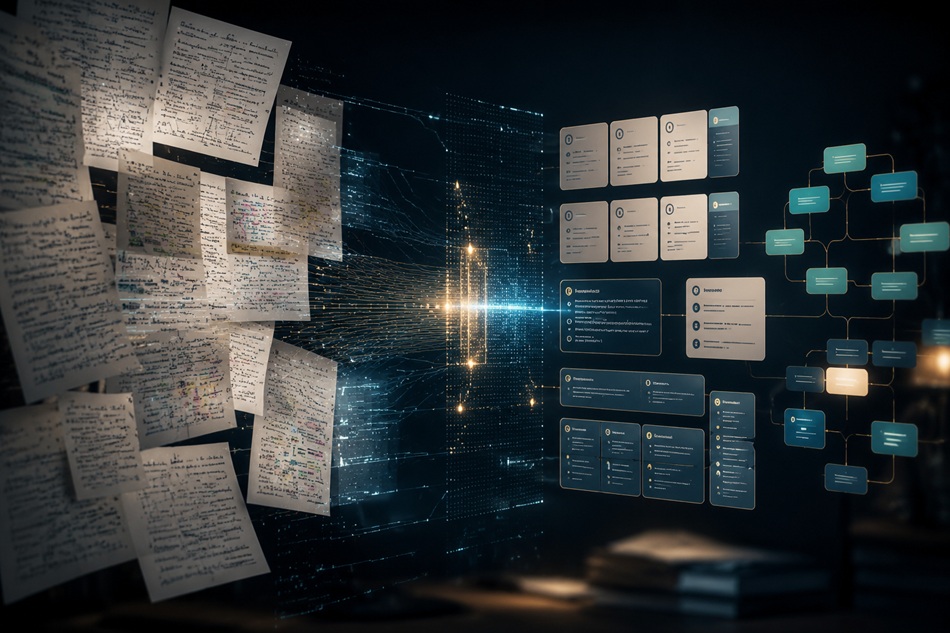
Most students treat note-taking as the endpoint of learning. You write it down, and you’re done. But notes aren’t knowledge. They’re raw material. And raw material doesn’t become useful until you process it.
This article shows you a different approach. Instead of just recording information, you’ll learn how to transform your notes into lasting understanding using a simple three-step system—powered by AI tools that handle the heavy lifting so you can focus on thinking.
🧠 Part 1: Why Your Beautiful Notes Aren’t Enough
Here’s a hard truth from cognitive science: writing something down doesn’t mean you’ve learned it.
The physical act of note-taking has value—it engages your brain during lectures, helps you process information in real time, and creates a record you can return to. But research consistently shows that passive review of notes (re-reading, highlighting, copying) is one of the least effective study methods.
What works? Active engagement with your notes. Retrieving information from memory, connecting ideas, and testing yourself. That’s where the learning happens. And that’s where most students stop.
The gap between having notes and knowing the material is where students lose time, confidence, and grades. This article bridges that gap with a simple system.
🔄 Part 2: The Three-Step Note Transformation System
Instead of treating your notes as a finished product, treat them as raw material. Here’s a system that turns passive notes into active knowledge.
Step 1: Capture—Get It Out of Your Head
The first step is simple: write everything down. Capture lectures, readings, ideas, and questions in one central place. Don’t worry about organization yet. Just get it out of your head and into a system.
Research shows that externalizing information reduces cognitive load—the mental effort required to process and hold information. When you don’t have to remember everything, you have more brainpower for understanding.
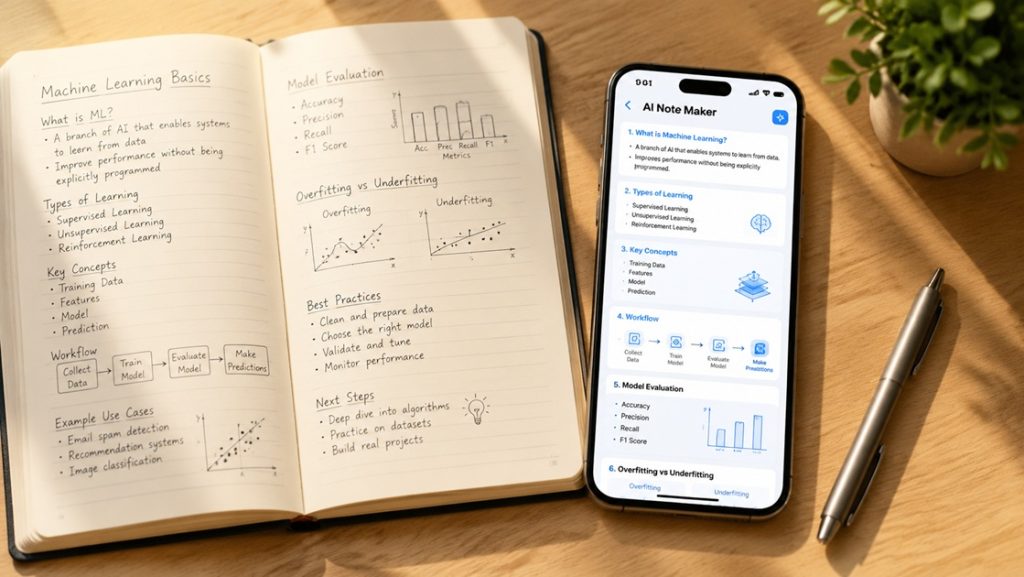
How StudyWizardry Helps: The AI Note Maker processes raw input—lecture recordings, PDFs, videos—and transforms it into structured, searchable notes. You don’t have to transcribe or organize. Just capture, and the AI handles the formatting.
Step 2: Activate—Turn Notes into Questions
This is the step most students skip. After you take notes, turn them into active recall materials. Flashcards. Practice questions. Self-tests. Anything that forces your brain to retrieve information without looking.
Research shows that students who create and use retrieval practice materials from their own notes retain significantly more information than those who simply re-read. A 2026 study found that students who engaged with AI-generated practice questions while studying achieved significantly higher scores on follow-up quizzes.
How StudyWizardry Helps: The AI Flashcards feature generates flashcards from your notes automatically. The AI Quiz Generator creates practice tests from the same material. You don’t have to write your own questions—just study and test.
Step 3: Review—Spaced Repetition
One review isn’t enough. The Forgetting Curve shows that information decays rapidly without reinforcement. But if you review at increasing intervals—1 day, 3 days, 7 days, 30 days—you can dramatically slow that decay.
Research confirms that spaced repetition significantly improves memory retention and overall satisfaction. Medical students who used digital flashcards with spaced repetition showed improved performance in physiology courses.
How StudyWizardry Helps: The AI Flashcards feature uses spaced repetition algorithms automatically. Cards you know appear less frequently. Cards you struggle with appear more often. You never have to decide when to review—the system handles it.
📊 Part 3: What This System Looks Like in Practice
| Phase | What You Do | How AI Helps | Time Required |
|---|---|---|---|
| Capture | Attend lecture, record or upload materials | AI Note Maker structures notes automatically | 5-10 minutes |
| Activate | Create flashcards and practice tests from your notes | AI Flashcards and Quiz Generator handle creation | 5 minutes setup, then study time |
| Review | Study flashcards and take quizzes at spaced intervals | Spaced repetition algorithm schedules reviews | 10-15 minutes daily |
This isn’t a complex system. It’s three simple steps that turn passive notes into active knowledge—with AI handling the logistics so you can focus on the learning.
🗂️ Part 4: Why AI Note Tools Are Different
Traditional note-taking apps store information. AI note tools transform it.
| Traditional Notes | AI-Powered Notes |
|---|---|
| You organize everything manually | AI structures content automatically |
| You spend hours transcribing | AI extracts key concepts instantly |
| You create flashcards by hand | AI generates flashcards from your notes |
| You guess when to review | AI schedules reviews at optimal intervals |
| You have information | You have an active study system |
Research shows that AI-powered summarization and key point extraction alleviate the cognitive burden of digesting extensive information. Students who rely on AI note-taking tools can focus on the lecture instead of transcribing key content, leading to increased confidence and efficiency.
The difference isn’t convenience—it’s effectiveness. AI tools remove the friction that prevents students from using evidence-based learning strategies consistently.
📝 Part 5: A Real Student’s Workflow
Here’s how this actually works for a student in a typical course.
Monday (Lecture Day)
- Attend lecture, record audio (or upload slides)
- AI Note Maker processes the recording into structured notes
- Key concepts, definitions, and relationships are extracted automatically
- You spend 5 minutes reviewing the notes and adding your own insights
Tuesday (Active Recall Day)
- Open AI Flashcards generated from Monday’s notes
- Study for 15-20 minutes using spaced repetition
- Cards you know appear less often; cards you struggle with appear more often
- You end the session knowing exactly which concepts need more work
Wednesday (Practice Day)
- Open AI Quiz Generator based on the same material
- Take a 10-15 question practice test
- Review the detailed explanations for any questions you missed
- Identify and focus on weak areas
Thursday (Review Day)
- Continue using flashcards with spaced repetition
- Generate a new quiz on the same material—different questions this time
- Test yourself again. Did you improve?
Friday (Retention Check)
- Spaced repetition algorithm triggers a review of older material
- You review concepts from previous weeks
- This combats forgetting and reinforces long-term retention
Total active study time: about 30-45 minutes per day. Total learning: significantly better than hours of passive re-reading.
🎯 The Honest Truth
Here’s what successful students know: notes aren’t knowledge. They’re raw material.
The students who perform well aren’t the ones with the most organized notes. They’re the ones who actively engage with their notes—turning them into flashcards, creating practice tests, reviewing at spaced intervals. They treat notes as the beginning of learning, not the end.
AI tools don’t replace that engagement. They handle the logistics—creation, organization, scheduling—so you can focus on the cognitive work. The thinking, retrieving, testing, and connecting is still yours.
Your next study session, try this: Instead of just reading your notes, open the AI Quiz Generator. Take one practice test. Identify what you missed. Create flashcards for those gaps. Review them tomorrow. Repeat. You’ll learn more in 45 minutes of active engagement than in three hours of passive review.
📚
More from StudyWizardry
📄 What If You Could “Google” Your Own Brain?
The philosophy behind building a Second Brain—and why it’s the ultimate academic advantage.
📄 The Forgetting Curve Is Not Your Enemy. It’s Your Best Teacher.
Why spaced repetition is essential for long-term retention—and how AI automates it.
📄 The Self-Explanation Effect: Why Asking “Why” Unlocks Deeper Learning
Why elaborative interrogation—another evidence-based strategy—complements active recall.
✨ Notes are raw material. Active recall is the forge. Let StudyWizardry‘s AI tools handle the creation and scheduling so you can focus on the real work: thinking, retrieving, and understanding.
No—if you use AI as a starting point, not an endpoint. AI handles transcription and initial organization. The active learning happens when you engage with the material: creating flashcards, taking quizzes, reviewing at spaced intervals. AI removes friction; you still do the cognitive work.
Handwritten notes have their own benefits—they engage different neural pathways during encoding. The ideal approach often combines both: handwritten notes for initial capture (which aids encoding), then AI tools for organization and review (which aids retention).
Research shows that students who use AI note tools save hours of manual note-taking time each week. Instead of spending 2 hours transcribing and organizing, you spend 10-15 minutes reviewing AI-generated notes and then 30 minutes actively engaging with the material. The total time is lower—and the retention is higher.
Yes. The principles—capture, activate, review—apply across subjects. The specific tools adapt: AI Note Maker handles any content format; AI Flashcards creates cards for any material; AI Quiz Generator creates tests for any subject.
That's fine. You can take handwritten notes traditionally and still use the activate and review phases with AI tools. The key is the overall system—capturing information, turning it into active recall materials, and reviewing at spaced intervals. The capture phase can be as analog or digital as you prefer.