Why Studying Feels Impossible with Adult ADHD—and How AI Can Finally Help
You sit down to study at 7 PM with every intention of finishing your homework by 10. You organize your books. You find the perfect playlist. You tell yourself you’ll focus this time.
By 8 PM, you’ve checked your email twice, scrolled TikTok for “just five minutes” (which turned into forty‑five), and somehow ended up watching a documentary about the Roman Empire. Your homework is untouched.
This kind of night happens to almost every student sometimes. It doesn’t mean you have ADHD.
Adult ADHD is a medical condition that requires a professional diagnosis. It involves persistent, lifelong patterns of inattention, impulsivity, and/or hyperactivity that significantly impair daily functioning across multiple areas of life (school, work, relationships). If you’re concerned, the right first step is to speak with a doctor or mental health professional—not to rely on an online article or a checklist.
That said, many of the study strategies that help people with diagnosed ADHD also work for anyone who struggles with task initiation, organization, or sustained focus—whether or not they meet the criteria for a disorder. And modern AI tools can provide the kind of external structure that supports those challenges.
This article is written for two audiences:
-
Students who have been professionally diagnosed with ADHD and want practical, evidence‑informed ways to use AI as part of their academic toolkit.
-
Students who don’t have ADHD but still find traditional study methods frustrating—because they procrastinate, lose focus, or feel overwhelmed by complex tasks.
The strategies below are not a substitute for medical advice or treatment. But they can help anyone who wants to stop fighting their brain and start studying with it.
🧠 Part 1: What’s Actually Happening Inside Your Brain
Adult ADHD isn’t about being lazy or unfocused. It’s a neurodevelopmental condition that affects your brain’s executive functions—the mental skills that help you organize, plan, prioritize, and regulate behavior. For college students, these challenges create a cascade of academic difficulties that no amount of “just try harder” can fix.
A 2025 systematic review published in the Journal of Attention Disorders confirmed that ADHD symptoms are directly associated with lower academic performance in university students, particularly those with pronounced inattention. Research also shows that individuals with ADHD often struggle with metacognitive monitoring—accurately assessing their own performance—which leads to overconfidence and reduced engagement with academic support services.
In practical terms, this means:
- You lose track of deadlines and assignments not because you don’t care, but because your brain has difficulty organizing time and remembering future tasks.
- You procrastinate chronically because task initiation feels overwhelming. That five-page paper doesn’t look like a series of small steps. It looks like a mountain.
- You start strong and fade fast because sustained attention drains your mental energy more quickly than it drains others’.
- You know the material but freeze during exams because working memory issues make retrieval unreliable under pressure.
Executive function deficits in ADHD include problems organizing materials and academic content, planning long-term projects, and maintaining consistency. Students easily lose necessary items, forget requirements, and watch opportunities slip through their fingers.
The traditional advice—”just use a planner” or “block out your time”—often fails because these strategies assume a brain that can estimate time, resist distraction, and follow through without external reinforcement. Your brain needs different tools.
🤖 Part 2: Why AI Changes the Game for ADHD Brains
Here’s where the landscape shifts. The same AI tools that feel like optional extras for neurotypical students become essential accommodations for ADHD learners.
Traditional studying requires sustained attention, working memory, task initiation, organization, and time estimation—all the things your ADHD brain struggles with. But here’s what’s powerful: AI can handle those cognitive loads for you.
Recent research from University College London (2025) explored how large language model (LLM) agents can transform dense text into interactive mind maps specifically designed for ADHD learners, resulting in increased motivation, enhanced concentration, and better task planning. Other studies are actively designing digital learning tools that integrate support features directly into lecture interfaces to reduce cognitive load and improve engagement for ADHD students.
The principle is simple: AI externalizes executive function. Instead of forcing your brain to do everything at once, you offload the heavy organizational lifting to technology designed to work with your neurodivergent wiring.
🔧 Part 3: Practical Ways AI Helps You Study
Let’s move from theory to practice. Here are specific ways AI tools can address your most frustrating academic challenges.
Challenge 1: You Can’t Get Started
That blank page is terrifying. Your brain sees the entire project at once and panics.
How AI helps: Use AI to break tasks down automatically. Instead of staring at “write research paper,” you can ask an AI to generate a step-by-step outline, suggest sources, or even create an initial paragraph structure. The first step is the hardest. AI can hand you that first step.
Challenge 2: You Lose Focus During Long Readings
Textbook chapters feel endless. Your eyes move across words, but nothing sticks.
How AI helps: AI summarizers can condense 20 pages into bullet-point key concepts in seconds. You’re not skipping the reading—you’re getting a road map first, which makes the actual reading more focused and less overwhelming. Some AI study apps now extract smart notes, flashcards, and study guides from lectures and documents automatically, reducing the cognitive load of real-time note-taking.
Challenge 3: You’ve Studied but Can’t Remember Anything on Test Day
You reviewed. You read your notes. You felt prepared. Then the exam came, and your mind went blank.
How AI helps: AI-powered flashcards use spaced repetition algorithms that show you information right before you would forget it. Research confirms that spaced repetition is particularly effective for ADHD brains, but it needs modification to work with executive function challenges. Structured review systems built into AI tools significantly improve academic outcomes for students with ADHD. The algorithm does the scheduling so you don’t have to remember when to review.
Challenge 4: Your Notes Are a Mess
You leave class with a notebook full of half-sentences, doodles, and random disconnected facts. Organizing them feels impossible.
How AI helps: AI note-taking tools can transform messy recordings or scattered notes into structured, searchable outlines. Some platforms automatically generate flashcards and practice quizzes directly from your notes, turning disorganized information into active recall materials instantly.
🚀 Part 4: How StudyWizardry Supports ADHD Learners
StudyWizardry was designed with students like you in mind. Here’s how its features address the specific executive function challenges of adult ADHD:
-
Homework Solver with Step-by-Step Explanations
Instead of staring at a problem you don’t understand, you can snap a photo and get a clear, step-by-step breakdown. This lowers the barrier to starting and helps you understand how to solve similar problems on your own. -
PDF & Video Summarizer
Long readings and lecture recordings become concise, digestible summaries. You get the key information without getting lost in the details. -
AI Note Maker
Turn scattered notes, lecture recordings, or textbook excerpts into organized, searchable study materials. No more losing information across multiple notebooks or files. -
Smart Flashcards with Spaced Repetition
The algorithm schedules review sessions for you at optimal intervals—1 day, 3 days, 7 days, 30 days. You never have to decide when to review; the app tells you. -
Quiz Generator
Create practice tests from your notes instantly. Testing yourself is one of the most effective learning methods, and this removes the friction of creating your own questions. -
Voice AI
For students who think better out loud, voice-powered AI lets you explain concepts verbally and get feedback. This multi-sensory approach is particularly effective for ADHD learners. -
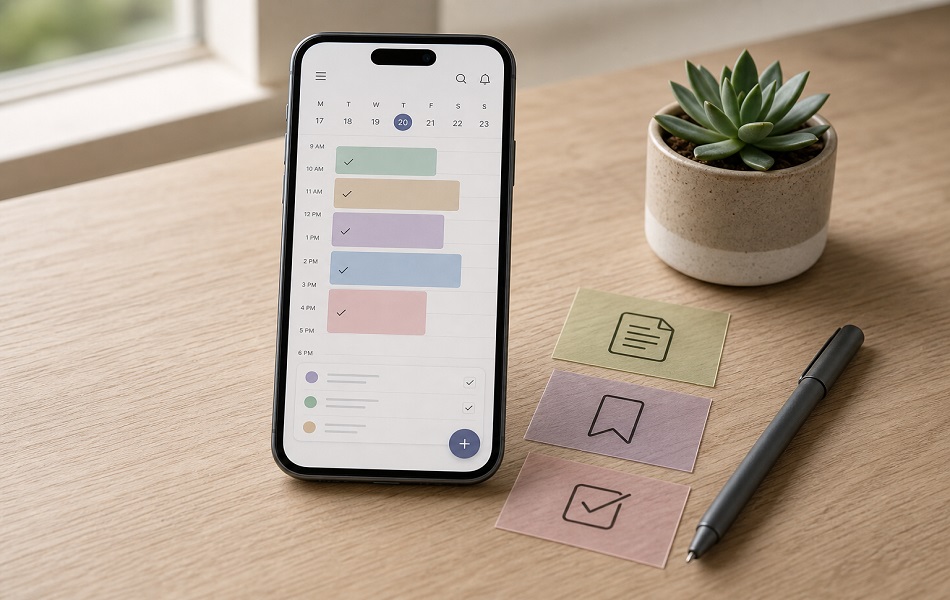
Study Planner
Input your deadlines once, and the AI generates a realistic daily and weekly plan with clear next steps. Executive function challenges often make long-term planning feel impossible; this automates it.
🎯 Part 5: A Simple ADHD-Friendly Study Protocol
Based on what research and lived experience tell us works, here’s a study routine designed for your brain, not against it.
| Phase | What You Do | How AI Helps |
|---|---|---|
| Prep (5 min) | Brain dump everything on your mind. Write down every task, worry, and distraction. | Use voice AI to dictate your brain dump or type it into a note. Externalizing reduces mental clutter. |
| Summarize (10 min) | Upload your lecture recording, PDF, or video to get a clear summary of key concepts. | AI Note Maker or PDF Summarizer handles the heavy lifting. |
| Sprint (25 min) | Work in short, timed intervals. Use a visual timer. | Pomodoro-style work blocks are highly effective for ADHD brains. The app’s timer keeps you on track. |
| Break (5 min) | Move your body. Stretch, walk, hydrate. No screens. | Use the timer to enforce breaks. |
| Review (10 min) | Use flashcards or a quiz on what you just studied. Active recall strengthens memory. | Smart flashcards and quiz generator automate this step. |
| Repeat | Complete 3-4 cycles, then take a longer 15-30 minute break. | The planner schedules your cycles so you don’t have to track them mentally. |
This protocol works because it externalizes executive function. You don’t need to decide what to study, when to review, or how long to work. The system decides for you. You just show up and follow the next step.
💡 The Honest Truth
You are not lazy. You are not broken. Your brain simply operates on a different system—one that traditional study methods were never designed to support.
The students who succeed with ADHD aren’t the ones who force themselves to study like their peers. They’re the ones who find tools and systems that work with their brain’s wiring. They offload what they’re bad at (planning, organizing, sustaining attention) to external systems and save their mental energy for what they’re good at (creative thinking, problem-solving, hyperfocus).
AI isn’t a crutch. It’s an accommodation. And in 2026, it’s an accommodation available to every student—not through expensive coaching or extensive therapy, but through the phone in your pocket.
Your next study session, try this: Don’t plan. Don’t organize. Just open StudyWizardry, upload your lecture, let it summarize the key points, and run through one set of flashcards. See what happens when you stop fighting your brain and start working with it.
📚
More from StudyWizardry
📄 The Pomodoro Hack: Engineering Your Brain’s ‘Flow State’ On Demand
Perfect your focus sprints—essential for ADHD-friendly studying.
📄 The Forgetting Curve Is Not Your Enemy. It’s Your Best Teacher.
Why spaced repetition works for ADHD brains—and how AI automates it.
📄 Stop Wasting 3 Hours on a Single Math Problem
A practical system for getting unstuck fast—without endless frustration.
✨ You don’t need to study harder. You need to study smarter. Let StudyWizardry handle the planning, summarizing, and quizzing—so your brain can do what it does best: think, create, and learn.
No. Traditional methods like active recall and spaced repetition are still effective. The challenge is implementing them consistently. AI handles the implementation—scheduling, generating materials, tracking progress—so you can focus on the actual learning.
Using AI to do your thinking for you is cheating. Using AI to organize, summarize, and quiz you is not. The rule is simple: the AI should never produce work you submit. It should only prepare you to produce that work yourself.
The strategies in this article work for anyone who struggles with executive function—which includes many neurotypical students as well. You don't need a diagnosis to benefit from externalizing organization, using structured work intervals, or reducing cognitive load.
Track one thing: output. Are you completing assignments? Retaining information? Feeling less overwhelmed? If yes, the tool is helping. If you're just using the tool without seeing results, adjust your approach.
Indirectly, yes. By lowering the friction of starting and providing immediate feedback through quizzes and flashcards, AI can create small wins that build momentum. Motivation often follows action, not the other way around.