
The Forgetting Curve Is Not Your Enemy. It’s Your Best Teacher.
You’ve been told that forgetting is a sign of failure. That good students remember everything. That if you really understood something, it would stick.
Here’s the truth nobody tells you: your brain is designed to forget.
Not because it’s broken. Because forgetting is essential. Imagine remembering every face you’ve ever seen, every conversation you’ve overheard, every random fact you’ve skimmed. You’d be paralyzed by information. Forgetting is your brain’s way of clearing space for what actually matters.
The problem isn’t that you forget. The problem is that you forget the wrong things. You remember the Instagram post you scrolled past yesterday but forget the chemistry formula you studied for an hour.
This isn’t a flaw in your brain. It’s a flaw in your study method.
And once you understand how forgetting actually works, you can stop fighting your own biology and start using the most powerful learning tool you already have: strategic forgetting.
Part 1: What the Forgetting Curve Actually Looks Like
In the 1880s, a German psychologist named Hermann Ebbinghaus did something tedious but brilliant. He memorized lists of meaningless syllables—nonsense words like “ZOF” and “KAF”—then tested himself repeatedly to see how fast he forgot them.
What he discovered changed how we understand memory.
The Forgetting Curve shows that memory drops off exponentially. Within one hour of learning something new, you’ve already forgotten about half of it. Within 24 hours, you’ve forgotten about 70%. Within a week, you’re down to maybe 20%.
Here’s what that looks like on a timeline:
| Time After Learning | What You Probably Remember |
| 20 minutes | 58% |
| 1 hour | 44% |
| 9 hours | 36% |
| 1 day | 33% |
| 2 days | 28% |
| 6 days | 25% |
This isn’t because you’re bad at studying. This is what brains do. Ebbinghaus used meaningless information so he could study pure memory without interference from meaning. With meaningful information—like what you’re actually studying—the curve is less steep, but it still exists.
The conclusion is unavoidable: without intervention, forgetting is guaranteed.
But here’s what most people miss. The curve isn’t just a problem to solve. It’s a map. It tells you exactly when to review for maximum efficiency.
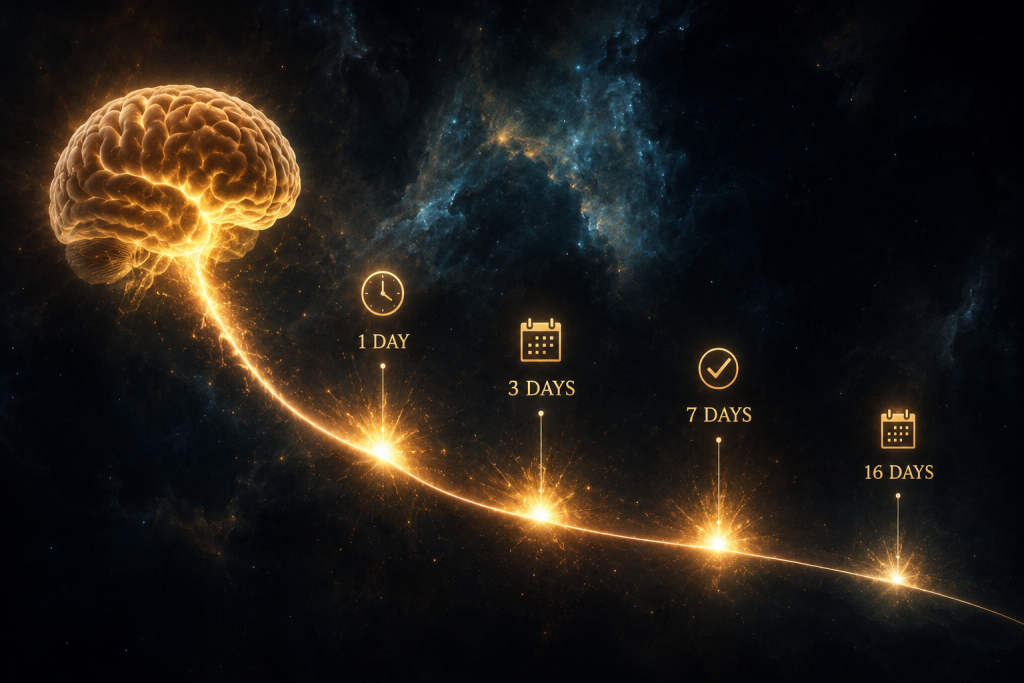
Part 2: Why Cramming Works (Until It Doesn’t)
You’ve probably experienced this: you stay up all night before an exam, cramming everything into your head. The next morning, you take the test and… you pass. Not great, but pass.
This feels like proof that cramming works. And in a way, it does—for one specific purpose. Cramming creates short-term familiarity. You see the material again right before the test, so it’s fresh. Your brain recognizes it. You get by.
But here’s the problem. Ask yourself the same material a week later. Nothing.
Cramming is like building a sandcastle at the edge of the ocean. It looks great for a few hours. Then the tide comes in. You didn’t build anything permanent. You just borrowed time.
The research is clear: massed practice (cramming everything into one session) creates weak memory traces that decay quickly. Spaced practice (reviewing material over multiple sessions) creates durable memories that last.
But here’s where most advice stops. It tells you to “space your studying” without explaining how. And without understanding the forgetting curve, spacing feels random. You review when you remember to review. That’s not a system. That’s hoping.
Part 3: The Counterintuitive Solution—Forget on Purpose
Here’s what I learned that changed everything.
You don’t need to prevent forgetting. You need to schedule it.
When you learn something new, you’re going to forget most of it within 24 hours. That’s not optional. So instead of trying to stop forgetting, work with it.
Learn something. Let yourself start to forget. Then review it right before it disappears completely.
This is called spaced repetition, and it’s the most powerful learning technique most students have never heard of.
Here’s the cycle:
- You learn something on Day 1.
- You review it on Day 2 (just before you would have forgotten it).
- You review it again on Day 4.
- Then Day 8.
- Then Day 16.
- Then Day 32.
Each review reinforces the memory. Each review flattens the forgetting curve. After 5-6 reviews, the information becomes permanent. You don’t need to review it anymore because your brain has decided it’s important.
This is how your brain works. Not by forcing information in, but by repeatedly retrieving it at the right moments.
Part 4: How to Build This System Without Going Crazy
Here’s the challenge. Manually tracking what to review and when is nearly impossible for one subject, let alone five. You’d need a spreadsheet, a calendar, and more discipline than most humans possess.
This is where technology actually helps. Not by doing the thinking for you, but by handling the scheduling.
Smart flashcards do exactly this. Each time you review a card, the system asks how well you remembered it. If it was easy, the card appears again further in the future. If it was hard, it appears sooner. The algorithm learns what you know and what you don’t.
Over time, you spend zero time deciding what to study. You just open the app and review whatever it shows you. The system handles the forgetting curve.
Quizzes work the same way. Instead of reviewing the same material over and over, you test yourself on what you’re about to forget. The questions you get wrong become priority review items.
Voice AI adds another layer. When you explain something out loud—to yourself, to the app—you’re forcing retrieval in a different format. Sometimes you think you know something until you try to say it. The gaps become obvious immediately.
And when you’re stuck on a problem, scanning it gives you access to multiple explanations from different AI models. Each explanation attacks the concept from a different angle. One of them will match how your brain thinks.
The point isn’t to use every feature. The point is to have a system that respects the forgetting curve instead of fighting it.

Part 5: Why This Changes Everything
Most students spend their time on the wrong part of learning. They focus on getting information in—reading, highlighting, watching videos. But getting information in is the easy part. The hard part is keeping it there.
The forgetting curve teaches you that memory isn’t about input. It’s about retrieval. Every time you successfully recall something, you strengthen the neural pathway. Every time you struggle to recall it, you strengthen it even more.
This is the beautiful irony. The forgetting curve isn’t your enemy. It’s your best teacher because it forces you to retrieve. Without forgetting, you’d never need to practice retrieval. And without retrieval, you’d never build lasting memory.
The students who ace exams aren’t the ones who study the most hours. They’re the ones who study at the right intervals. They let themselves forget—just a little—and then review right before the information disappears.
They’ve stopped fighting their biology and started working with it.
🎯 The Honest Truth
I used to think forgetting meant I wasn’t trying hard enough. I’d reread chapters three times. I’d rewrite my notes. I’d highlight everything until my textbook looked like a rainbow.
None of it worked. Because I was fighting the wrong battle.
The problem wasn’t that I forgot. The problem was that I didn’t have a system for what to do about it.
Once I understood the forgetting curve, everything changed. I stopped feeling guilty about forgetting. I started seeing it as information—a signal telling me exactly when to review.
Now I review what the system tells me to review. I test myself on what I’m about to forget. I use multiple explanations when I’m stuck. And I spend less time studying than I used to, but I remember more.
If you’ve ever felt like your memory is broken, it’s not. You’ve just been fighting a battle you can’t win. Stop fighting. Start working with your biology.
📚
More from StudyWizardry
📄 Why Memorizing Formulas Never Works (And What to Do Instead)
Move past surface-level memorization to real understanding.
📄 The Problem With One Explanation (And Why You Need Three AI Models)
Why multiple perspectives unlock understanding faster than grinding.
📄 I Studied 14 Hours a Day for a Month. Here’s What I Learned About Learning.
One student’s story of hitting bottom and discovering what actually works.
No. That's what brains do. The problem isn't forgetting—it's not having a system to review at the right time. Without a system, you forget. With spaced repetition, each review flattens the curve until the information becomes permanent.
Most people review randomly. They look at notes when they remember, which is usually right before a test. Spaced repetition reviews at specific intervals—1 day, 3 days, 7 days, etc.—based on when you're about to forget. It's targeted, not random.
You can, for one subject, for a short time. But tracking intervals for multiple subjects across a semester becomes a full-time job. Smart flashcards automate this completely. They track what you know and schedule reviews automatically.
Yes. The forgetting curve applies to all types of memory—facts, formulas, concepts, vocabulary. The intervals might vary slightly, but the principle is universal. Review before you forget.
The "explain it" test. Close the book. Say the concept out loud in your own words. If you can't, you don't know it—you're just familiar with it. This is why voice AI can help. Speaking forces retrieval in a different format.