
The Practice Exam Trap: Why Most Students Waste Their Best Study Tool
You’ve done the right thing. You found a practice exam for your upcoming test. You sat down, timed yourself, and worked through every question. You checked your answers. You scored a 72%. You felt a mix of relief (not failing) and dread (still far from an A).
Then you did what most students do: you looked at the questions you missed, read the correct answers, and told yourself you’d “review those topics later.”
That “later” never comes. Or when it does, you just re-read the same notes and make the same mistakes again.
Here’s the problem: a practice exam is not a diagnostic. It’s a raw material. And most students have no idea how to refine it into actual learning.
This article will show you a three-step feedback loop that transforms one practice test into a personalized, AI-powered study plan—so you never waste another practice exam again.
🔍 Part 1: Why Checking Answers Isn’t Enough
When you check your answers and move on, you’re engaging in passive error review. Your brain registers the correct answer, but it doesn’t rebuild the faulty reasoning that led you to the wrong one. The next time you see a similar question, you’re likely to repeat the same mistake.
Research in cognitive psychology has shown that retrieval attempts—even when you get the answer wrong—can enhance learning, but only when followed by immediate corrective feedback (Kornell, Klein, & Rawson, 2015). Without that feedback, your brain simply notes the error and moves on, reinforcing the original misunderstanding.
You need to actively correct your thinking, not just memorize the right letter.
The solution is a feedback loop:
- Identify exactly where your reasoning broke down.
- Understand the correct reasoning through step-by-step explanation.
- Practice the same concept in a new context until it sticks.
Most students skip the first two steps entirely. Let’s fix that.
⚙️ Part 2: The 3-Step Feedback Loop
Here’s a system you can apply after any practice exam—whether it’s from your textbook, a professor, or one you generated with StudyWizardry‘s quiz generator.
Step 1: Error Triage (15 minutes)
Go through your incorrect answers. For each one, write down one sentence explaining why you got it wrong. Be honest:
- “I misread the question and solved for the wrong variable.”
- “I applied the correct formula but made an algebra error.”
- “I had no idea which formula to use.”
- “I confused this concept with a similar one.”
This forces metacognition. You’re no longer just seeing “wrong.” You’re seeing patterns.
Step 2: Targeted Explanation (30 minutes)
For each incorrect question, use StudyWizardry‘s Homework Solver or voice AI to get a step-by-step explanation. But don’t just read it. Do this:
- Cover the solution. Try to explain the first step in your own words.
- Reveal the AI’s step. Compare. Where did you differ?
- Correct your mental model. Then move to the next step.
For conceptual errors, use the voice AI to explain the concept out loud. The act of speaking forces you to organize the reasoning. If you stumble, you’ve found the gap.
Step 3: Spaced Practice (Distributed over days)
You’ve identified the types of errors you make. Now you need to practice similar problems—but not all at once.
Use StudyWizardry‘s quiz generator to create a new 5-question quiz on just the concepts you missed. Take it the next day. Then two days later. Then a week later.
The smart flashcards feature can also help: create cards that ask why a certain answer is correct, not just what the answer is. The spaced repetition algorithm will show them at the right intervals.
This loop turns one practice exam into a week of efficient, targeted learning.
📊 Part 3: What This Looks Like for Different Subjects
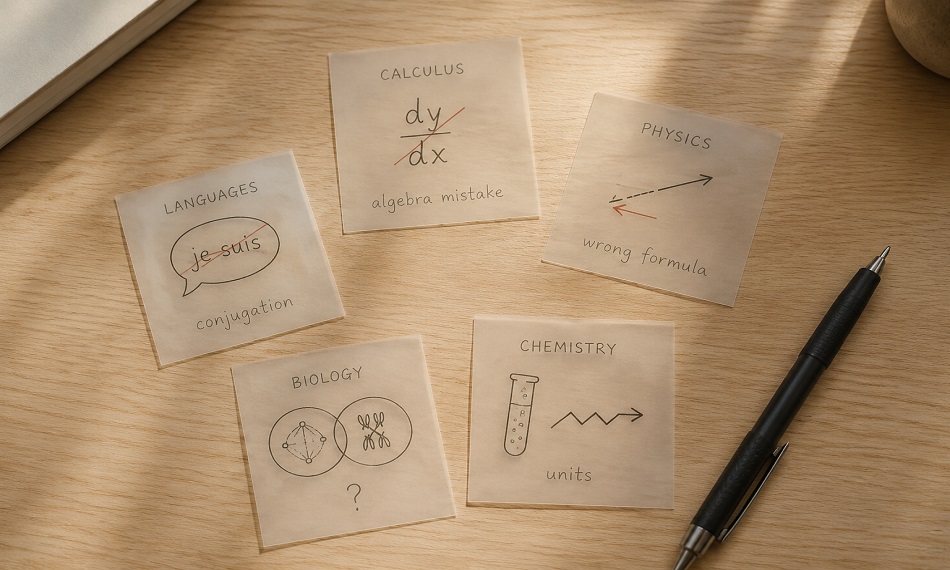
| Subject | Common Error Pattern | Targeted Strategy |
|---|---|---|
| Calculus | Algebra mistakes after setting up the derivative correctly | Step 2: Use step-by-step solver to check each algebra move. Step 3: Generate 5 similar derivatives with different numbers. |
| Physics | Choosing wrong formula (confusing work-energy with kinematics) | Step 2: Voice-explain the conditions for each formula. Step 3: Interleaved quiz with mixed problem types. |
| Chemistry | Forgetting to convert units before plugging into equation | Step 2: Study a worked example with unit conversions highlighted. Step 3: Flashcards with “What’s the first unit conversion?” |
| Biology | Mixing up similar terms (mitosis vs. meiosis) | Step 2: Voice-explain the differences in simple language. Step 3: Flashcards that ask “What is the key difference between…?” |
| Languages | Using wrong verb tense | Step 2: AI explains the rule and provides examples. Step 3: Generate fill-in-the-blank sentences for that tense only. |
The principle is universal: diagnose, understand, then practice the specific gap.
🧠 Part 4: Why This Works (The Science of Error-Driven Learning)
Research in cognitive psychology has consistently shown that error-driven learning—where you actively correct mistakes—produces stronger and more durable memories than errorless learning.
When you make an error and then receive immediate, detailed feedback, your brain encodes the correct information more deeply. The struggle of realizing you were wrong, understanding why, and then practicing the right approach creates multiple memory traces.
But the key is specificity. General feedback (“you need to review chapter 4”) is nearly useless. Specific, step-by-step correction of your exact error is what drives improvement.
That’s why the 3-step loop works. It’s not generic. It’s personal to your mistakes.
🤖 Part 5: How StudyWizardry Automates the Loop
You can do this loop with a tutor, a textbook, and a lot of discipline. But most students won’t. The friction is too high.
StudyWizardry reduces that friction to near zero:
-
Step 1 (Error Triage): The app doesn’t do this for you—but it can highlight which problem types you consistently miss, so you see patterns faster.
-
Step 2 (Targeted Explanation): The homework solver gives step-by-step reasoning. The voice AI lets you explain out loud and compare to a model. Multiple AI models (Grok, GPT, Gemini) offer different explanation styles until one clicks.
-
Step 3 (Spaced Practice): The quiz generator creates new questions on your weak topics instantly. The smart flashcards schedule review at optimal intervals.
The app doesn’t replace the loop. It removes the friction of executing it.
🎯 The Honest Truth
One practice exam is not a study session. It’s a diagnostic. The learning happens in the 24-48 hours after you take it.
Most students skip that part. They take the exam, glance at the answers, and move on. Then they wonder why they make the same mistakes on the real test.
The students who improve fastest are not the ones who take the most practice exams. They’re the ones who learn the most from each one.
Your next practice exam, do this: After you finish, spend 45 minutes on the 3-step loop. Error triage. Targeted explanation. Spaced practice. You’ll learn more from that one exam than most students learn from five.
📚
More from StudyWizardry
The feedback loop is one part of a complete study system. Explore these guides to level up your learning.
📄 How to Stop Feeling Like a Failure When You Have 4 Exams and No Time to Study
A crisis protocol for exam week—including how to use practice exams under time pressure.
📄 The Self-Explanation Effect: Why Asking “Why” Unlocks Deeper Learning
The cognitive science behind Step 2 of the feedback loop.
📄 Interleaving: The Secret to Mastering Multiple Subjects
Why mixing topics during practice prevents errors—and how to do it with AI.
✨ Ready to stop wasting practice exams? Let StudyWizardry be your feedback loop engine—generating targeted quizzes, step‑by‑step explanations, and spaced repetition flashcards.
Quality over quantity. One or two well-analyzed exams with the 3-step loop will teach you more than five exams you simply score and forget.
Use StudyWizardry's quiz generator to create one from your notes. Upload your lecture slides or textbook PDF, and the AI will generate a realistic practice test covering key concepts.
For a 60-minute practice exam, budget 45-60 minutes for the loop. That's less than 2 hours total—far less time than retaking another full exam.
Yes. Write a practice essay. Then use the voice AI to explain your argument out loud. Identify weak reasoning. Use the AI note maker to restructure your thesis and evidence. Then rewrite the essay.
That means your error triage wasn't deep enough. You identified the symptom ("I used the wrong formula") but not the cause ("I don't understand the conditions for using each formula"). Go back to Step 2 and ask the AI for a conceptual explanation of when to use each formula, then practice with mixed problem sets.