The Whiteboard Method: Why Writing on a Board Beats Writing in a Notebook
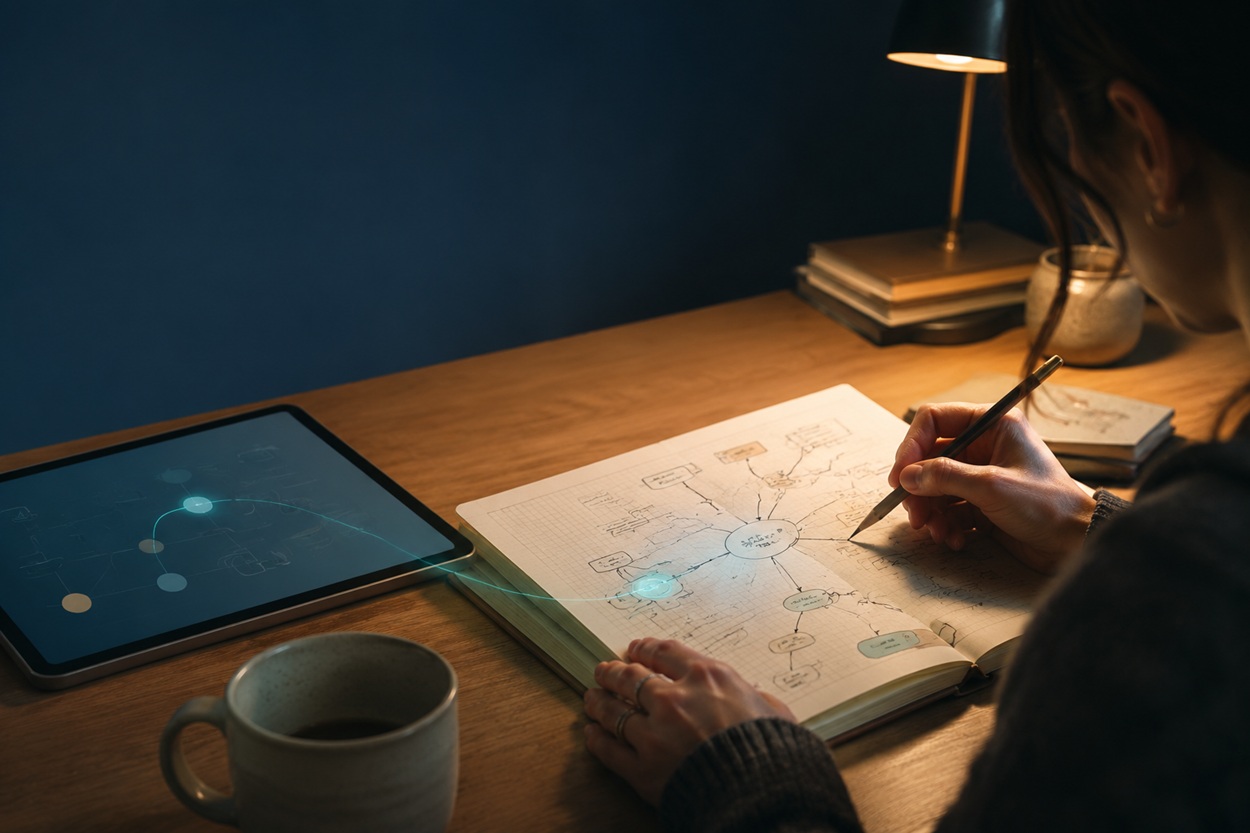
You’ve probably had this experience. You’re working through a complex problem, scribbling in your notebook. Your handwriting gets smaller. The margins fill up. You run out of space, start writing sideways, and eventually, you’re just copying your own messy notes without actually thinking.
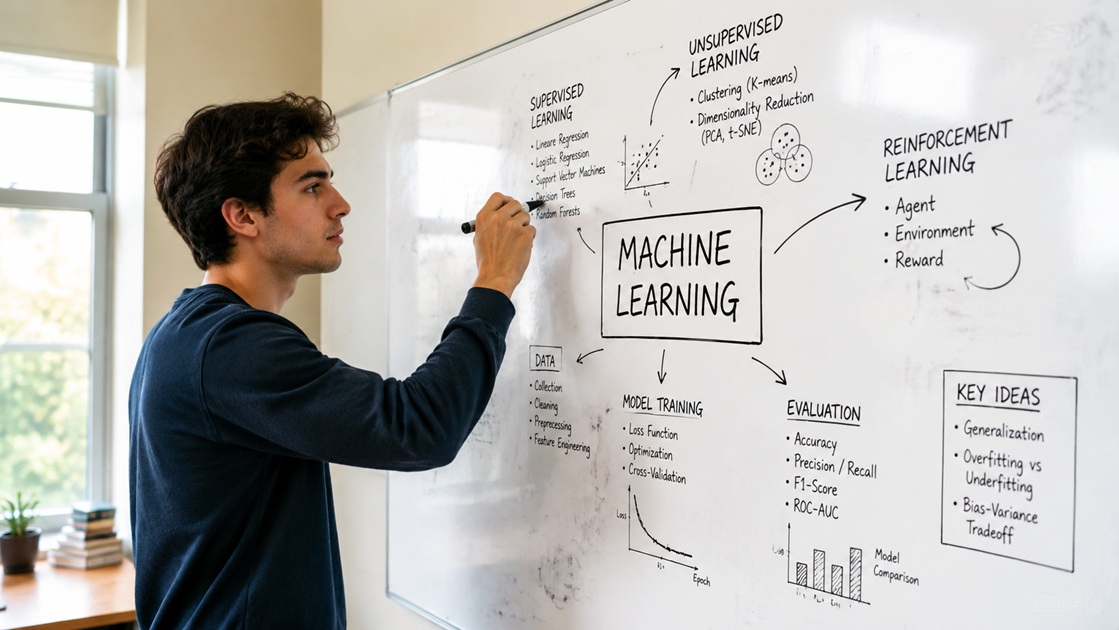
Then, one day, you try a whiteboard. You stand up. You write big. You make a mistake, erase it instantly, and rewrite. The problem starts to feel different—more manageable, more visual, more yours.
This isn’t just a feeling. Research confirms that writing on a vertical surface, standing up, and using a large, erasable canvas changes how your brain processes information. The Whiteboard Method is a simple, science-backed study technique that turns complex problems into clear, organized thinking.
This article explains why whiteboards work, provides a step-by-step protocol, and shows how to use this method for any subject.
🧠 Part 1: Why Whiteboards Work (The Science)
Most students default to notebooks for studying. But a notebook imposes invisible limits: small space, horizontal writing, and a seated posture that can feel passive. A whiteboard removes those limits.
The Space Advantage
When you write on a large vertical surface, your brain treats the problem differently. You have room to spread out ideas, see connections, and organize information spatially. Research on distributed cognition shows that whiteboarding reduces cognitive load by allowing you to externalize your thinking in a large, visible space. Instead of holding multiple steps in your working memory, you can see them all at once.
The Posture Effect
Standing while studying changes your mental state. Studies on posture and cognition suggest that standing can increase engagement and alertness. One educator observed that when students are standing at a whiteboard, they feel less anonymous and more engaged than when sitting at a desk. The physical act of standing and moving your arm to write activates different neural pathways than sitting hunched over a notebook.
The Erasable Advantage
Whiteboards are non-permanent. This small detail matters enormously. When you know you can erase and rewrite easily, you take more risks. A 2024 report on vertical learning noted that students are more willing to try approaches they’re unsure of because “it is easy to erase, so it is like it didn’t happen”. This reduces the fear of being wrong and encourages experimentation.
The Spatial Thinking Boost
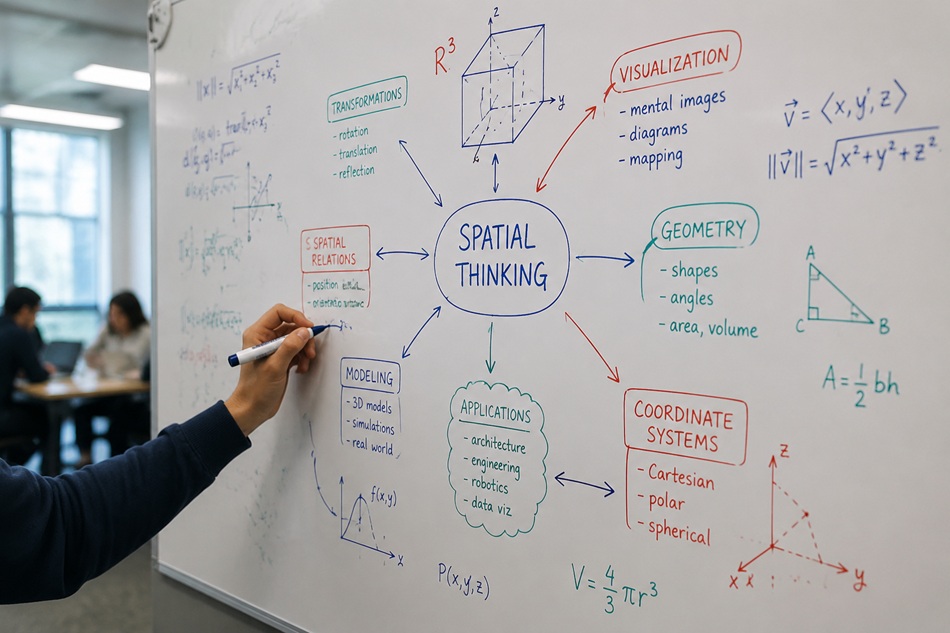
Research comparing note-taking methods found that students who used whiteboards or paper spontaneously used more spatial strategies—drawing diagrams, creating maps, and organizing information visually. In contrast, students using computers tended to rely on verbal strategies (words only). Whiteboards naturally encourage you to think visually and spatially, which is essential for subjects like math, physics, and biology.
📝 Part 2: The Whiteboard Method Protocol
The Whiteboard Method is simple but structured. Follow these five steps for any topic you want to master.
Phase 1: Setup
Find a whiteboard—wall-mounted, standing, or even a large sheet of paper on a wall. Stand up. Have your markers ready. Clear your mind of distractions. This physical setup signals to your brain: “This is different from notebook studying. This is active.”
Phase 2: The Brain Dump
Write down everything you already know about the topic. Don’t organize yet. Just get it on the board. Use large writing. Draw diagrams. Connect ideas with arrows. The goal is to externalize your current understanding in a visible, spatial format.
Phase 3: Identify the Gaps
Step back and look at your board. What’s missing? What connections are unclear? Where did you stop? These gaps are your study guide. Circle them. Write questions next to them. This is where you need to focus.
Phase 4: Fill and Reorganize
Go back to your notes, textbook, or other resources. Research only the gaps you identified. Then return to the whiteboard and add the missing information. Reorganize the board into a coherent structure—a mind map, a flowchart, a timeline, or whatever format makes sense for the subject.
Phase 5: Teach It
Now, explain the entire board to an imaginary audience—or better, to a friend or using voice AI. If you can’t explain it clearly, you haven’t fully understood it. Erase and revise until you can.
📊 Part 3: Adapting the Method for Different Subjects
| Subject | How to Use the Whiteboard Method |
|---|---|
| Mathematics | Write the problem large. Work through each step, erasing and correcting as you go. Draw graphs. Show your work visibly. |
| Physics | Draw force diagrams. Map out energy transfers. Show the relationships between variables spatially. |
| Chemistry | Draw molecular structures. Map out reaction pathways. Show electron flow with arrows. |
| Biology | Create large system diagrams. Show how organs connect. Map out cycles and processes visually. |
| Languages | Write sentence structures. Diagram grammar rules. Create vocabulary maps with connections between related words. |
| History | Create timelines. Map cause and effect. Show connections between events, people, and places. |
The principle is universal: take the information out of linear notes and put it into a spatial, visual format.
🛠️ Part 4: How StudyWizardry Amplifies the Method
The Whiteboard Method is powerful on its own, but technology can make it even more effective.
After you’ve created your whiteboard map, you have a visual representation of your understanding. Here’s how StudyWizardry can help you take it further:
-
Turn your whiteboard into flashcards: After you’ve organized your board, the key concepts you’ve mapped out can become the basis for smart flashcards. Instead of writing them from scratch, you already have the structure—you just need to practice retrieval.
-
Generate quizzes from your board: The concepts you’ve organized spatially can be turned into practice questions. A quiz generator can create targeted questions based on the topics you’ve mapped out, helping you test your understanding.
-
Use voice AI to explain your board: Explaining your whiteboard out loud is one of the most effective ways to solidify understanding. Voice AI lets you practice this explanation and get feedback on where your explanation breaks down.
The app doesn’t replace the whiteboard. It extends its power, turning your visual map into a complete study system.
🔄 Part 5: The Mastery Cycle
The Whiteboard Method works best when repeated. Here’s a cycle you can follow:
| Day | Activity | How It Helps |
|---|---|---|
| Day 1 | Create your initial whiteboard map | Externalize current knowledge |
| Day 2 | Review your board, add missing information | Fill gaps and deepen understanding |
| Day 3 | Erase and recreate the board from memory | Strengthen retrieval and recall |
| Day 5 | Explain the board out loud without looking | Test your understanding under pressure |
| Week 2 | Create a new, refined version of the board | Consolidate learning into long-term memory |
Each cycle builds on the last. Your boards become clearer, more organized, and more complete. And because you’re actively retrieving and reconstructing the information each time, the knowledge sticks.
🎯 The Honest Truth
Here’s what successful students know: how you study matters as much as what you study.
The Whiteboard Method isn’t about having a fancy board. It’s about changing how you interact with information. Standing, writing large, erasing freely, and thinking spatially all engage your brain differently than sitting and writing in a notebook.
The students who truly understand their material don’t just review it. They organize it, visualize it, and teach it. The whiteboard gives you a tool to do all three.
Your next study session, try this: Instead of opening your notebook, find a whiteboard. Write down everything you know about your topic. Stand up. Step back. Look at the gaps. Fill them. Then explain it out loud. You might be surprised at how much clearer everything becomes.
📚
More from StudyWizardry
📄 Stop Highlighting. Start Blurting.
A cognitive science approach to reliable recall—using free recall to expose knowledge gaps.
📄 Your Brain’s UI: Designing Flashcards for Your Unique Cognitive Operating System
How to build flashcards that match the way your brain processes information.
📄 The Forgetting Curve Is Not Your Enemy. It’s Your Best Teacher.
Why spaced repetition is essential for long-term retention—and how to use it.
✨ The Whiteboard Method gives you the big picture. Let StudyWizardry‘s flashcards, quizzes, and voice AI turn that picture into lasting knowledge.
An actual whiteboard is ideal because it allows you to erase, rewrite, and think spatially without limitations. Large paper can work in a pinch, but the vertical, erasable surface is part of what makes the method effective.
You can use a large sheet of paper taped to a wall, or even a window with dry-erase markers. The key is the vertical, spacious surface—not the specific tool.
No. The Whiteboard Method engages multiple learning styles: visual (seeing the board), kinesthetic (writing and moving), and auditory (explaining it out loud). It works for everyone because it forces active engagement.
A mind map is a static product. The Whiteboard Method is an active process. You're standing, writing, erasing, reorganizing, and explaining. The physical engagement and the ability to revise freely are what make it different.
Absolutely. Whiteboards are excellent for group study because everyone can see the same information, add ideas, and correct each other. Research shows that vertical surfaces significantly encourage discussion, participation, and persistence.