
Start Studying the Way Your Brain Actually Works
Here’s a question that will sound strange at first: Why do you study physics differently than you study history?
Probably because physics has formulas and history has dates. But that’s not what I’m asking.
I’m asking: why does your brain feel different when you switch subjects?
For me, physics feels like solving a puzzle where the pieces keep changing shape. Chemistry feels like tracking invisible particles that refuse to follow rules. Biology feels like memorizing a thousand names that all sound the same. Math feels like building a tower where every block has to be perfect or everything collapses.
Each subject hits different parts of my brain. So why do I study them all the exact same way?
This is the hidden flaw in almost every study app, every textbook, and every “one-size-fits-all” learning method. They treat every subject the same. But your brain doesn’t.
Part 1: The Subject-Language Mismatch
Think about what you’re actually doing when you study different subjects.
Physics is about relationships between invisible forces. You can’t see gravity. You can’t touch a magnetic field. You learn by understanding how one thing affects another—through equations, diagrams, mental models.
Chemistry is about tracking things you’ll never see. Electrons jumping between atoms. Molecules changing shape. You learn by visualizing processes, memorizing patterns, and understanding why reactions happen.
Biology is about systems within systems. Cells inside organs inside organisms inside ecosystems. You learn by connecting hierarchies, remembering terminology, and seeing how everything fits together.
Math is about pure logic. Steps that must be followed in order. You learn by doing, failing, and doing again until the pattern becomes automatic.
Geometry is about space. Shapes, angles, proofs. You learn by seeing relationships spatially, not just symbolically.
Here’s the problem: most study tools don’t care about any of this. They give you the same generic explanation for every subject. A physics formula gets the same treatment as a biology definition. A geometry proof gets the same flashcard format as a chemistry equation.
No wonder it feels like you’re fighting your brain instead of working with it.

Part 2: What If Your Study Tools Spoke Your Subject’s Language?
This is where the new version of StudyWizardry does something genuinely different.
Instead of one generic AI, it uses three different models—Grok, GPT, and Gemini—and each one explains things differently depending on what you’re studying.
For a physics problem, the explanation might start with a diagram in your mind. “Imagine a box on an incline. Gravity pulls down. The normal force pushes perpendicular.” It builds the visual model first, then adds the math.
For a chemistry problem, the same problem gets a different treatment. “Let’s track the electrons. Here’s where they start. Watch them move. Now count the charges.” It’s a process explanation, not a visual one.
For a biology concept, the explanation might focus on connections. “This process happens here. It connects to this other process. Here’s why they’re linked.” It builds a web of understanding.
For math, the explanation is step-by-step procedural. “First, identify what you know. Second, choose the right formula. Third, substitute. Fourth, solve.”
For geometry, the explanation is spatial. “Look at this triangle. Notice these angles are equal because…” It uses visual reasoning.
The same app. The same problem type. Completely different explanation styles. Because the subject demands it.
🗣️ Part 3: Why Voice Changes Everything
Here’s something most study apps miss entirely: you don’t always want to read.
Sometimes you’re walking to class. Sometimes you’re cooking dinner. Sometimes your eyes are tired and you just want to hear the explanation.
And sometimes—especially for language learning or for concepts that feel abstract—hearing something out loud makes it click in ways reading never does.
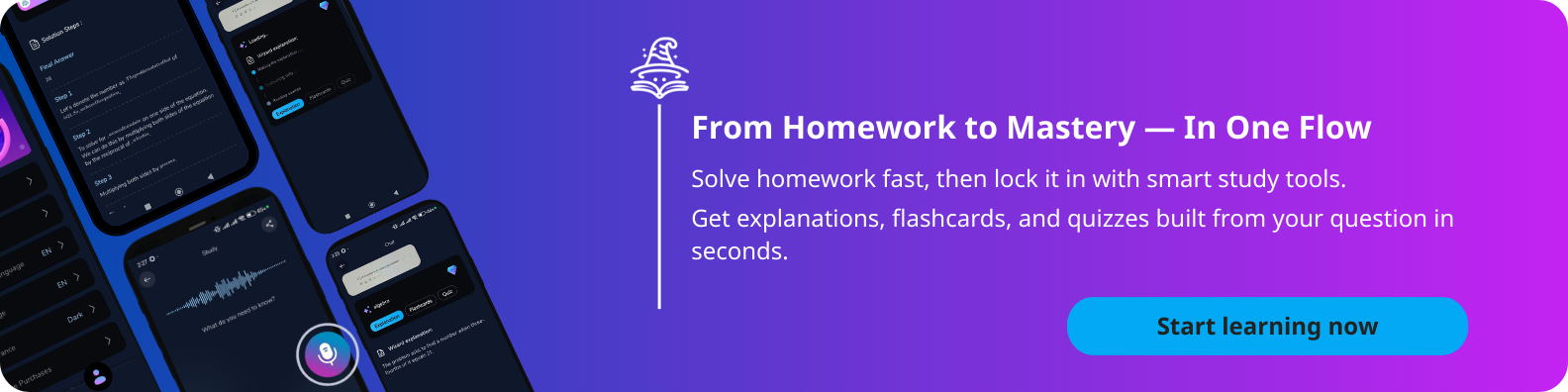
StudyWizardry includes voice-powered AI. You can ask questions out loud. You can get explanations spoken back to you. You can practice pronunciation, talk through problems, and learn the way humans have learned for thousands of years: through conversation.
This isn’t a gimmick. There’s real neuroscience behind it. When you hear information, you activate different neural pathways than when you read it. Combining both creates stronger memories.
For subjects like language learning, voice is essential. You can’t learn to speak by reading. You have to actually say words, hear yourself, and adjust. The voice AI lets you do that without needing a conversation partner at 11 PM.
📱 Part 4: The Full Cycle—From Stuck to Confident
Let me walk you through what this actually looks like in a real study session.
8:00 PM – You’re studying physics. You hit a problem about angular momentum that makes no sense.
8:02 PM – You open StudyWizardry and scan the problem. The app shows you three different explanations from three different AI models. One is mathematical. One is conceptual. One uses an analogy about spinning ice skaters. The analogy clicks.
8:10 PM – You close the app and explain the concept out loud using the voice feature. You stumble a few times. The AI gently corrects you. After three tries, you can explain it smoothly.
8:15 PM – You generate a smart flashcard deck on angular momentum. The first few cards are easy. Then they get harder. The ones you miss keep coming back.
8:25 PM – You take a quick quiz—five questions generated on the spot. You get four right. The one you missed becomes a priority flashcard.
8:30 PM – You’re done. You understand angular momentum. Not because you memorized a formula, but because you engaged with it from multiple angles, spoke it out loud, and practiced what you actually needed.
This is the cycle that works: encounter → multiple explanations → voice rehearsal → adaptive practice → immediate testing.
📊 Part 5: What This Means for Different Subjects
Every subject demands a different kind of thinking. Here’s how StudyWizardry adapts its approach to match the unique challenge of each one:
| Subject | The Real Challenge | How StudyWizardry Adapts |
| Physics | Invisible forces, abstract relationships | Visual-first explanations, analogies, then equations |
| Chemistry | Tracking particles, understanding reactions | Process-focused explanations, electron flow, periodic patterns |
| Biology | Massive terminology, interconnected systems | Web-building explanations, connections, hierarchies |
| Math | Step-by-step logic, error-prone procedures | Procedural explanations, practice with immediate feedback |
| Geometry | Spatial reasoning, proofs | Visual-spatial explanations, diagram-based reasoning |
| Languages | Pronunciation, context, recall | Voice practice, contextual flashcards, conversational AI |
The app doesn’t treat every subject the same. Because your brain doesn’t either.
🎯 The Honest Truth
Here’s what I’ve learned after years of struggling with hard subjects and trying every study method:
The problem isn’t your brain. The problem is that your tools don’t speak your subject’s language.
You can’t learn physics the way you learn history. You can’t memorize chemistry like you memorize vocabulary. Each subject demands a different approach, a different kind of thinking, a different style of explanation.
The students who succeed aren’t the ones with the best memory. They’re the ones who have figured out how to match their study method to the subject they’re learning.
And now, for the first time, there are tools that can help you do that without becoming an expert in learning science yourself.
If you’ve ever felt like you’re fighting your brain when you study, you’re not wrong. But it’s not your brain’s fault. It’s your tools’ fault.
Try something that actually adapts to you.
📚 Further Reading
📚
More from StudyWizardry
📄 I Studied 14 Hours a Day for a Month. Here’s What I Learned About Learning.
One student’s story of hitting bottom with marathon study sessions.
📄 The Problem With One Explanation (And Why You Need Three AI Models)
Why multiple perspectives unlock understanding faster than grinding.
📄 Why Memorizing Formulas Never Works (And What to Do Instead)
Move past surface-level memorization to real understanding.
When you scan a problem or create a flashcard set, you select the subject (physics, chemistry, biology, geometry, math, etc.). The app then routes your request to the AI model best suited for that subject and adapts the explanation style accordingly.
For some subjects, yes. For languages, absolutely not. For talking through complex concepts, it's incredibly useful. And for students who process information better auditory, it's a game-changer. The point is having the option—not forcing everyone to use it.
You can absolutely focus on the model that works best for you. The app gives you access to all three, but you're not required to use all of them. Some students prefer Grok for math, GPT for conceptual explanations, Gemini for analogies. Find what works for you.
Yes. The subject-specific approach works for any exam that tests physics, chemistry, biology, math, or geometry. For language exams, the voice feature and contextual flashcards are particularly helpful.