The AI Memory Crisis: Why Students Remember Less Than Ever
It’s 11:47 PM. You close your laptop after a long study session. You reviewed the material. You asked ChatGPT a few clarifying questions. You feel prepared.
Three days later, you open your notes and realize you remember almost nothing.
This isn’t a failure of effort. It’s a failure of process. And it’s becoming one of the most under-discussed problems in education today.
Welcome to the AI Memory Crisis.
📌 Key Insight
The more you outsource remembering to AI, the less your own memory systems are activated.
AI doesn’t make you stupid. But it does make remembering optional.
The Paradox of AI-Assisted Learning
AI is supposed to make learning easier. It summarizes readings. It generates practice questions. It explains concepts in multiple ways. It’s the ultimate study assistant.
Yet something strange is happening. Students are using AI more than ever—and remembering less.
A 2025 randomized controlled trial found that students who had unrestricted access to ChatGPT during self-directed study performed significantly worse on long-term retention tests than those who studied without it. The researchers concluded that while AI assistance may ease initial learning, it “appears to undermine the effortful processes needed for robust learning”.
Another study from 2025 found that students given unrestricted GPT-4 access performed 17% worse when the AI was removed than students who never had it.
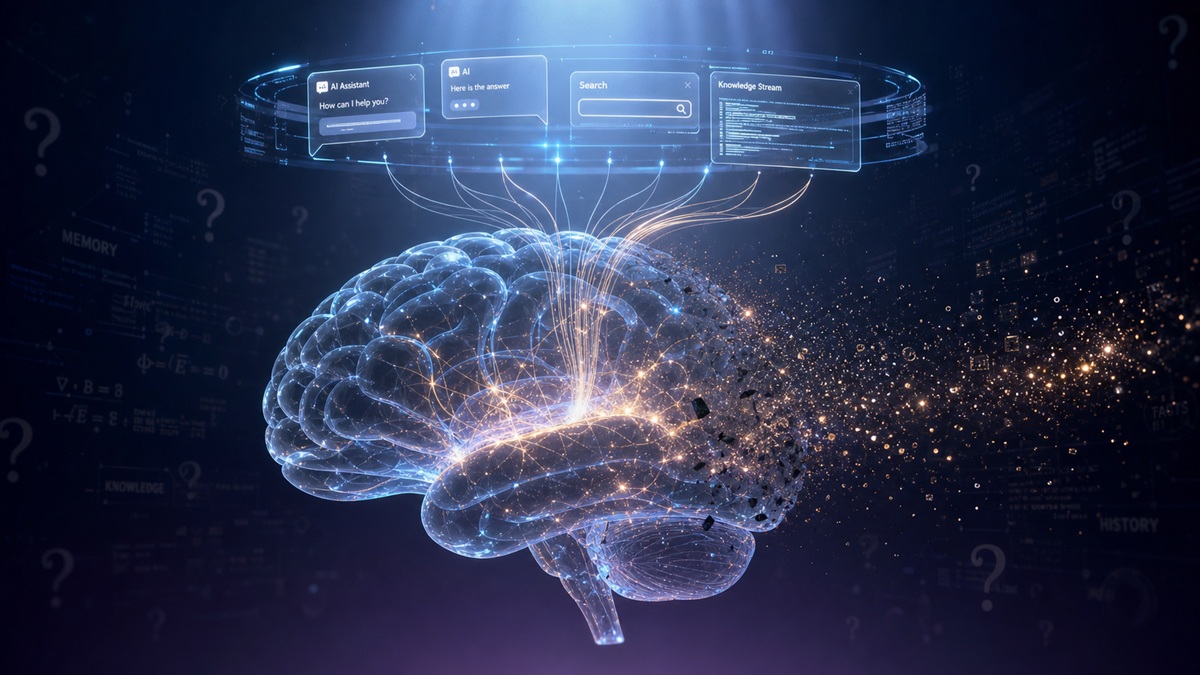
This is the AI Memory Crisis: the more we outsource remembering to AI, the less our own memory systems are activated.
The problem isn’t that AI is bad. It’s that AI removes friction—and sometimes friction is exactly what creates learning.
🧠 Memory Science: Why Remembering Is Not Automatic
Your brain doesn’t store memories like a hard drive. Information doesn’t just “save” itself.
Memory requires retrieval. Every time you successfully recall something, you strengthen the neural pathway. Every time you don’t, the pathway weakens.
| Passive Learning | Active Recall |
|---|---|
| Re-reading notes | Testing yourself |
| Highlighting text | Explaining concepts |
| Watching videos | Answering questions |
| Listening to lectures | Teaching others |
| Feels productive | Feels hard |
| Creates familiarity | Builds memory |
This is why active recall is one of the most powerful learning techniques ever studied. Research consistently shows that students who test themselves retain significantly more than those who re-read the same material.
When you ask AI to retrieve information for you, you’re skipping this process. You’re getting the answer without the cognitive effort. The information is there—but your brain hasn’t built the pathways to access it.
Recognition is not recall. Familiarity is not memory.
🗺️ The GPS Analogy
Think about what happened when GPS became ubiquitous.
Before GPS, you needed to learn routes. You paid attention to landmarks. You developed a mental map of your city. When GPS arrived, it made navigation effortless—but it also made navigation optional. You stopped learning routes. You stopped building mental maps.
A similar thing is happening with AI and memory.
GPS weakened our sense of direction. AI can weaken our sense of knowledge when it replaces retrieval rather than supporting it.
When AI answers your questions instantly, you’re navigating without ever building the mental map. You’re reaching the destination without understanding the route. And just like with GPS, the moment the tool is removed, you’re lost.
📊 Research Snapshot: What the Data Actually Shows
The evidence is mounting.
| Study | Finding |
|---|---|
| Microsoft Research & CMU (2025) | Using generative AI “reduced critical engagement.” Users engaged less critically when they deferred to the machine. |
| EEG Study (2025) | “Excessive reliance on AI significantly reduces EEG activation, recall accuracy, and critical thinking scores.” |
| Adaptive Pretesting Study (2026) | While AI can elevate initial understanding, “sustained learning depends on how subsequent AI-supported practice is structured.” |
💡 Key takeaway: Cognitive offloading is not inherently bad. The problem is when it replaces thinking instead of supporting it. As one researcher put it: “This reliance on AI can be seen as a form of cognitive offloading, where users depend on AI to perform tasks they feel less confident in handling themselves”.
🎯 Two Students, Two Outcomes
Consider two students preparing for the same exam.
Student A uses AI the way many students do: whenever they encounter a difficult question, they paste it into ChatGPT and ask for the answer. They read the explanation, feel satisfied, and move on. They feel confident they’ve “learned” the material.
Student B also uses AI—but differently. When they get stuck, they ask AI for the next step, not the final answer. They generate practice questions from the AI and answer them themselves first. They explain concepts out loud using Voice AI. They use AI after retrieval, not before.
Both students finish their study session feeling prepared.
One week later, Student A can barely remember what they studied. Student B can still explain the concepts clearly.
The difference isn’t AI. It’s how they used it.
⚠️ Common Mistake: The Familiarity Trap
When you use AI to answer questions, you’re not learning—you’re recognizing. Your brain registers the information as familiar. It feels like you know it. But when you need to recall it without prompting, it’s gone.
Recognition is not recall. Passing AI’s test is not the same as passing your own.
🔄 The AI Memory Loop
Here’s a framework to understand how AI affects your learning:
⚠️
❌ Memory Killers vs. ✅ Memory Builders
Here’s what peer-reviewed studies are revealing about AI’s effect on learning and memory retention.
| ❌ Memory Killer | ✅ Memory Builder |
|---|---|
| Asking AI for the final answer | Asking AI to explain the concept |
| Copying AI-generated summaries | Generating practice questions from AI |
| Using AI before trying yourself | Using AI after retrieval |
| Reading AI explanations passively | Explaining concepts to Voice AI |
| Skipping flashcards entirely | Building flashcards from key concepts |
| Cramming with AI-generated content | Creating a spaced review schedule |
7 Ways to Use AI Without Losing Your Memory
Here’s the good news: AI isn’t the problem. How you use it is.
1. 💬 Ask AI to Explain, Not to Answer
When you’re stuck, don’t ask for the solution. Ask for an explanation of the concept. Then try the problem yourself.
Why it works: You’re still doing the retrieval work. The AI provides context—not the final answer.
2. 📝 Generate Practice Questions, Not Answers
Use AI to create practice questions. Answer them yourself. Then check your work.
Why it works: This is retrieval practice—one of the most effective learning techniques.
3. 🔁 Use AI After Retrieval
Study the material first. Test yourself. Then use AI to check your understanding or fill gaps.
Why it works: You’re doing the cognitive work first. AI becomes a feedback tool, not a replacement.
4. 🗣️ Use Voice AI to Explain Concepts
Explain a concept out loud. Ask AI to identify gaps in your understanding.
Why it works: Speaking forces you to organize your thoughts. You can’t just nod along—you have to produce.
5. 🎯 Compare Your Answer to AI’s
Solve a problem yourself. Then ask AI to solve it. Compare your approach. Where did you differ?
Why it works: This builds metacognitive awareness—understanding how you think.
6. 📚 Build Flashcards, Don’t Just Read Them
Use AI to identify key concepts, but study them actively. Cover the answer. Recall it. Then check.
Why it works: Flashcards force retrieval. Spaced repetition ensures you review before you forget.
7. 🗓️ Create a Spaced Review Schedule
Use AI to plan your review sessions. Let it suggest what to study and when.
Why it works: Spaced repetition strengthens memory over time. It’s one of the most reliable learning techniques.
🤖 Why StudyWizardry Fits This Learning Model
The key to learning isn’t consuming information—it’s retrieving it.
StudyWizardry is built around this principle. The app doesn’t replace your thinking. It creates conditions for you to think more deeply.
-
Smart Flashcards use spaced repetition to help you move knowledge from short-term to long-term memory. You don’t just read—you retrieve.
-
Quiz Generator creates practice tests from your notes. You answer questions, identify gaps, and improve.
-
Voice AI lets you explain concepts out loud and get feedback. You’re not just consuming—you’re producing.
-
AI Note Maker turns messy lectures into organized summaries. But the real learning happens when you engage with those notes—not just read them.
These aren’t features. They’re a philosophy: learning is retrieval, not consumption.
🚀 Quick Win: Try This Today
Instead of asking AI to summarize your lecture notes, ask it to generate 10 practice questions. Answer them yourself. Then check your work.
One study session, one retrieval practice. That’s all it takes to start building memory instead of just consuming information.
“Convenience creates confidence. Retrieval creates memory.”
💡 The Honest Truth
AI isn’t destroying your memory. But it is exposing your study habits.
If you already practice retrieval, AI can make you faster. If you don’t, AI can make you weaker—because it gives you the illusion of learning without any of the cognitive effort.
AI doesn’t decide what you remember. Your study habits do.
The students who will thrive in the AI era aren’t the ones who use AI the most. They’re the ones who use it most strategically—to support their learning, not replace it.
📚
More from StudyWizardry
The AI Memory Crisis is just one piece of the puzzle. Explore these guides to build a complete learning system.
📄 The AI Learning Gap: Why Students Are Moving Faster Than Universities
How students are using AI strategically—and why institutions are struggling to keep up.
📄 You’re Not Struggling Enough. You’re Struggling Wrong.
Why the best learning feels hard—and how to struggle productively.
📄 The Thinking Revolution: Why Rote Learning Is Dying and Critical Thinking Is Taking Over
How students are moving beyond memorization and toward genuine analytical thinking.
✨ Three guides, one system: Read them in any order—each one builds on the science of active recall, productive struggle, and durable learning.
Not necessarily. Research shows that when AI replaces thinking, retention suffers. But when AI supports retrieval practice—like generating practice questions or providing feedback—it can enhance learning. The key is how you use it.
Cognitive offloading is the process of using external tools to reduce mental effort. GPS is a form of cognitive offloading for navigation. AI is a form of cognitive offloading for knowledge. The problem occurs when offloading replaces thinking instead of supporting it.
Yes—if you use it strategically. AI can generate practice questions, create flashcards, and plan spaced review sessions. But you still have to do the retrieval work. AI can't remember for you.
Familiarity is recognizing something. Memory is being able to recall it without cues. AI makes things feel familiar—but that doesn't mean you've learned them. The only way to build memory is through retrieval.
Try to explain a concept without looking at your notes or AI. If you can't, you haven't learned it—you've just seen it. The test is whether you can produce the information, not just recognize it.
StudyWizardry is built around retrieval, not consumption. The flashcards, quizzes, and voice features are designed to force active recall—the kind of learning that actually builds memory. It's not about giving answers. It's about helping you learn to produce them.