Why You Forget What You Study: The Science of Memory Interference
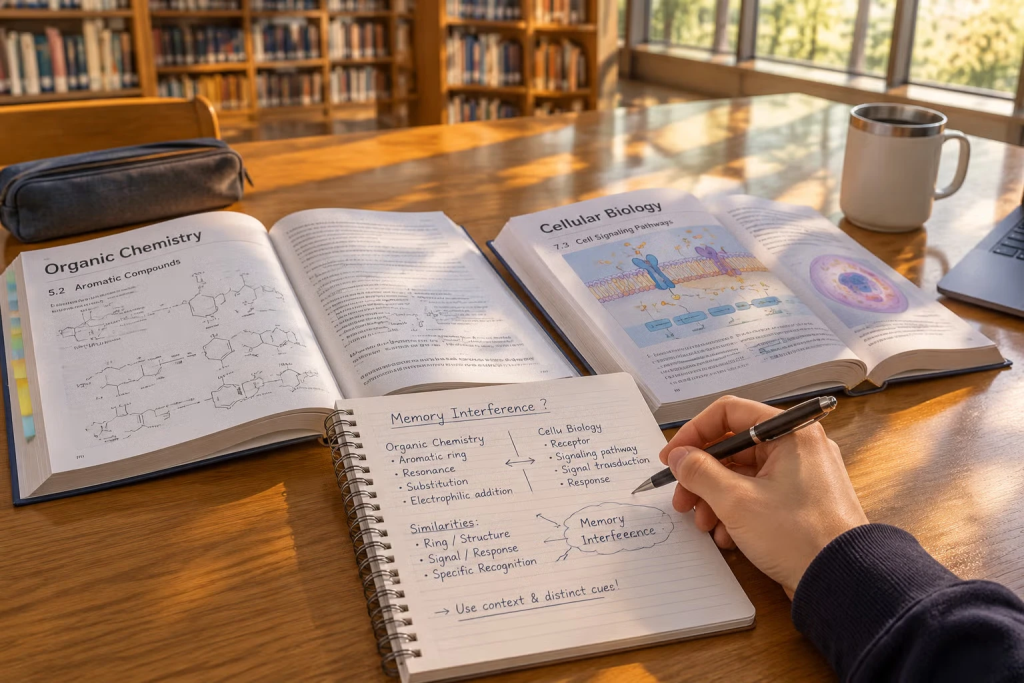
You study biology on Monday. On Tuesday, you switch to chemistry. On Wednesday, you sit down to review biology—and the concepts feel slippery, as if the chemistry material has somehow crowded them out.
Nothing is wrong with your memory. You’ve just encountered one of the most well-documented mechanisms of forgetting: memory interference.
It’s not the only reason we forget—decay, lack of retrieval, and simple absent-mindedness all play a role. But interference explains a specific and frustrating pattern: the more similar two things are, the more likely they are to blur together in your mind.
Understanding why this happens can change how you study—especially when your timetable forces you to juggle overlapping subjects.
Why Your Brain Confuses Similar Information
Your memory doesn’t store information like files in separate folders. It stores it as networks of associations. When two pieces of information share features—similar names, similar structures, similar contexts—those networks overlap. And overlapping networks compete.
This is the core of interference theory: forgetting happens not because memories disappear, but because other memories get in the way.
In 2015, researchers Kevin Darby and Vladimir Sloutsky published a study in the Journal of Experimental Psychology: General titled “The Cost of Learning: Interference Effects in Memory Development.” Their work showed that learning new information can interfere with memory for previously learned information—and that this interference is particularly pronounced when the new material overlaps with the old.
In other words: the more your subjects resemble each other, the harder your brain has to work to keep them apart.
What Is Memory Interference?
Interference comes in two directions.
Proactive interference happens when old information disrupts your ability to learn or recall new information. You’ve studied Spanish for years; now you’re learning Italian, and every Italian word you try to recall comes out in Spanish.
Retroactive interference happens when new information disrupts your ability to recall old information. You learn a new statistical method, and suddenly the method you mastered last semester feels fuzzy.
Both are normal. Both are well-documented. And both are especially common when the material you’re studying shares surface features—terminology, structure, or context.
A 2021 review by Oliver Kliegl and Karl-Heinz Bäuml in Neuroscience & Biobehavioral Reviews examined how proactive interference builds up over time and how it can be released. The key finding: interference accumulates when you keep studying similar material without a break, and it can be reduced when the material changes in a meaningful way.
That’s a practical insight. It means the problem isn’t just what you study—it’s how you sequence it.
The Consolidation Window: Why Timing Matters
There’s another dimension to interference that most students never hear about: the first few minutes after learning are fragile.
A 2018 study published in Frontiers in Psychology, titled “When Learning Disturbs Memory – Temporal Profile of Retroactive Interference of Learning on Memory Formation,” focused on the first twelve minutes after learning. The researchers found that interference during this window decreased memory performance by up to 20%, and concluded that “the first 12 min after learning are highly important for memory consolidation”.
In plain terms: what you do immediately after studying matters. If you close your biology notes and immediately open your chemistry notes—especially if the material is similar—you risk disrupting the consolidation of what you just learned.
This doesn’t mean you can’t study multiple subjects in one day. It means you should be thoughtful about what comes next.
Why Studying Similar Subjects Can Be Tricky
Some combinations are more vulnerable to interference than others.
High-interference pairs:
-
Two languages with shared roots (Spanish and Italian, for example)
-
Two sciences with overlapping terminology (biology and chemistry, particularly around molecular processes)
-
Two mathematical methods with similar procedures but different conditions
-
Two historical periods with similar names, figures, or cause-and-effect patterns
Lower-interference pairs:
-
A science and a humanities subject
-
A language and a quantitative subject
-
Two subjects that use entirely different vocabularies and structures
This doesn’t mean you should avoid studying similar subjects. It means you should separate them—in time, in context, or both.
How to Reduce Memory Interference
The research points to several practical strategies. None of them are complicated, but they require a little planning.
1. Separate similar subjects in time
If you have to study biology and chemistry on the same day, don’t study them back-to-back. Put a gap between them—ideally a few hours, or at least a meaningful break. The 2018 study’s finding about the twelve-minute consolidation window suggests that even a short delay can protect what you’ve just learned.
2. Change your context
A classic finding in memory research is that studying the same material in different physical contexts can reduce interference. If you study biology at your desk, study chemistry at the kitchen table or in the library. The change in context gives your brain a stronger cue to distinguish between the two.
3. Use interleaving—carefully
Interleaving—mixing different topics within a single study session—is often recommended for reducing interference, because it forces your brain to discriminate between concepts. But the key word is carefully. Interleaving works best when you’re practicing discrimination—when the goal is to tell similar things apart—not when you’re trying to learn two completely new bodies of material at once.
4. Protect the consolidation window
After a study session, take a short break before switching to something cognitively demanding. Don’t immediately jump into a similar subject. A few minutes of rest—or a low-demand task—gives your brain time to stabilize what it just learned.
5. Retrieve, don’t just review
One of the most effective ways to combat interference is to test yourself on the material. Retrieval practice strengthens the specific memory you’re trying to access, making it more resistant to competing information. When you retrieve, you’re not just reviewing—you’re carving a clearer path to that memory.

Study Strategies That Help You Remember Distinct Concepts
Beyond the general principles, here are a few specific techniques for keeping similar material separate in your mind.
Contrastive retrieval. Instead of studying one concept at a time, practice explaining how two similar concepts differ. This forces your brain to encode the distinguishing features, not just the shared ones.
Dual coding. Pair verbal information with a visual representation—a diagram, a timeline, a concept map. Visual and verbal memories are stored somewhat separately, which gives you two paths to the same information and reduces the chance of interference.
Spaced discrimination. Review similar concepts at spaced intervals, but always ask yourself: “Which one is this, and how do I know?” The act of discriminating between them strengthens both memories.
How StudyWizardry Can Help You Organize and Review What You Learn
Interference is a problem of organization and discrimination. Your tools can support both.
Study Sets let you group material into clearly defined collections—one for biology, one for chemistry, one for each unit or topic. This mirrors the kind of separation that reduces interference. When your material is organized into distinct sets, you’re less likely to blur the boundaries between subjects.
Flashcards are particularly useful for discrimination practice. When you create cards for similar concepts, you can deliberately mix them—forcing yourself to identify which card belongs to which concept. That’s retrieval plus discrimination, which is exactly what interference research suggests you need.
Quizzes serve a similar function. Generating practice questions that ask you to distinguish between similar ideas—rather than simply recall isolated facts—builds the kind of precise memory that resists interference.
And because StudyWizardry works in your browser, you can move between organizing, testing, and reviewing without losing your place—or your train of thought.
The principle is consistent: the thinking is yours. The tools handle the structure.
The Honest Truth
Memory interference is not a sign that something is wrong with you. It’s a predictable consequence of how memory works. Your brain stores information in overlapping networks, and when those networks compete, recall becomes harder.
The students who manage interference well aren’t the ones with the best memories. They’re the ones who plan their study in a way that respects how memory actually works—separating similar material, protecting the consolidation window, and using retrieval to strengthen the distinctions.
You won’t eliminate interference. But you can work with it instead of against it.
Your next study session, try this: If you’re studying two similar subjects today, put a gap between them. Change where you sit. And before you switch, take five minutes to test yourself on what you just learned. Those small changes can make a measurable difference in what sticks.
📚
More from StudyWizardry
Interference is one mechanism of forgetting. These guides explore the others—and what to do about them.
📄 The Leaky Bucket: Why You Forget Almost Everything You Learn (And How to Fix It)
Why information slips away—and the practical strategies that slow the leak.
📄 Your Brain’s Delete Button—And How Active Recall Disables It!
Why retrieval practice is the foundation of durable learning.
📄 Interleaving Study Technique: Why Mixing Topics Helps You Learn Better
How deliberate mixing strengthens discrimination—and when it can backfire.
✨ Three guides, one system: Understand forgetting, use retrieval to fight it, and learn when interleaving helps—and when it doesn’t.
📚 References
-
Darby, K. P., & Sloutsky, V. M. (2015). The cost of learning: Interference effects in memory development. Journal of Experimental Psychology: General, 144(2), 410–431. https://psycnet.apa.org/record/2014-48387-001
-
Kliegl, O., & Bäuml, K.-H. T. (2021). Buildup and release from proactive interference – Cognitive and neural mechanisms. Neuroscience & Biobehavioral Reviews, 120, 264–278. https://pubmed.ncbi.nlm.nih.gov/33152421/
-
Sosic-Vasic, Z., Hille, K., Kröner, J., Spitzer, M., & Kornmeier, J. (2018). When learning disturbs memory – Temporal profile of retroactive interference of learning on memory formation. Frontiers in Psychology, 9, 82. https://pubmed.ncbi.nlm.nih.gov/29503621/
No. Interference is one of several mechanisms of forgetting, alongside decay, retrieval failure, and simple lack of encoding. This article focuses on interference because it explains a specific pattern—confusion between similar material—that many students experience but few can name.
Proactive interference is when old information disrupts new learning. Retroactive interference is when new information disrupts old memory. Both are normal and both are influenced by how similar the material is.
Research suggests that the early consolidation window is fragile. Interference during this period—especially from similar material—can reduce memory performance. Taking a short break before switching to a demanding or similar subject can help protect what you've just learned.
Not necessarily. But you should separate them in time or context. Study one, take a break, then study the other. Changing rooms or locations can also help your brain distinguish between the two.
Study Sets let you organize material into distinct collections, which reduces blurring between subjects. Flashcards and Quizzes let you practice discriminating between similar concepts—retrieval plus discrimination, which is exactly what interference research suggests you need.
It depends on the goal. Interleaving is excellent for discrimination—practicing the ability to tell similar concepts apart. But when you're first learning two new and similar bodies of material, studying them back-to-back can increase interference. Use interleaving deliberately, not automatically.