Feedback Gap in Learning: Why You Don’t Know What You Don’t Know (Until It’s Too Late)
You studied for hours. You read the chapter twice. You highlighted the key points. You reviewed your notes before bed.
You felt prepared.
Then you sat down for the exam, read the first question, and realized you had no idea what the answer was. Not because you forgot. Because you never actually understood it in the first place.
You studied blind. And you didn’t even know it.
This is the feedback gap—the space between “I think I understand” and “I know I understand.” It’s one of the most under-discussed problems in learning, and it explains why so many students study hard and still fail.
The Problem With Studying Alone
Learning requires feedback. Not praise, not grades, not a teacher’s approval—but information about whether you’re right or wrong.
When you practice a sport, you see the ball go in or miss. When you play an instrument, you hear whether the note is sharp or flat. When you cook, you taste the food and adjust.
But when you study alone? You read. You highlight. You take notes. You have no idea whether any of it is working.
You are studying without a feedback loop. And that is the single biggest inefficiency in how most students approach learning.
Why the Brain Can’t Self-Assess
The human brain is remarkably bad at knowing what it knows. Psychologists call this the Dunning-Kruger effect—the tendency for people with low ability in a domain to overestimate their competence. But the problem is even broader than that: almost everyone overestimates their understanding of complex material, because familiarity feels like knowledge.
When you re-read a chapter, the material feels familiar. That feeling of familiarity is interpreted by your brain as “I know this.” But familiarity is recognition, not recall. And recognition is not the same as understanding.
This is why students consistently overestimate how well they’ll do on exams. They mistake the feeling of fluency for actual mastery. A 2026 review of self-regulated learning found that students’ judgments of their own learning are often poorly calibrated with their actual performance—they feel prepared when they aren’t.
The result: you spend hours studying the wrong things, skip the topics you actually need to review, and walk into the exam with false confidence.
What Feedback Actually Does
Feedback is not just about correcting errors. It serves three critical functions in learning.
It reveals gaps you didn’t know existed. You cannot fix what you cannot see. Feedback makes the invisible visible.
It confirms whether your understanding is accurate. When you retrieve an answer and get it right, you strengthen that memory. When you get it wrong and learn the correct answer, you correct a misconception before it hardens.
It builds metacognitive accuracy. Over time, feedback teaches you to better judge your own understanding. You learn to distinguish between “I recognize this” and “I can produce this.” This skill—accurate self-assessment—is one of the strongest predictors of academic success.
Without feedback, none of this happens. You study in the dark.
Why Students Avoid Feedback
If feedback is so essential, why do most students avoid it?
Because feedback is uncomfortable.
Getting an answer wrong feels bad. Discovering a gap in your understanding is threatening. Confirming that you don’t actually know something after hours of studying is demoralizing.
So students default to methods that feel safe—re-reading, highlighting, reviewing notes. These methods provide no feedback, but they also provide no discomfort. They are comfortable. And they are ineffective.
The students who learn most effectively are not the ones who avoid discomfort. They are the ones who seek it out, because they know that discomfort is the signal of a gap that can be closed.
How to Build Feedback Into Your Studying
Here are three strategies that close the feedback gap.
Strategy 1: Test Yourself Before You Feel Ready
The most effective way to get feedback is to test yourself—before you think you’re ready.
Close the book. Write down what you remember. Answer questions without looking at your notes. The moment you struggle is the moment you learn something you didn’t know.
This is called retrieval practice, and it is one of the most robust findings in cognitive science. Research consistently shows that students who test themselves retain significantly more than those who re-study material.
The key: You must test yourself honestly. No peeking. No re-reading the question and thinking “yeah, I probably know that.” Actually retrieve the answer. If you can’t, you’ve found a gap.
And that gap is not a failure. It is the most valuable information you have. It tells you exactly where to focus next.
Strategy 2: Get Feedback in the Moment
The gap between trying to recall something and getting the answer matters. Immediate feedback—within seconds or minutes—is more effective than delayed feedback (like getting your exam results a week later).
When you struggle with a problem and then see the correct solution immediately, your brain is primed to encode it. The struggle creates the need; the feedback fills it. This is sometimes called the pretesting effect—wrong answers followed by correct ones strengthen memory more than just studying the correct answer alone.
But here’s the problem: when you’re studying alone, immediate feedback is hard to get. You get stuck on a problem. You don’t know if your approach is right. You don’t know where you went wrong. So you skip it, or you wait until you can ask someone, or you look at the answer and move on without understanding why.
This is where the feedback loop breaks down.
One way to close that gap is to have a tool that gives you feedback in the moment—without requiring you to leave what you’re doing. StudyWizardry now works directly in your browser. You can drop in a photo of a problem, crop the question, and get a step-by-step explanation immediately. If you’re still confused about a step, you can ask a follow-up question—just like you would with a tutor. The dialogue continues until the gap is closed.
The key is that the feedback is immediate and contextual. You don’t have to remember to look it up later. You don’t have to hope you’ll figure it out on your own. You get the information you need, exactly when you need it.
Strategy 3: Explain It Out Loud
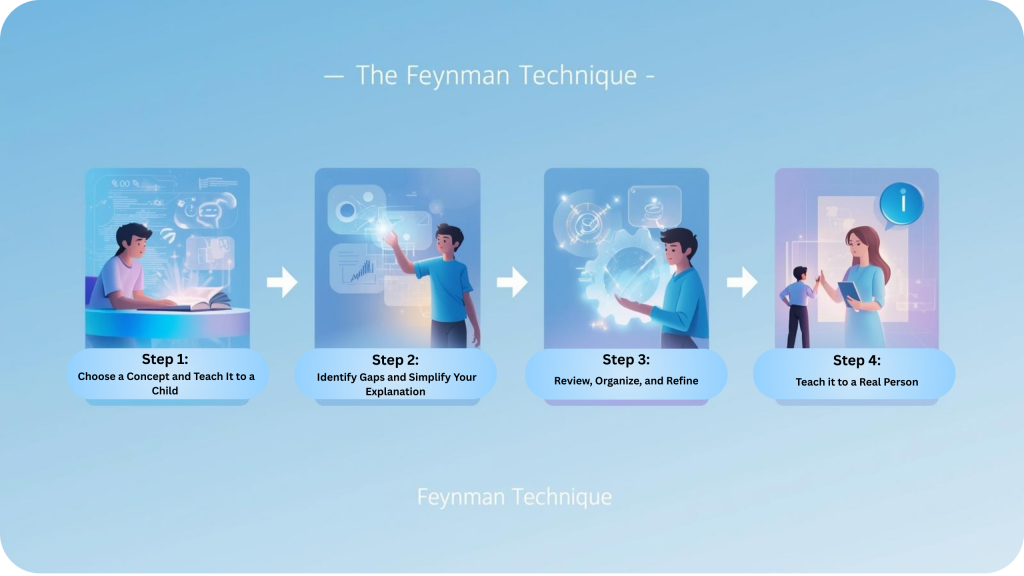
Explaining a concept out loud—to a friend, to a recording device, to an empty room—is a form of feedback. If your explanation is halting, vague, or full of jargon you can’t unpack, you’ve found a gap.
The Feynman Technique is built on this principle: if you can’t explain it simply, you don’t understand it well enough.
Turning Passive Content Into Active Feedback
The feedback gap isn’t just about problems you get stuck on. It’s also about the material you think you’ve learned but haven’t.
You read a chapter. You watch a lecture. You feel like you understood it. But how do you know?
Reading and watching are passive. They create the feeling of understanding without testing whether that understanding is real. To close the feedback gap, you need to turn passive content into active retrieval.
One way to do that is to generate questions from your own materials. If you have a chapter or a video to learn, you can turn it into a study set—lessons, flashcards, quizzes, and a concept map, all generated from your own material. The quizzes give you immediate feedback on what you know and don’t know. The flashcards force retrieval. The concept map shows you the structure of your understanding—and where the gaps are.
This is not about replacing the reading. It’s about testing the reading. You still read the chapter. You still watch the lecture. But now you have a way to find out whether it stuck.
The Planning Problem
There’s another gap that students rarely talk about: the gap between what you should study and what you actually study.
You know you have an exam in two weeks. You know there are five chapters to cover. But which one do you start with? How much time do you spend on each? How do you balance studying with your job, your commute, your life?
Most students default to studying what feels easiest or what they happen to be holding in their hand. They don’t have a system for prioritizing based on actual gaps.
One approach is to tell a tool what’s coming up and let it plan your week around your life. If you’re already using StudyWizardry, the planner can take your deadlines and your available time and generate a plan that tells you what to study when. The plan itself becomes feedback: it tells you what you’re spending time on, and whether that matches your actual gaps.
And when it’s time to study, a focus timer keeps you on track—one round at a time. Because the best feedback loop in the world doesn’t help if you never actually sit down to use it.
The Feedback Loop Across Devices
There’s one more thing that matters: consistency.
The feedback gap is hardest to close when your studying is fragmented. You study on your laptop between classes. You review on your phone at night. You read on your tablet on the weekend. If your tools don’t sync, your feedback loop breaks every time you switch devices.
StudyWizardry syncs across web, iOS, and Android. You can start a study session on your laptop, get stuck on a problem, close the tab, and pick up the same session on your phone later. The feedback loop doesn’t break when you move.
The Honest Truth
The most important question in studying is not “How much did I study?” It is “How do I know it’s working? “
If you can’t answer that question, you are studying blind. You might get lucky. You might already know the material. But you have no way of knowing whether you do.
Feedback is not a luxury. It is not a bonus feature of good learning. It is the mechanism by which learning happens at all.
The students who succeed are not the ones who study the most hours. They are the ones who close the feedback gap—who find out what they don’t know, and fix it before it’s too late.
Your next study session, try this: Before you start reviewing, close your notes and write down what you remember. Then check. The gaps you find are not failures. They are the most valuable information you have. They tell you exactly where to focus.
StudyWizardry. Start free at app.studywizardry.com.
📚
More from StudyWizardry
Closing the feedback gap is the first step. These guides will help you build the rest.
📄 Your Brain’s Delete Button—And How Active Recall Disables It!
Why retrieval practice is the foundation of durable learning.
📄 You Asked the Right Question. Now What? How to Turn AI Answers into Actual Learning
A 4-step framework for processing AI answers and building real understanding.
📄 Cognitive Surrender: Why Your Brain Is Giving Up (And How to Take Back Control)
The difference between using AI and surrendering to it—and how to stay in control.
✨ Three guides, one system: Learn to use AI without surrendering your thinking, turn answers into learning, and build understanding that sticks.
The feedback gap is the space between "I think I understand" and "I know I understand." It exists because most studying happens without any mechanism for checking whether your understanding is accurate. You read, highlight, and review—but you never test yourself, so you never find out what you don't know until it's too late.
Your brain confuses familiarity with knowledge. When you re-read material, it feels familiar—and that feeling of familiarity is interpreted as "I know this." But familiarity is recognition, not recall. You only discover the difference when you try to produce the answer without looking.
Ask yourself one question: "How do I know it's working?" If your answer is "because it feels familiar," you're studying blind. If your answer is "because I tested myself and got it right," you're closing the feedback gap.
StudyWizardry provides the feedback loop that solo studying lacks. It works in your browser, so you can drop in a photo of a problem and get a step-by-step explanation immediately. You can ask follow-up questions until the gap is closed. You can turn a chapter or video into a study set with quizzes that test your understanding. The planner helps you prioritize based on what you actually need to study. And everything syncs across web, iOS, and Android, so the feedback loop follows you.
No. The strategies for closing the feedback gap—self-testing, immediate feedback, explaining out loud—work with or without technology. Technology just makes them easier to apply consistently, especially when you're studying alone.
That's not failure. That's learning. Every time you get an answer wrong and then learn the correct answer, you're strengthening your memory more than if you had just studied the correct answer alone. The wrong answer creates a need; the correct answer fills it. That's how learning works.