
Three Ways to Learn Better: Blurting, Brain Dumping, and Teaching
You’ve probably tried “blurting” at some point. Maybe you saw it on a study blog, or a friend recommended it. You close the book, grab a blank page, and write down everything you remember.
It feels productive. It’s uncomfortable. And for some subjects, it works beautifully.
But for others? It wastes time.
Here’s the problem nobody talks about: “blurting,” “brain dumping,” and “learning by teaching” are often used interchangeably—but they’re not the same thing. They activate different cognitive processes, and they work best for different kinds of material.
Using the wrong one is like using a hammer to tighten a screw. The tool is fine. The application is wrong.
This article isn’t a protocol. It’s a decision guide. By the end, you’ll know which method fits your subject, and why.
The Common Thread (And Where It Breaks)
All three methods are forms of retrieval practice—producing information from memory rather than reviewing it. That’s the shared foundation. Decades of research show that retrieval strengthens memory far more than rereading.
But the type of retrieval matters. And the differences show up in what each method demands from your brain.
| Method | What you produce | Cognitive demand | Best for |
|---|---|---|---|
| Blurting | Everything you know about a topic, on paper | High (free recall) | Conceptual subjects, essay prep, exposing gaps |
| Brain dumping | A rapid, unstructured stream of associations | Medium (cued by flow) | Brainstorming, overcoming blank-page anxiety, starting momentum |
| Teaching (protégé effect) | An explanation for someone else | Very high (organization + retrieval + audience awareness) | Deep understanding, procedural subjects, exam defense |
Let’s break each one down.
Blurting: The Gap-Finder
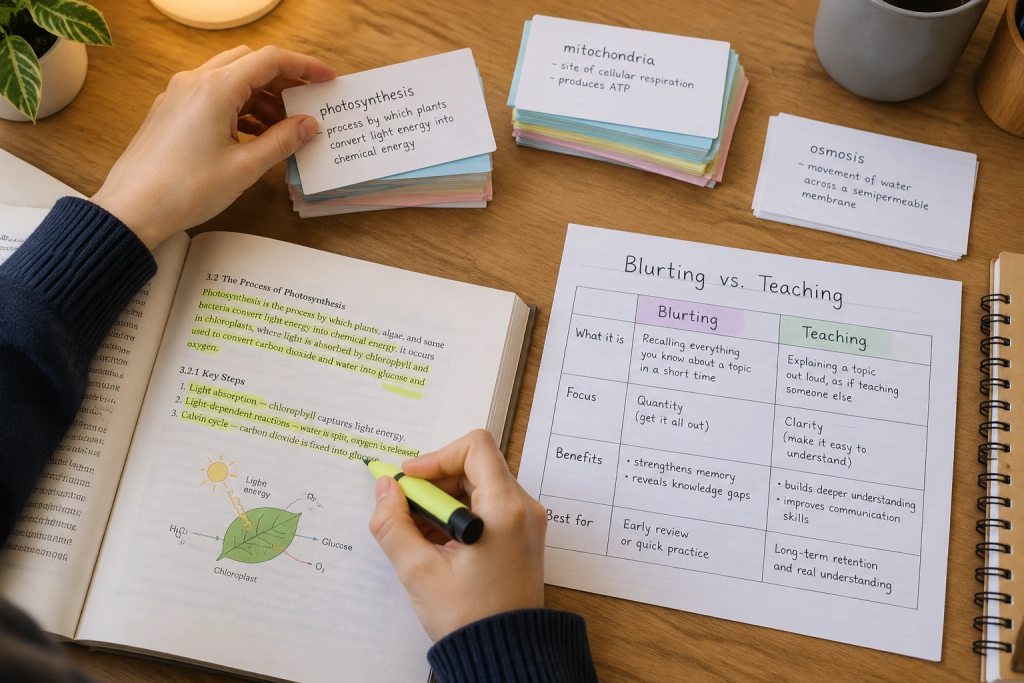
Blurting is free recall—writing everything you remember without cues. It’s the most demanding of the three, because you’re generating structure from nothing.
What it does well: It exposes gaps with brutal honesty. When you blurt a chapter on the Krebs cycle and realize you can’t remember the third enzyme, that gap is now visible. You know exactly what to study.
Where it falters: For highly structured or procedural subjects (math proofs, physics derivations, coding algorithms), blurting can produce a messy list of facts without the sequence that makes them useful. You might remember the formula but not when to apply it.
The verdict: Blurting is excellent for conceptual understanding and essay preparation. It’s less effective for subjects where order and application matter more than recall.
Brain Dumping: The Momentum Builder
Brain dumping is often confused with blurting, but it’s different in one key way: it’s less about testing yourself and more about clearing mental clutter.
A brain dump is unstructured by design. You write whatever comes to mind—questions, fragments, worries, half-ideas—without trying to retrieve a specific body of knowledge. The goal isn’t to measure what you know. It’s to get everything out of your head so you can see it.
Brain dumping is often described as a mental clearing exercise—a way to externalize scattered thoughts so you can focus on what matters.
What it does well: It reduces cognitive load. If you’re anxious or overwhelmed, a brain dump gets the noise out of the way so you can actually focus.
Where it falters: It doesn’t test retrieval the way blurting does. You’re not forcing your brain to produce specific information from memory—you’re just externalizing whatever is already there.
The verdict: Brain dumping is a pre-study tool, not a retrieval test. Use it when you’re scattered. Use blurting when you need to find out what you actually know.
Teaching (The Protégé Effect): The Deepest Retrieval
Teaching—or even preparing to teach—is a different beast entirely.
When you explain a concept to someone else, you’re not just retrieving information. You’re organizing it, sequencing it, and adapting it to another person’s understanding. That’s a much heavier cognitive load than blurting.
The protégé effect describes the finding that students who prepare to teach learn more than students who study for themselves. The act of organizing material for someone else forces you to confront gaps you didn’t know existed.
Research on peer teaching in health professions education suggests that near-peer teaching can be as effective as faculty teaching for knowledge outcomes, and particularly effective for building procedural skills. There is also evidence that tutors benefit—strengthening their own teaching, communication, and clinical skills through the act of explaining material to others.
What it does well: It builds deep, flexible understanding. You can’t teach something you only half-know. The preparation process reveals gaps and forces you to resolve them.
Where it falters: It’s time-intensive. You can’t teach every topic. And for pure factual recall (dates, vocabulary, formulas), the overhead of preparing a “lesson” may not be worth it.
The verdict: Teaching is the gold standard for deep understanding. It’s overkill for simple memorization, but indispensable for subjects where you need to explain, defend, or apply knowledge.
A Simple Decision Framework
Here’s how to choose.
If the subject is conceptual and essay-based (history, philosophy, literature, biology):
→ Blurting. You need to know what you can argue, not just what you can list.
If you’re overwhelmed and can’t start (any subject):
→ Brain dump. Clear the mental clutter first. Then study.
If the subject is procedural or explanatory (math, physics, chemistry, coding, medicine):
→ Teaching. Walk through the steps out loud. Explain why each step matters. If you can’t, you don’t understand it yet.
If you’re preparing for a viva or oral exam (any subject):
→ Teaching. The exam is a teaching performance. Practice the performance.
If you’re short on time and need to find gaps fast (any subject):
→ Blurting. It’s the fastest way to see what’s missing.

Where StudyWizardry Fits
Each of these methods produces a different kind of output—and each output can feed into your study system.
After a blurt, you have a list of gaps. The Quiz Generator can turn those gaps into targeted questions. Flashcards can lock in the facts you missed.
After a brain dump, you have a list of what’s on your mind. The Study Planner can help you turn that scattered list into a structured plan.
After a teaching session, you have an explanation. The AI Note Maker can organize it into a permanent resource. And if your explanation revealed a concept you still can’t explain, the Homework Solver can walk through it step by step—so you can teach it better next time.
The principle is consistent: retrieval belongs to you. The tools handle the logistics.
The Honest Truth
All three methods work. But they don’t work the same way, and they don’t work for the same things.
Blurting is a diagnostic tool. It shows you what’s missing.
Brain dumping is a clearing tool. It makes space for focus.
Teaching is a mastery tool. It builds understanding that lasts.
The students who learn most effectively aren’t the ones who use the most techniques. They’re the ones who match the technique to the task.
Your next study session, try this: Before you start, ask yourself one question: “Am I trying to find gaps, clear my head, or build deep understanding?”
Then pick the method that fits.
📚
More from StudyWizardry
Blurting is one retrieval method. Here’s the full picture.
📄 Stop Highlighting. Start Blurting. (A Cognitive Science Approach to Reliable Recall)
The complete six-phase protocol for using blurting to expose gaps and build durable memory.
📄 The Protégé Effect: Why Teaching Is the Fastest Way to Learn
How preparing to teach forces you to organize, retrieve, and deepen your understanding.
📄 Your Brain’s Delete Button—And How Active Recall Disables It!
Why retrieval practice is the foundation of durable learning—and how it works.
✨ Three guides, one system: Match the retrieval method to the task, then use the right tool to close the gaps.
Blurting is a retrieval test—you're forcing your brain to produce specific information from memory. Brain dumping is a mental clearing exercise—you're externalizing whatever is on your mind to reduce cognitive load. Blurting finds gaps. Brain dumping makes space.
For deep understanding, yes. The protégé effect shows that preparing to teach forces you to organize and sequence information, which reveals gaps that simple recall might miss. But teaching is time-intensive, so it's best reserved for subjects where explanation and application matter most.
Ask yourself what you're trying to accomplish. Finding gaps? Blurt. Clearing your head? Brain dump. Building deep, flexible understanding? Teach.
Absolutely. A brain dump before studying clears the noise. A blurt after studying reveals gaps. Teaching before an exam tests whether you can explain what you know. They work best in sequence, not in isolation.
Yes. The Quiz Generator and Flashcards help close gaps found through blurting. The Study Planner can turn a brain dump into a structured plan. The AI Note Maker and Homework Solver support the preparation that teaching requires.