The Two-Pass Note Method: How to Turn Your Notes Into Real Learning
You finish a lecture with three pages of notes. They’re neat. They’re organized. They cover everything the professor said.
Then, three weeks later, you open those same notes to study for the exam—and they might as well be written in a foreign language. You recognize the words. You remember writing them. But the meaning is gone.
You didn’t take bad notes. You took notes that were designed for recording, not for learning.
There’s a difference. And once you understand it, everything changes.
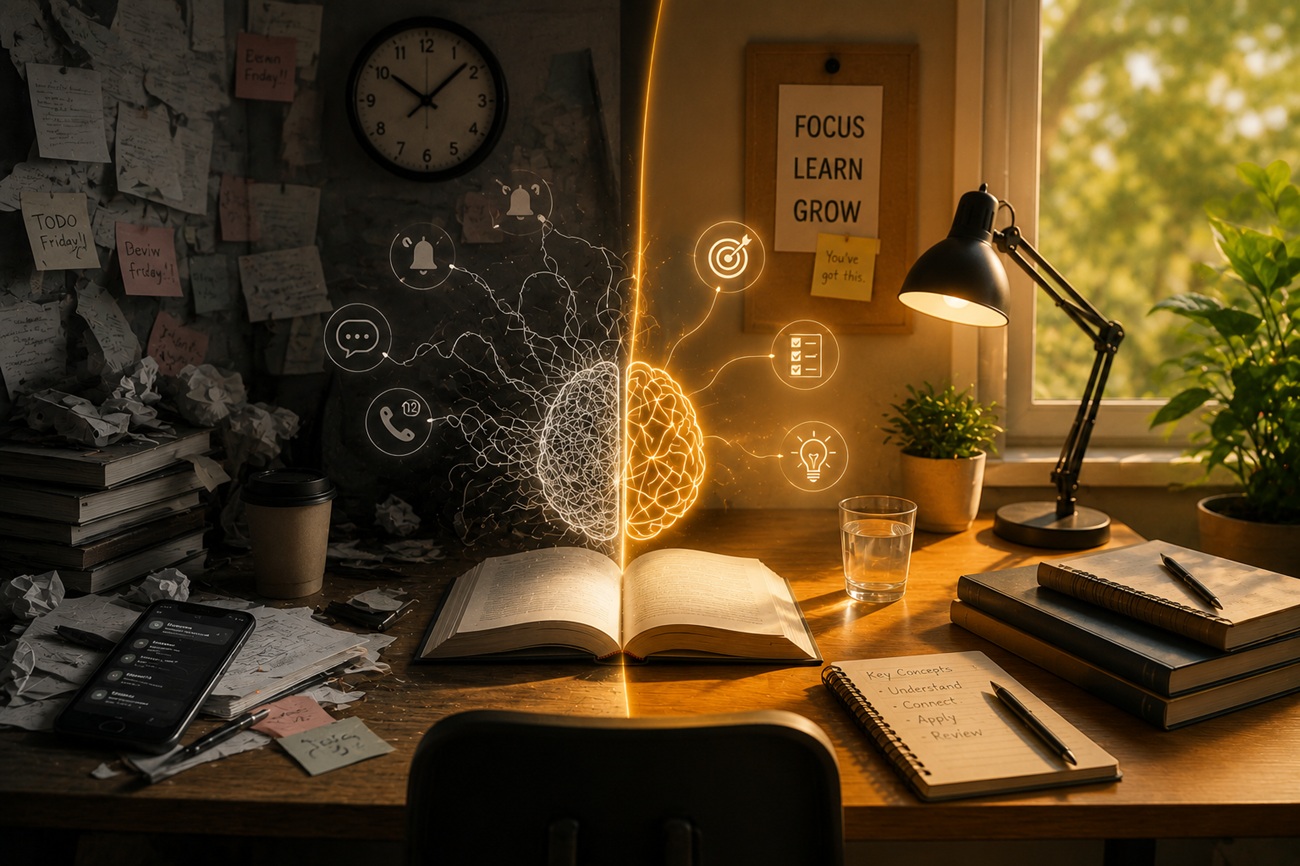
The Note-Taking Paradox
Here’s the uncomfortable truth about notes: the act of taking them can either deepen your understanding or replace it entirely. It depends entirely on what your brain is doing while your hand is moving.
When you’re in a lecture, your brain is juggling multiple tasks at once: listening, understanding, selecting what matters, and writing it down. Under time pressure, most students make a subconscious trade-off. They prioritize capture over comprehension. They transcribe what the professor says, verbatim, because it feels safer than risking a missed point.
The result is notes that are complete but cognitively hollow. You recorded the information without ever processing it. And information that isn’t processed during encoding is information that won’t be retrievable later.
This is the note-taking paradox: the more you focus on capturing everything, the less you actually learn.
Why AI Changes the Equation—But Only If You Let It
This is where AI tools enter the picture. And this is where most students use them wrong.
The instinctive move is to let AI take the notes for you. Record the lecture, upload the transcript, get a summary. Problem solved, right?
Not quite.
Research on AI-assisted note-taking reveals something more nuanced. A 2026 study with graduate students found that AI tools do reduce the transcription burden—they can handle the mechanical work of capturing spoken words and organizing them into text. But the study also warned that “excessive automation may encourage overreliance and reduce learner participation” .
In other words: AI can free up your cognitive resources. But if you don’t use those freed-up resources for active processing, you’ve simply replaced one passive activity (transcribing) with another (reading AI-generated notes).
The key is a hybrid approach—one where AI handles the mechanical work, and you handle the cognitive work.
The Two-Pass Method: A Hybrid Note-Taking Workflow
Here’s a structured system for taking notes that actually work. It’s called the Two-Pass Method, and it separates the capture phase from the processing phase—using AI to support the first and your own brain to drive the second.
Pass 1: Capture (AI-Assisted)
Goal: Get the raw material without drowning in transcription.
What to do:
-
During the lecture or while reading, use a recording tool or your phone’s voice memo to capture the audio.
-
If you’re reading a PDF or textbook chapter, upload it directly.
-
Take minimal handwritten notes—just enough to mark moments that felt confusing, important, or surprising.
What AI does:
-
Transcribes the audio into text.
-
Organizes the text into a structured document with headings and key points.
-
Extracts definitions, formulas, and concepts.
-
Produces a clean, readable summary.
What you’re doing:
-
Listening actively. Following the argument. Noticing where you get lost.
-
Marking moments that need more attention later.
Why this works: A 2026 randomized experiment with 405 secondary school students found that note-taking combined with AI use produced “significant positive effects on retention and comprehension compared to using the AI alone” . The students who benefited most weren’t the ones who let AI do everything. They were the ones who combined AI support with their own cognitive engagement.
Pass 2: Process (Human-Driven)
Goal: Transform the captured material into knowledge you actually own.
This is the step most students skip. Don’t skip it.
Step 1: The Gap Audit (10 minutes)
Open the AI-generated notes. Read through them once. As you read, ask yourself: “Did I understand this during the lecture? Or is this the first time I’m actually thinking about it?”
Mark every section where the answer is the second one. Those are your gaps. Those are where the real learning needs to happen.
Step 2: The Reconstruction (15 minutes)
Close the AI notes. Take a blank sheet of paper. Write down everything you can remember from the lecture, in your own words. Don’t organize it yet. Just get it out.
Then, open the AI notes and compare. What did you miss? What did you get wrong? What did you remember that the AI didn’t capture?
The gaps between your reconstruction and the AI notes are your actual study plan.
Step 3: The Question Conversion (10 minutes)
This is where notes become learning tools.
For every major concept in your notes, write a question that would test whether you understand it. Not a factual question (“What year did X happen?”)—a conceptual one (“Why did X happen? How does X connect to Y?”).
These questions become the foundation for active recall practice.
Step 4: The Compression (5 minutes)
Take your notes and reduce them by 50%. Then reduce them again by 50%.
What’s left? The core ideas. The essential structure. This compressed version becomes your “master summary”—the thing you review before the exam when you don’t have time to go through everything.
Why this works: The act of reconstructing, questioning, and compressing forces your brain to do the cognitive work that AI cannot do for you. You’re not just reviewing information—you’re rebuilding it from scratch.
What the Research Says About AI-Assisted Note-Taking
The evidence on hybrid note-taking is still emerging, but the patterns are consistent.
A 2026 study on video-based STEM learning found that “learner-AI-notetaking”—where the student actively interacts with AI-generated notes—was significantly more effective than either learner-only or AI-only note-taking. The researchers found that this hybrid approach increased attention to the note area, improved note quality, and enhanced “self-paced learning sequences, particularly in the organization and integration of multiple sources of information” .
The key phrase here is “learner-AI-notetaking.” It’s not AI taking notes for you. It’s you and AI working together—each doing what you do best.
How StudyWizardry Supports the Two-Pass Method
StudyWizardry‘s tools are designed to support each phase of the Two-Pass Method without replacing your cognitive engagement.
| Phase | Tool | What It Does |
|---|---|---|
| Capture | AI Note Maker | Transforms lecture recordings, PDFs, and notes into structured, organized content—so you’re not drowning in transcription |
| Gap Audit | Quiz Generator | Creates questions from your notes so you can immediately test whether you actually understood the material |
| Reconstruction | Flashcards | Turns your key concepts into active recall practice—forcing you to retrieve, not just recognize |
| Question Conversion | Quiz Generator | Generates conceptual questions from your notes, giving you a ready-made practice test |
| Compression | AI Note Maker | Helps you distill your notes into a master summary by identifying core ideas and key structures |
The goal isn’t to automate your learning. It’s to automate the logistics—so you have more cognitive energy for the thinking.
The One Rule That Makes This Work
If you take nothing else from this article, take this:
Never let AI be the last step.
AI can capture, organize, and summarize. But it cannot understand for you. The moment you close your notes and move on—without reconstructing, questioning, and compressing—you’ve turned a learning opportunity into a filing exercise.
The students who benefit most from AI note-taking aren’t the ones who use it the most. They’re the ones who use it first—and then do the cognitive work themselves.
The Honest Truth
Your notes aren’t failing you. You’re failing your notes.
You’re treating them as a record of what was said, instead of a tool for what you need to learn. You’re capturing information without processing it. You’re organizing it without understanding it.
AI can help with the capture and the organization. It can transcribe, summarize, and structure. But it cannot do the one thing that actually matters: make you think.
Your next lecture, try this: Record the audio (or upload the materials). Take minimal handwritten notes—just enough to mark what’s confusing. Afterward, open the AI-generated summary. Read it once. Then close it. Take a blank sheet of paper. Write down everything you remember. Then check your gaps.
You might be surprised at how much more you learn when you stop trying to capture everything—and start trying to understand something.
Your notes are raw material. Your brain is the machine. AI is just the conveyor belt.
📚
More from StudyWizardry
Mastering note-taking is one piece of the puzzle. Explore these guides to build a complete learning system.
📄 Your Notes Are Raw Material—Here’s How to Process Them Into Knowledge
A three-step system for turning passive notes into active knowledge.
📄 The 10-Minute Pre-Read: The Fastest Way to Understand Any Textbook Chapter
How to preview material before diving in—so your notes capture what actually matters.
📄 The Note Concept: Why Your Brain Needs More Than Just Notes
Why organized notes aren’t enough—and what your brain actually needs.
✨ Three guides, one system: Learn to pre-read, process your notes, and build the conceptual understanding that makes learning stick.
Capturing is recording what was said. Processing is transforming that record into understanding. Most students stop at capturing—they transcribe the lecture, organize the notes, and call it done. But processing is where the actual learning happens: reconstructing from memory, asking questions, and compressing the material into core ideas.
No. Using AI to transcribe, organize, and summarize your lecture material is no more cheating than using a calculator for math. The question is whether you're using the tool to support your learning or to replace it. The Two-Pass Method is designed to keep you in the cognitive driver's seat.
The processing phase should take about 30–40 minutes per lecture or reading. That sounds like a lot, but it's far less time than you'd spend re-reading your notes multiple times before an exam—and it's far more effective.
StudyWizardry's AI Note Maker handles the capture phase—transforming recordings, PDFs, and notes into structured content. The Quiz Generator supports the processing phase by creating questions from your notes. And the Flashcards turn your key concepts into active recall practice.
Even 10 minutes of processing is better than none. Do the Gap Audit—read through the AI notes and mark where you're confused. That alone will tell you where to focus your study time.
Absolutely. Upload the PDF or take photos of the textbook pages. The AI Note Maker will extract the key concepts. Then run through the same processing steps: reconstruct, question, compress.