
Interleaving Study Technique: Why Mixing Topics Helps You Learn Better
You’re studying for your math final. You spend an hour on quadratic equations, grinding through problem after problem. You get the hang of it. You move on to derivatives. Another hour. You feel good. You’re making progress.
Then comes the exam. The questions are all mixed up. You stare at a problem that looks like quadratics, but wait—is it derivatives? Your brain freezes. You know this. You practiced it. But in this messy, mixed-up context, you can’t figure out which tool to use.
You just experienced the difference between blocked practice and interleaving—and it might be the reason your grades don’t reflect how much you studied.
What Is Interleaving?
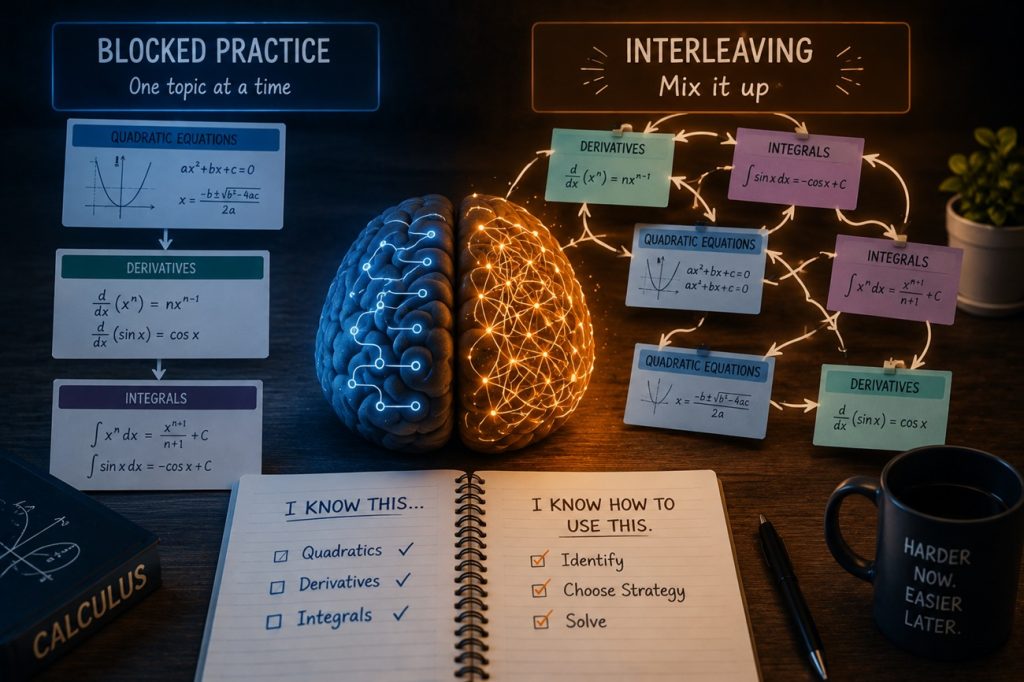
Interleaving is a learning strategy that involves mixing different topics, problem types, or concepts within a single study session, rather than focusing on just one thing at a time.
The opposite is blocking—studying one topic exclusively until you “master” it, then moving to the next.
Here’s what that looks like in practice:
| Blocked Practice | Interleaved Practice |
|---|---|
| 60 minutes: Quadratic equations | 60 minutes: Mix of quadratics, derivatives, and integrals |
| 60 minutes: Derivatives | Switch problems every few minutes |
| 60 minutes: Integrals | Topics are mixed and shuffled |
Most students default to blocked practice because it feels more productive. You see progress. You get better at each individual skill. But feeling productive isn’t the same as being productive.
The Science: Why Mixing It Up Works
The research on interleaving is surprisingly clear. One influential study found that students who practiced mixed sets of math problems performed substantially better on a later test than students who practiced the same problems in blocked sets. In one influential math study, interleaved practice produced a test-performance advantage of more than 40% over blocked practice.
A 2024 study published in npj Science of Learning found that students who engaged in more interleaved practice showed better classification performance, including in a delayed-transfer task.
Research across multiple subjects—including math, science, English, art, and foreign languages—has consistently shown similar results.
So why does interleaving work so well?
According to cognitive scientists, interleaving works through three main mechanisms:
1. Improved Discrimination
When you study topics separately, you learn to recognize patterns for each one. But when they’re mixed together, you’re forced to distinguish between them. This is the core skill exams test: Which approach fits this problem?
2. Frequent Retrieval
Switching between topics requires you to continually pull information from memory. This effortful recall strengthens memory and highlights gaps in your understanding. You can’t coast on familiarity.
3. More Cognitive Effort
Interleaving is harder. It feels more difficult. But that difficulty is exactly what makes it work. These are what psychologists call “desirable difficulties”—learning conditions that slow down immediate performance but enhance long-term learning and transfer.
💡 What this means for you: If it feels harder, you’re probably doing it right. The struggle is the learning.
Why Your Brain Lies to You
When you solve five quadratic equations in a row, the fifth one feels easier than the first. That’s satisfying—but it can be misleading.
You’ve just practiced the same procedure repeatedly, so your brain already knows what kind of problem it’s looking at. On an exam, that helpful label disappears. You have to identify the problem type before you can choose the right strategy.
Interleaving removes that artificial advantage.
Every new question forces you to ask: What am I looking at? Which method applies here? Why?
That’s what exams actually require. And it’s exactly the kind of thinking interleaving is designed to strengthen.
How to Actually Use Interleaving
Here are practical ways to apply interleaving to your studies:
1. Shuffle Your Homework Problems
Instead of doing all the problems from one section, then all from the next section, mix them up. Do problem 1 from section A, then problem 5 from section C, then problem 3 from section B.
2. Review Current and Previous Material Together
When you’re studying a new topic, don’t just focus on what you’re learning right now. Include questions from topics you covered weeks ago. This is also called spaced retrieval, and it works wonderfully with interleaving.
3. Use the “Compare and Contrast” Question
While you’re studying, ask yourself: “What’s the difference between concept A and concept B?” or “What have we already covered that this idea reminds me of?”. Draw explicit attention to contrasts and comparisons.
4. Start with Two or Three Related Topics
Start with two or three related topics. Once you get comfortable identifying which strategy each problem requires, you can gradually expand the mix.
5. Explain Why You’re Doing This to Yourself
Frame interleaving as a positive challenge—an interesting way to go back and forth between different types of questions rather than doing the same thing over and over. Interleaving reveals to you the possible confusions you might have and gives you the type of practice that better matches exams and real life.

Common Mistakes and How to Avoid Them
Even great study strategies can backfire if applied the wrong way. Here are the most common pitfalls—and how to avoid them.
| ❌ Mistake | ✅ Fix |
|---|---|
| Switching between completely unrelated subjects (e.g., math and French) | Switch between similar but distinct topics (e.g., quadratics and derivatives) |
| Interleaving too many topics at once |
Start with 2–3 related topics and expand as you become more comfortable. |
| Only using interleaving for “hard” subjects | Use it beyond math—but adapt it to the subject. Interleaving is especially useful when you need to distinguish between similar concepts, problem types, or strategies. |
| Not explaining the method to yourself | Understand why you’re studying this way—it makes the effort feel purposeful |
| Giving up because it feels harder | The difficulty is the point. Stick with it |
The Honest Truth
Interleaving feels wrong. It feels less productive. You’ll make more mistakes. You’ll feel less confident. And that’s exactly why it works.
Blocked practice gives you the illusion of mastery. You get good at recognizing patterns for one specific type of problem. But exams don’t group problems by topic. Life doesn’t group challenges by category. The real world is interleaved.
The students who succeed aren’t the ones who study the most hours. They’re the ones who study the right way. They use interleaving. They embrace the discomfort. And they perform better when it counts.
Your next study session, try this: Instead of doing all your math problems from one section, mix them up. Include some from last week’s material. Ask yourself the compare-and-contrast question. Feel the difficulty. And trust that this struggle is building something that lasts.
Mix it up. Learn better. Remember longer.
📚
More from StudyWizardry
Interleaving is part of a family of evidence-based study techniques. Explore these guides to build a complete learning system.
📄 Stop Highlighting. Start Blurting.
How free recall exposes your knowledge gaps—and why that’s the best thing that can happen.
📄 Your Brain’s Delete Button—And How Active Recall Disables It!
Why retrieval practice is the foundation of durable learning.
📄 3 Best AI Study Tools to Supercharge Active Recall and Spaced Repetition
How AI tools automate the logistics of evidence-based learning—so you can focus on what matters.
✨ Three techniques, one integrated system: Interleaving to mix it up, blurting to find gaps, and active recall to make it permanent.
They're completely different. Multitasking is trying to do two things at once (which doesn't work). Interleaving is switching between focused study of different topics in a single session—one thing at a time, just mixed up.
One influential math study found that students using interleaved practice performed more than 40% better on a later test than students using blocked practice. That result came from a specific study and shouldn't be interpreted as a universal 40% improvement. Other studies have found benefits from interleaving, but the size of the effect varies by subject, task, and study design.
Research has examined interleaving across a range of subjects and learning tasks, with particularly strong evidence in areas where learners must distinguish between similar concepts, categories, or problem-solving strategies. For example, mixing up vocabulary words from different categories, or alternating between analyzing different types of texts. It's especially useful when you need to distinguish between similar concepts, problem types, or strategies.
Because it requires your brain to work harder. With blocked practice, you're using the same strategy repeatedly—it becomes automatic. With interleaving, you have to constantly stop and think: "Which approach fits this problem?" This effortful processing is exactly what builds stronger memory.
Absolutely. Interleaving works well with active recall, spaced repetition, and retrieval practice. In fact, switching between topics naturally forces you to retrieve information from memory, which is the foundation of active recall.
StudyWizardry's Quiz Generator can create mixed practice tests from your materials. The Flashcards feature lets you shuffle decks so you're reviewing different concepts in random order. And the Study Planner can help you schedule your study sessions to include interleaved practice.