The Anxiety Loop: How Getting Stuck on Homework Triggers a Chain Reaction (And How to Break It)
You’re staring at a problem. A single problem. On a page that, five minutes ago, seemed perfectly manageable.
Now it’s a wall.
You’ve read it three times. You understand the words individually. You know you’ve seen something like this before. But your brain—your usually reliable, high‑functioning brain—has gone silent. It’s not refusing to work. It’s refusing to engage.
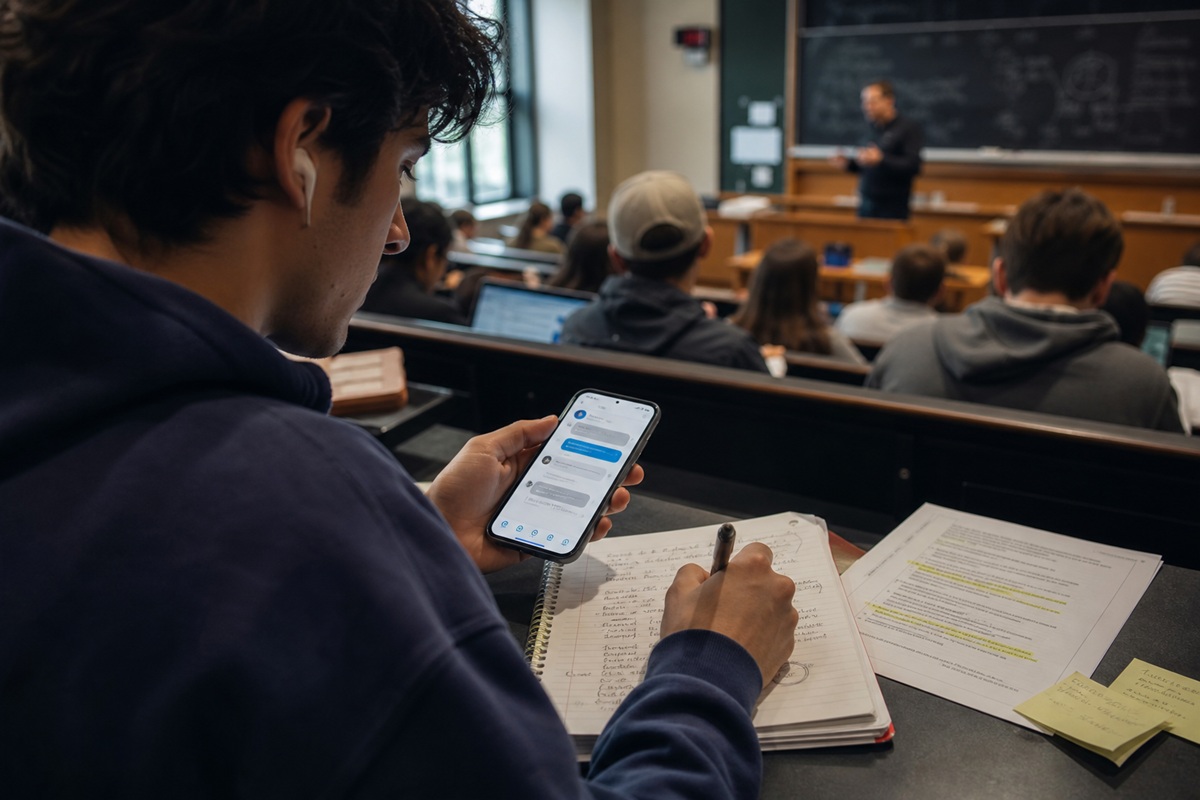
Your chest tightens slightly. Your eyes drift. You reach for your phone, open a tab, scroll. Anything to escape the growing pressure behind your eyes.
Forty minutes later, you’ve accomplished nothing. The problem is still there. Your anxiety has grown. And the part that hurts most? You know you could solve this if you could just start.
Here’s the truth: this isn’t a weakness. It’s a predictable, well‑documented, and entirely breakable psychological chain reaction. And once you understand how it works, you can stop fighting it—and start using it.
🧠 Part 1: The Hidden Cost of Getting Stuck
When you’re stuck on a problem, two things happen simultaneously. First, your brain experiences cognitive load—the mental effort required to process information and solve problems. Second, your body triggers a stress response: increased heart rate, shallow breathing, a surge of cortisol.
In healthy learning, this is manageable. But for many students, the stress response spirals. The anxiety becomes the obstacle, not the problem itself. Anxious thoughts consume short-term memory, preventing complete focus on the task at hand. Your cognitive capacity drops exactly when you need it most.
Research confirms that psychological stress directly influences the level of cognitive load among college students. When you’re stressed, your working memory is compromised. When your working memory is compromised, problem-solving becomes harder. When problem-solving becomes harder, stress increases.
A 2025 study of 557 college students, published in the journal Acta Psychologica, formally confirmed what many students already feel: psychological stress doesn’t just affect academic performance directly—it significantly damages learning through a specific mechanism. This pathway begins with increased cognitive load, which then leads to reduced academic performance (Hu et al., 2023).
In other words, the research validates exactly what you’re describing. When academic stress rises, so does cognitive load. And when cognitive load is high, learning suffers. This isn’t just speculation—it’s a documented psychological mechanism with real implications for how students study and perform.

🔄 Part 2: The Chain Reaction
Let’s map the chain reaction:
| Stage | What Happens | Cognitive Impact |
|---|---|---|
| 1. Encounter | You face a problem you can’t immediately solve | Cognitive load increases |
| 2. Stress activation | Your body releases cortisol and adrenaline | Working memory capacity decreases |
| 3. Avoidance impulse | Your brain seeks escape (phone, other tabs, any distraction) | Problem-solving is deprioritized |
| 4. Reinforcement | You avoid the problem, anxiety subsides temporarily | Avoidance behavior is strengthened |
| 5. Return | You come back to the problem—but now it’s more threatening | Cognitive load is even higher |
Research shows that students who experience high math anxiety are significantly more likely to skip problems entirely and less likely to seek help when they make errors. The same pattern appears across subjects. When students are anxious, they avoid effortful study strategies and deprioritize difficult problem-solving.
This avoidance is reinforced every time it works—every time you pick up your phone and the anxiety subsides, your brain learns that avoidance is a solution. But it’s not a solution. It’s a delay that makes the problem harder when you return.
The cycle deepens. Homework anxiety is a genuine phenomenon, with 83.3% of students in one survey reporting that homework created stress—more than any other academic, financial, or personal factor. And academic stress, in turn, is associated with reduced cognitive performance, increased depression and anxiety, and disrupted sleep.
🛑 Part 3: Breaking the Loop
The chain reaction is predictable. And predictable cycles are breakable.
The Right Kind of Help
A 2023 study found that highly math-anxious students who were encouraged to incorporate self-testing and overcome avoidant behaviors showed significant improvement in both academic performance and anxiety symptoms. The key wasn’t just solving problems—it was changing the relationship to problem-solving.
When you get stuck on a homework problem, the goal shouldn’t be to get the answer at any cost. It should be to understand the path—to see the chain of reasoning that leads from the starting point to the solution. This is where a tool like StudyWizardry’s Homework Solver makes a genuine difference: it provides step-by-step breakdowns that show the reasoning, not just the result.
Research on academic procrastination confirms that homework emotion—particularly the negative emotions of anxiety and boredom—has the greatest impact on student procrastination. When you replace negative emotion with a clear, manageable process, the avoidance impulse weakens.

Reduce Cognitive Load
Cognitive load theory distinguishes between different types of mental effort. When you’re stuck on a problem, you’re dealing with high intrinsic load (the inherent difficulty of the material). Adding extraneous load—uncertainty about which method to use, not understanding a prerequisite concept, not knowing if you’re on the right track—makes the problem much harder than it needs to be.
Removing extraneous load is one of the most effective ways to reduce academic stress. When students see a clear, structured solution pathway, their cognitive load decreases, and their ability to focus and learn increases.
Shift the Frame
Research on the appraisal-anxiety-avoidance model shows that students who view challenges as opportunities rather than threats are less likely to procrastinate. The same problem can be framed as “this is impossible” or “this is a puzzle I haven’t solved yet.” The latter is more honest—and more productive.
📊 Part 4: What Breaking the Cycle Looks Like
Here’s how the same student experience can unfold differently with the right support:
| Traditional Experience | With Step-by-Step Support |
|---|---|
| Stuck on problem. Feeling of dread. | Stuck on problem. Clear pathway available. |
| Avoidance (phone, other tabs). | Engagement with the first step. |
| Returning later with more anxiety. | Completing the first step. |
| Rushed, incomplete, or copied work. | Building momentum, understanding the logic. |
| Reinforcement of avoidance. | Reinforcement of persistence. |
The distinction is subtle but powerful. The problem hasn’t changed. What’s changed is the student’s experience of the problem—and their ability to work through it.
🎯 The Honest Truth
Here’s what research confirms: anxiety and learning are incompatible.
When you’re stuck and anxious, your brain’s resources are split between solving the problem and managing the stress. Some of your working memory is occupied by anxious thoughts, not by the task itself. You’re effectively trying to learn with a handicap.
The solution isn’t to eliminate difficulty—difficulty is essential for learning. The solution is to reduce the ambiguity that fuels anxiety. When you can see a clear path forward, the anxiety recedes and the learning can begin.
Step-by-step explanations don’t replace thinking. They replace the paralysis that happens when you don’t know where to start. They turn a wall into a staircase.
Your next study session, try this: When you’re stuck on a problem for more than five minutes, stop grinding. Look for a step-by-step breakdown of the solution—not to copy it, but to understand the logic. Then close the solution and try it yourself. The goal is to see the path, not to skip the walk.
📚
More from StudyWizardry
📄 The Practice Exam Trap: Why Most Students Waste Their Best Study Tool
How to use practice tests to reduce test anxiety—not increase it.
📄 The Forgetting Curve Is Not Your Enemy. It’s Your Best Teacher.
Why spaced repetition reduces the anxiety of forgetting.
📄 How to Stop Feeling Like a Failure When You Have 4 Exams and No Time to Study
A crisis protocol that breaks the stress cycle before it starts.
✨ Anxiety and learning don’t mix. But clarity and learning do. Let StudyWizardry‘s step-by-step Homework Solver clear the path so you can focus on understanding—not on the fear of being stuck.
Only if you skip the thinking. The goal of a step-by-step explanation is to show you the reasoning so you can internalize it. You still have to understand the logic. You still have to practice similar problems. The solver is a teacher, not a crutch.
Anxiety thrives on uncertainty. When you don't know the first step, your brain interprets the situation as threatening. A clear, structured pathway reduces that uncertainty, which reduces the stress response. You can then engage with the material from a calmer, more receptive state.
This is common. Research shows that highly anxious students are less likely to seek help, which perpetuates the cycle of poor performance. Start with tools that don't require direct human interaction. A step-by-step solver is a low-stakes way to get unstuck without the social anxiety of asking someone in person.
Yes. The pattern—uncertainty → stress → avoidance → more stress—appears across subjects. The specific content changes; the cognitive mechanism doesn't. Step-by-step reasoning works for chemistry, physics, economics, and any subject that involves problem-solving.
That's normal, especially if you've been stuck for a while. Take a break—a real one, not a phone break. Walk away for five minutes. Breathe. Then return. The solver will still be there, and the problem will be more approachable with a calmer mind.