
How to Build a Study Space That Actually Works (Without Spending Money)
Your desk is a disaster. Empty coffee cups. Random sticky notes. A textbook open to a page you don’t remember reading. Your phone is face-up, vibrating every few minutes. The overhead light is buzzing. And you’ve been “studying” for an hour but haven’t retained a single thing.
You blame yourself. You think you’re lazy. You think you lack discipline.
But here’s the truth most students don’t realize: your environment is working against you.
Why Your Study Space Matters More Than You Think
Your brain is wired to respond to your surroundings. Every object, every color, every sound tells your brain what mode to be in. A messy desk tells your brain: “We’re in chaos mode.” A dimly lit room tells your brain: “Time to sleep.” A phone next to your hand tells your brain: “Stay distracted.”
The problem isn’t willpower. It’s that you’re asking your brain to focus in an environment designed for distraction.
Here’s what happens when you study in the wrong environment:
-
Your working memory shrinks. A cluttered space competes for your attention, even when you’re not looking at it.
-
Your stress levels rise. Visual chaos triggers your brain’s stress response.
-
Your focus fractures. Every distraction—even a quick glance at your phone—takes 23 minutes to recover from.
-
Your motivation drops. An uncomfortable space literally makes you want to leave.
And the best part? You can fix all of this today. Without spending a dollar.

The 5 Biggest Mistakes Students Make With Their Study Space
Before we fix things, let’s identify what’s probably going wrong.
❌ Mistake 1: Studying Where You Sleep
Your bed is for sleeping. Your desk is for studying. When you blur this line, your brain gets confused. You lie down to study and suddenly feel tired. You sit at your desk to relax and feel restless.
The fix: If you have to study in your bedroom, create a clear separation. Use a desk. Never study in bed. Your brain needs the signal: “This is work mode.”
❌ Mistake 2: Face-Up Phone
Your phone is the single biggest threat to your focus. Even if you don’t check it, just knowing it’s there reduces your cognitive capacity.
The fix: Phone face-down. Or better: phone in another room. Or even better: phone on Do Not Disturb.
❌ Mistake 3: Overhead Lighting Only
Harsh overhead lights cause eye strain and fatigue. They make you feel like you’re in an office—but not in a good way.
The fix: Use a desk lamp with warm light. If you can’t, position your study setup near a window.
❌ Mistake 4: Cluttered Desk
Every item on your desk that isn’t related to what you’re studying is a visual distraction. Even if you’re not looking at it, your brain is processing it.
The fix: Clear your desk. Only keep what you need for this session. Put everything else in a drawer or another room.
❌ Mistake 5: Wrong Temperature
Too hot? You feel sluggish. Too cold? You can’t focus. Both kill your ability to study effectively.
The fix: Aim for 20-22°C (68-72°F). If you can’t control the temperature, dress in layers.
One Important Caveat: This Isn’t a One‑Size‑Fits‑All Rule
The advice in this article is backed by research—but research also shows that not everyone responds the same way to their study environment.
- 🔍 Some people think better in messier spaces. Early studies (e.g., Vohs, 2013) found that disorderly environments can actually boost creativity—though a larger follow‑up study didn’t replicate that effect. The jury is still out, but individual differences clearly exist.
- 🧠 Order helps with the “big picture”—disorder can sharpen focus on details. Research suggests that neat environments encourage global processing (seeing the forest), while messy ones can trigger local processing (seeing the trees). Neither is better—they just suit different tasks.
- 💪 Your working memory capacity changes the game. People with higher working memory are often less distracted by clutter or background noise. If you’re one of them, you might study perfectly well in a busy café or a slightly cluttered desk.
🎯 So what should you actually do? Treat the suggestions in this article as starting points, not rigid rules. Experiment. Try a quiet, tidy setup for a few days—then try your usual space. Track your focus, comprehension, and retention. Choose what works for you.
The goal isn’t to copy someone else’s ideal environment. It’s to build one that helps your brain learn best.
How to Build the Perfect Study Space (For Free)
Here’s the good news: you don’t need to spend money to create a great study environment. You just need to make a few intentional changes.
Step 1: Find Your Spot
You don’t need a dedicated room. You just need a dedicated space.
What to look for:
-
A flat surface (desk, table, counter)
-
Good lighting (natural light is best)
-
Decent seating (you don’t need an expensive chair—just one that doesn’t hurt)
-
Minimal foot traffic
If you don’t have a desk: A kitchen table works. A counter works. Even a well-organized corner with a laptop tray works.
Step 2: Set Up Your Lighting
Lighting affects your brain more than you think.
What to do:
-
Natural light: Position your desk near a window. Natural light boosts mood and alertness.
-
Desk lamp: If you study at night, use warm light (2700-3000K). It’s easier on your eyes.
-
Avoid: Overhead fluorescent lights. They cause eye strain and fatigue.
-
Don’t study in the dark: Dim light tells your brain it’s time to sleep.
Simple hack: If you can only study at night, try studying near a window during the day. Even 15 minutes of natural light can reset your circadian rhythm and improve evening focus.
Step 3: Control the Chaos
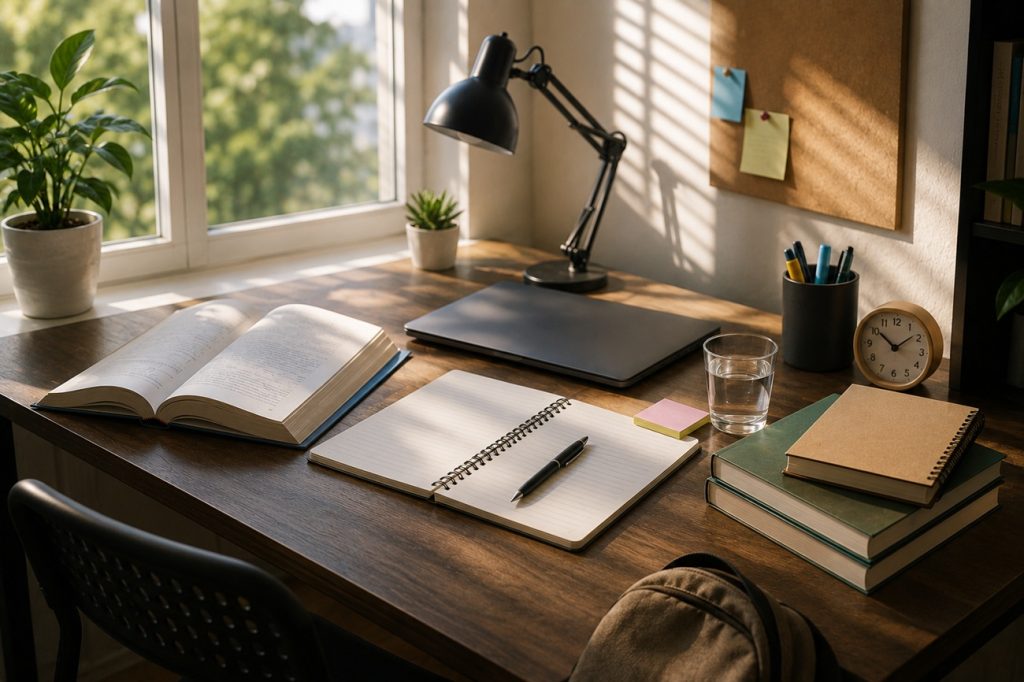
Your desk should have only what you need. Nothing more.
What to keep on your desk:
-
Your laptop or books
-
Your notebook and pen
-
One drink (water is best)
-
A clock (optional)
What to move:
-
Your phone (another room or face-down)
-
Snacks (eat before or after, not during)
-
Anything decorative (keep it simple)
-
Unrelated papers (file them away)
Simple rule: If you don’t need it for this study session, it doesn’t belong on your desk.
Step 4: Tune Your Temperature
Your brain works best at 20-22°C (68-72°F). Too hot and you’ll feel sluggish. Too cold and you’ll be distracted by discomfort.
What to do:
-
If you can control the temperature: set it to 20-22°C
-
If you can’t: dress in layers (warm socks, a light sweater)
-
Open a window if you feel stuffy—fresh air wakes up your brain
Simple hack: A cold glass of water can temporarily cool you down and wake you up.
Step 5: Manage the Sound
Silence is best for deep work. But if you’re in a noisy environment, you need a strategy.
What to do:
-
Silence: Ideal for complex subjects
-
White noise: Apps like Noisli or MyNoise can mask distracting sounds
-
Instrumental music: Lo-fi, classical, or ambient—no lyrics
-
Avoid: Music with lyrics, podcasts, or anything with variable volume
Simple hack: If you’re in a noisy space, noise-canceling headphones (even cheap ones) are worth the investment.
Step 6: Add Color (Thoughtfully)
Color isn’t magic, but it can set the right mood for studying.
| Color | What It Helps With | How to Use It |
|---|---|---|
| Blue | Focus and calm | Desk mat, folders, notebook |
| Green | Reading and reducing fatigue | A small plant, green pen, bottle |
| Yellow | Memory and energy | Sticky notes, highlighter |
| Red | Details and proofreading | Red pen for corrections |
You don’t need to repaint your room. A $2 folder, a free Google background, or a sticky note pack is enough.
The Space Audit: Is Your Study Space Working?
Here’s a quick checklist to see if your study space is helping or hurting you.
| ✅ Good Sign | ❌ Warning Sign |
|---|---|
| You feel calm when you sit down | You feel stressed or overwhelmed |
| You can focus for 30-60 minutes | You check your phone every 5 minutes |
| You look forward to studying | You dread sitting at your desk |
| You remember what you studied | You forget everything the next day |
| You feel physically comfortable | You’re constantly adjusting or uncomfortable |
What to Do If You Can’t Change Your Environment
If you’re in a dorm room, a shared apartment, or a space you can’t control:
1. Invest in quality headphones. Good headphones can block out almost anything.
2. Find alternative study spots. Library, coffee shop, quiet park bench, empty classroom. Rotating spaces also improves memory.
3. Create a “study kit.” A bag with everything you need—notebook, pens, laptop, charger—so you can study anywhere.
4. Use time management. If you can only get silence early in the morning, wake up early. If you can only focus late at night, embrace it.
5. Use StudyWizardry. Let the app handle the logistics—summarizing, quizzing, flashcards—so you can focus on learning even in imperfect environments.
The Honest Truth
Here’s what most students don’t want to hear:
Your environment isn’t the only reason you’re struggling. But it’s one of the biggest reasons. And it’s one of the easiest things to fix.
You don’t need a perfect desk. You don’t need an expensive chair. You don’t need a dedicated room. You just need an intentional space—a space that signals to your brain: “This is where we focus. This is where we learn.”
Your next study session, try this:
-
Clear your desk of everything except what you need
-
Put your phone in another room
-
Adjust your lighting (get some natural light or use a desk lamp)
-
Open a window for fresh air
-
Study for 45 minutes—then take a real break
You might be shocked at how much more you get done.
Your environment isn’t working against you anymore. It’s working for you.
📚
More from StudyWizardry
A great study space is just the beginning. Explore these guides to build a complete learning system.
📄 Interleaving Study Technique: Why Mixing Topics Helps You Learn Better
Master the science of mixing topics for better retention and exam performance.
📄 Your Brain’s Delete Button—And How Active Recall Disables It!
Why retrieval practice is the foundation of durable learning.
📄 You Asked the Right Question. Now What? How to Turn AI Answers into Actual Learning
Learn to process AI answers and turn them into lasting knowledge.
Yes. Research shows that environmental factors like lighting, noise, and organization can affect cognitive performance by up to 30%. It's not the only factor, but it's one of the easiest to control.
Create a portable "study kit" (notebook, pens, laptop, headphones) and use alternative spots—library, quiet café, empty classroom. Rotating spaces can also help with memory.
Put it in another room or on Do Not Disturb. If you need it, use focus apps that block distractions. The simple fix is often the most effective.
Silence is best. If you need sound, try instrumental music (lo-fi, ambient, classical) without lyrics. Avoid podcasts, music with words, and anything that demands your attention.
Optimize what you can control: use a desk (not your bed), add a plant or green object to reduce fatigue, keep it organized, and make sure you have adequate lighting.
Yes. Clear your desk, turn your phone off, reposition your lighting, open a window, and create a "study kit" you can take anywhere. All of these cost nothing.