
How to Study When You’re Already Behind in Every Class
You open your laptop intending to study. Then you check your course pages and see three overdue assignments, two unread chapters, a discussion post you forgot about, and an exam coming up next week. Suddenly, even deciding where to begin feels exhausting.
When you’re behind in every class, studying can start to feel impossible. The more work you have to do, the harder it becomes to focus. You might spend an hour making a perfect study schedule, only to feel too overwhelmed to follow it.
Here’s the important thing: you don’t have to catch up on everything at once. You need a system that helps you regain control, one decision and one task at a time.
And there’s a useful piece of evidence for exactly this situation. A 2024 study in the British Journal of Educational Psychology tracked 231 university students over 30 days and found that better study strategies can compensate for less study time—students who planned, monitored their work, concentrated well, and procrastinated less needed less time to reach a high goal level. The same study found that negative affect was highest on days when students studied for many hours with low concentration.
That’s worth sitting with. When you’re behind, the instinct is to grind longer. The research suggests the better move is to grind better—and that grinding badly makes you feel worse as well as learn less.
Here’s how to do it.
1. Stop Trying to Catch Up on Everything at Once
One of the biggest mistakes students make when they’re behind is treating every unfinished task as equally urgent.
You might feel that you need to read every chapter, review every lecture, complete every assignment, and organize all your notes before you can move forward. But this approach usually creates more pressure than progress.
Instead, pause and assess your actual situation.
Ask yourself three questions:
-
What absolutely needs to be completed this week?
-
Which assignments or exams have the biggest impact on my grades?
-
Which topics do I need to understand before I can move on to the next ones?
Your goal isn’t to erase your entire academic backlog in one day. It’s to identify the tasks that will make the biggest difference.
Try this: Spend 15 minutes reviewing your course platforms, syllabi, and assignment deadlines. Write down everything you’re behind on, but don’t start working on anything yet. First, you need a clear picture of what you’re dealing with.
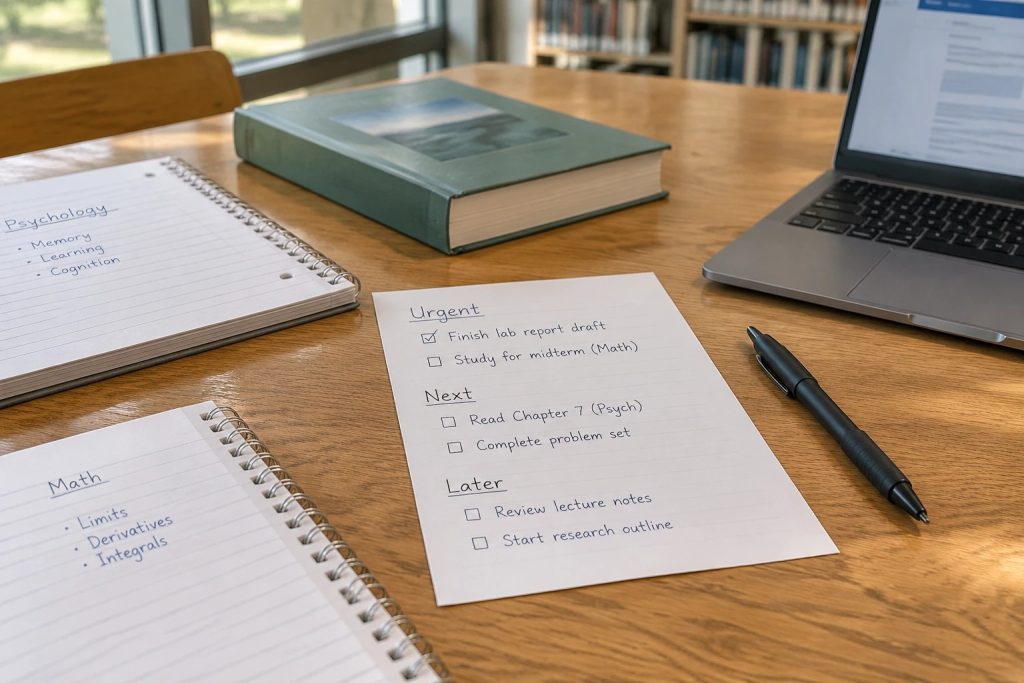
2. Create an Academic Triage List
When several classes demand your attention, prioritization matters more than motivation.
Think of your workload as a triage situation: what needs immediate attention, what can wait, and what might not need to be done at all.
| Course | Outstanding task | Deadline | Priority |
|---|---|---|---|
| Biology | Lab report | Tomorrow | High |
| Psychology | Chapter 5 reading | Friday | Medium |
| History | Discussion post | Today | High |
| Mathematics | Practice problems | Next week | Medium |
| Literature | Optional reading | No deadline | Low |
Priority 1: Urgent and important. Assignments due within 24–48 hours, upcoming exams, and anything that significantly affects your final grade.
Priority 2: Important but not immediately urgent. Essential readings, upcoming projects, and topics you need for future lessons.
Priority 3: Can wait. Optional readings, extra practice, and tasks without immediate academic impact.
One distinction that matters: don’t confuse an overdue task with an important one. An assignment that was due two weeks ago may be worth less than an exam scheduled for tomorrow.
If you’ve missed a deadline, check whether late submissions are still accepted before spending hours completing the assignment.
3. Contact Your Professors Instead of Guessing
When you’re behind, it’s easy to avoid checking your email or contacting instructors because you’re worried about explaining yourself.
But silence rarely makes an academic problem easier.
If you’ve missed assignments or fallen behind, contact your professor or teaching assistant. You don’t need a long explanation or personal details. Be polite, acknowledge the situation, and ask what to prioritize.
Example email:
Subject: Request for Guidance on Catching Up in [Course Name]
Hello Professor [Last Name],
I’ve fallen behind on some of the coursework and am working on getting back on track. I wanted to ask which topics or assignments I should prioritize to prepare for the upcoming assessments.
I understand that some deadlines may have passed, but I’d appreciate any guidance on what I can still complete and how best to move forward.
Thank you for your time.
Best regards,
[Your Name]
Professors can clarify course material, explain late-submission policies, or point you toward essential resources.
You don’t have to solve every academic problem on your own.
4. Use Short, Focused Sessions to Rebuild Momentum
When you have weeks of unfinished work, planning to study for eight hours straight can make the situation even more intimidating.
Start with manageable sessions instead:
-
Study for 25–30 minutes.
-
Take a 5-minute break.
-
Repeat two or three times.
-
Take a longer break before switching subjects.
During each session, focus on one clearly defined task.
Instead of writing “study chemistry” on your schedule, write:
-
Review lecture notes on chemical bonding.
-
Complete five practice problems.
-
Test yourself on ten key definitions.
Specific tasks make it easier to begin and help you recognize progress.
If even 25 minutes feels overwhelming, start with 10. The purpose of your first session isn’t to finish a chapter. It’s to break the cycle of avoidance and get moving again.

5. Stop Rereading Everything: Study More Strategically
When students fall behind, they often try to compensate by spending more time reading textbooks and reviewing slides.
But more study time doesn’t automatically mean better learning.
Two techniques have especially strong evidence behind them: retrieval practice and spaced practice. A major review by Carpenter, Pan, and Butler in Nature Reviews Psychology explains how these approaches support long-term learning and memory. And a landmark review by Dunlosky and colleagues, which evaluated ten common study techniques, rated practice testing and distributed practice as high-utility—while rereading and highlighting were rated low-utility.
In other words: if you’re short on time, the last thing you should do is reread.
Active Recall: Test Yourself Before Looking at Your Notes
Instead of reading a chapter repeatedly, close the textbook and try to explain its main ideas from memory.
You can:
-
Write down everything you remember about a topic.
-
Answer questions without checking the textbook.
-
Use flashcards to test key concepts.
-
Explain a difficult idea in your own words.
The gaps in your answers show you exactly what to review.
Spaced Practice: Revisit Material Across Multiple Days
Rather than spending three hours on one topic in a single session, divide your review across days.
| Day | Study activity |
|---|---|
| Monday | Learn the main concepts |
| Tuesday | Review and answer practice questions |
| Thursday | Test yourself without notes |
| Saturday | Review difficult concepts |
Even when catching up, try to revisit important topics rather than relying entirely on last-minute cramming. If you’re very short on time, prioritize the concepts most likely to appear in your assessments.
6. Build a Realistic Catch-Up Schedule
A common mistake is creating a schedule based on how much work you wish you could complete rather than how much time you actually have.
If you have four classes to catch up on, don’t assign each one three hours every day. You’ll create a schedule that’s impossible to maintain.
Here’s an example of a manageable catch-up day:
| Time | Activity |
|---|---|
| 9:00–9:30 | Review deadlines and choose priorities |
| 9:30–10:00 | Biology: review essential concepts |
| 10:00–10:10 | Break |
| 10:10–10:40 | Biology: practice questions |
| 10:40–11:00 | Break |
| 11:00–11:30 | History: complete discussion post |
| 11:30–12:00 | Review psychology lecture notes |
| 12:00–1:00 | Lunch and rest |
| 1:00–1:30 | Mathematics: solve practice problems |
| 1:30–1:40 | Break |
| 1:40–2:10 | Review upcoming deadlines and plan tomorrow |
Adjust this to your classes, energy levels, work commitments, and deadlines.
The important thing is to leave room for unexpected tasks. A schedule that uses every available minute tends to fall apart as soon as something changes.
7. Use AI to Save Time Without Skipping the Learning
When you’re behind in several classes, technology can help you work more efficiently.
AI study tools are particularly useful for breaking down difficult concepts, generating practice questions, and organizing complicated material.
For example, you can use an AI study assistant to:
-
Explain a difficult concept in simpler language.
-
Generate practice questions based on your lecture notes.
-
Create flashcards from your study materials.
-
Organize a long reading into key topics.
-
Identify areas where you need further explanation.
However, there’s an important distinction between using AI to support your learning and using it to avoid learning.
Asking an AI tool to summarize an entire chapter and reading the summary isn’t necessarily enough to understand the material. A better approach is to use AI interactively: ask it to explain a concept, close the explanation, and then try to describe that concept yourself. You can even ask it to quiz you and explain why your answers are wrong.
Always verify important information against your course materials, and follow your institution’s academic integrity and AI-use policies.
The goal is to make your studying more effective, not to replace your own thinking.
8. Deal With Overwhelm Before It Turns Into Burnout
Falling behind can create a frustrating cycle:
You feel stressed because you have too much work. You avoid studying because you’re stressed. Your workload grows, and you feel even more overwhelmed.
Recognizing the cycle matters. You might notice that you:
-
Keep checking deadlines without actually starting assignments.
-
Spend too much time organizing your notes.
-
Feel guilty whenever you take a break.
-
Switch between subjects without completing anything.
-
Stay up late trying to compensate for lost study time.
If this sounds familiar, remember that exhaustion isn’t a productivity strategy.
Try to protect the basics:
Get enough sleep. An all-nighter might seem like a quick fix, but sleep is essential for attention, memory, and learning.
Take real breaks. A short walk, a meal away from your desk, or a few minutes without a screen can help you reset.
Set a daily stopping point. Decide when you’ll stop studying instead of working until you’re completely depleted.
Recognize small wins. Completing one overdue assignment or understanding one difficult topic is meaningful progress.
If stress is seriously affecting your daily life, reach out to your university’s counseling or student support services.
9. Focus on Consistency, Not a Perfect Recovery
Once you start making progress, you might feel tempted to compensate for everything you’ve missed by studying as much as possible.
Resist that temptation.
The goal isn’t one incredibly productive day. It’s a routine you can maintain over the next several weeks.
At the end of each day, ask yourself:
-
What did I complete today?
-
Which task still needs attention?
-
What’s the most important thing I should do tomorrow?
Review your progress at the end of each week and adjust your schedule based on upcoming deadlines.
A useful strategy is to reserve a small amount of time each day for reviewing older material while keeping most of your study time on current coursework.
That way, you can catch up without falling behind all over again.
A Note on Planning: What the Evidence Actually Says
You might be tempted to solve this entire problem with a better plan. And planning does help—the 2024 study above found that better planning predicted higher daily goal achievement.
But a 2026 study in npj Science of Learning offers a useful reality check. Researchers tracked 87 university students across a four-week course, using experience sampling to capture 1,623 daily reports. Students who set implementation intentions—specific “when and how” plans for spacing their study—did not actually increase their use of distributed practice.
What did change their behavior? Exam proximity. Regardless of the planning intervention, students studied longer, invested more effort, and used more retrieval-based strategies as exams got closer.
The lesson for anyone behind is direct: a plan alone won’t rescue you. What changes behavior is a deadline you can feel.
That’s not a reason to skip planning. It’s a reason to make your deadlines visible, concrete, and close—rather than trusting that future-you will suddenly become disciplined.
Your 48-Hour Academic Reset Plan
If you feel completely overwhelmed and don’t know where to begin, use this two-day plan to get started.
Day 1: Regain Control
- Check all course pages and assignment deadlines.
- Make a complete list of unfinished work.
- Identify the three most urgent academic priorities.
- Contact instructors if you need clarification or deadline information.
- Complete one small but important task.
- Create a realistic study schedule for tomorrow.
Day 2: Start Rebuilding Momentum
- Begin with your highest-priority subject.
- Complete two or three focused study sessions.
- Use active recall to review important concepts.
- Make progress on one overdue assignment.
- Check upcoming deadlines again.
- Plan your next three days of studying.
You don’t have to finish everything in 48 hours. You just need to move from feeling completely stuck to having a clear plan and making measurable progress.
Final Thoughts: Being Behind Doesn’t Mean You’re Out of Time
Falling behind in college can feel like you’re losing control of your academic life. But being behind is a situation you can work through—not a permanent reflection of your ability or potential.
Start by identifying what matters most. Break large tasks into smaller steps, communicate with your instructors, and use study methods that help you learn rather than simply spend more time with your books.
Most importantly, stop measuring your progress against the schedule you wish you had followed.
You can’t change the weeks you’ve already lost, but you can make a better decision about what to do with the next hour.
Start there.
📚
More from StudyWizardry
Catching up is one problem. Staying caught up is another. These guides help with both.
📄 The Study Planner Guide: How to Build a Realistic Schedule
How to turn a vague workload into a daily structure you can actually follow.
📄 Your Brain’s Delete Button—And How Active Recall Disables It!
Why retrieval practice is the foundation of durable learning.
📄 How to Balance Work and University (Without Burning Out)
Practical strategies for managing a packed schedule without losing your mind.
📄 Working While Studying: How Many Hours Can College Students Work?
What the research says about the line between busy and overloaded.
✨ Three guides, one system: Build a realistic plan, use retrieval to learn faster, and protect yourself from burnout while you catch up.
📚 References
-
Carpenter, S. K., Pan, S. C., & Butler, A. C. (2022). The science of effective learning with spacing and retrieval practice. Nature Reviews Psychology, 1(9), 496–511. https://www.nature.com/articles/s44159-022-00089-1
-
David, L., Biwer, F., Crutzen, R., & de Bruin, A. (2026). Understanding and supporting university students’ use of distributed practice via implementation intentions. npj Science of Learning. https://doi.org/10.1038/s41539-026-00448-0
-
Dunlosky, J., Rawson, K. A., Marsh, E. J., Nathan, M. J., & Willingham, D. T. (2013). Improving students’ learning with effective learning techniques: Promising directions from cognitive and educational psychology. Psychological Science in the Public Interest, 14(1), 4–58. https://doi.org/10.1177/1529100612453266
-
Theobald, M. (2024). Study longer or study effectively? Better study strategies can compensate for less study time and predict goal achievement and lower negative affect. British Journal of Educational Psychology, 95(2), 405–420. https://doi.org/10.1111/bjep.12725
Start with a single 15-minute audit. Open every course page, list what's overdue, and mark which items are due in the next 24–48 hours. Don't study yet—just get the picture. Then pick the one task with the highest grade impact and the nearest deadline. That's your first session.
The evidence favours studying more effectively. A 2024 study of 231 university students found that better planning, monitoring, concentration, and less procrastination meant less time was needed to reach a high goal level. The same study found that negative affect was highest on days when students studied many hours with low concentration. Long, unfocused sessions tend to make you feel worse without producing proportionate learning.
There's no universal number, and aiming for a heroic total is usually counterproductive. A more useful rule: study in blocks of 25–45 minutes, with short breaks, and stop at a defined time each day. Consistency across a week beats one exhausting day.
Yes—and sooner is better. A short, polite email asking what to prioritise is usually received better than silence followed by a crisis. You don't need to explain personal details. You just need to show that you're taking responsibility and want guidance.
Study Planner turns a vague backlog into a daily structure, so you're not re-deciding what to do every morning. Quizzes let you test yourself on your own material with explanations for every answer, which is retrieval practice rather than rereading. Flashcards keep key concepts returning on a spaced schedule. Study Sets turn your lectures and readings into a study guide, lessons, and practice questions. And Homework Solver shows step-by-step reasoning when a concept won't click—so you understand the process, not just the answer.
You probably can't recover everything, and trying to will make it worse. Focus on the assessments that carry the most weight, check whether late submissions are still accepted, and ask your instructor what actually matters for your grade. A partial recovery built on the right priorities is worth more than a perfect plan you can't execute.
Partly. A 2026 study found that students who set specific implementation intentions did not increase their use of distributed practice—but their study behaviour did shift as exams got closer, with more effort and more retrieval-based strategies. The practical lesson: a plan helps most when it's tied to visible, near-term deadlines rather than a vague intention to "do better."