Why Your Brain Keeps Losing Attention (And How to Fix It)
You sit down to study. Laptop open. Textbook ready. Coffee within reach.
Twenty minutes later, you’re six Instagram posts deep, halfway through a YouTube rabbit hole, and genuinely confused about how you got there.
This scene plays out millions of times every day. And if you’ve experienced it, you’ve probably told yourself some version of: “I just need to focus harder.” “I’m so lazy.” “What’s wrong with me?”
Here’s what the research actually shows: nothing is wrong with you. You’re simply trying to focus in an environment that’s been engineered specifically to prevent it.
This article isn’t another “5 tips to boost focus” list. It’s an honest look at why concentration has become so difficult—and what you can actually do about it, without blaming yourself.
📱 Part 1: Why Focus Feels Impossible Right Now
Let’s start with what’s actually happening when you try to concentrate.
The Attention Economy
Your attention is worth money. Not metaphorically—literally. Every app on your phone generates revenue based on how long you stay engaged. The people designing these platforms understand neuroscience better than most doctors. They know exactly how to trigger dopamine, create variable rewards, and keep you scrolling.
When you lose focus, it’s not because you’re weak. It’s because you’re fighting against systems designed by some of the smartest minds on the planet.
The Switching Tax
Every time you switch from studying to checking a notification, your brain pays a cost. Researchers call it “attention residue”—part of your brain stays stuck on the previous task even after you’ve switched. Studies suggest it can take over 20 minutes to fully re-engage after an interruption.
That “quick check” of your phone isn’t quick. It’s a 20-minute detour.
The Exhaustion Cycle
Here’s what makes it worse. When you’re tired, your brain seeks quick dopamine hits. Quick dopamine hits come from phones. Phones fragment your attention further. Fragmented attention means less learning. Less learning means more stress. More stress means worse sleep. Worse sleep means more tired tomorrow.
It’s a cycle that feeds itself—but understanding it is the first step to breaking it.
📚 Know your enemy: The science behind attention residue and digital distraction is fascinating. Our guide “The Silent Focus Killer: How to Reclaim Your Concentration in the Digital Age“ dives deeper into what’s happening inside your brain.

🧠 Part 2: Three Myths About Focus That Keep You Stuck
Before we talk about solutions, we need to clear up some misconceptions that might be holding you back.
Myth 1: “I Just Need More Willpower”
Willpower is not a solution—it’s a finite resource. Every time you resist a distraction, you deplete mental energy. By the end of the day, you have nothing left. The students who focus best aren’t the ones with superhuman willpower. They’re the ones who’ve designed environments where willpower isn’t needed.
Myth 2: “Multitasking Helps Me Get More Done”
Multitasking is a myth. What feels like multitasking is actually rapid task-switching, and it costs you up to 40% of your productive time. Every switch requires your brain to reorient, reload context, and re-engage. You’re not doing two things at once—you’re doing both badly.
Myth 3: “Longer Study Sessions = Better Results”
The brain operates in natural 90-minute cycles of high focus followed by lower energy periods. Pushing beyond these cycles doesn’t produce more learning—it produces diminishing returns. Four focused hours beat twelve exhausted hours every time.
🧠 Work with your biology: Understanding your natural rhythms changes everything. Our guide “Find Your Golden Hours: How Your Chronotype Unlocks Deep Focus“ shows you when your brain is actually ready for deep work.
🏗️ Part 3: Four Strategies That Actually Work
Here’s what works when you stop fighting your brain and start designing for it.
Strategy 1: Create a “Focus Zone” — Physically and Digitally
The most effective focus strategy is also the simplest: your primary phone leaves the room. Not face-down. Not on silent. Not in your bag. Another room.
Research consistently shows that the mere presence of a phone—even off, even face-down—reduces cognitive capacity. Your brain allocates resources to resisting temptation. Removing it entirely eliminates the battle.
But here’s the key: This doesn’t mean abandoning technology. It means being intentional about which technology you use. Your study tools (like your laptop, tablet, or apps such as StudyWizardry) stay in the room—they’re part of your focus system. The distraction-optimized apps (social media, entertainment) are the ones that need to be physically removed.
Try this: For your next study session, put your primary phone in another room. Use your laptop or tablet only for study-related apps. Notice the difference.
Strategy 2: Schedule Your Dopamine
You will check your phone. Resisting entirely is unsustainable. The solution isn’t abstinence—it’s scheduled indulgence.
Try this: Build deliberate 5-minute breaks into your focus block. Use them to scroll, reply, check everything. Then, when the five minutes end, your phone goes back in the other room. This works because it removes the scarcity mindset—your brain stops obsessing about what it’s missing because it knows exactly when it will get its next hit.
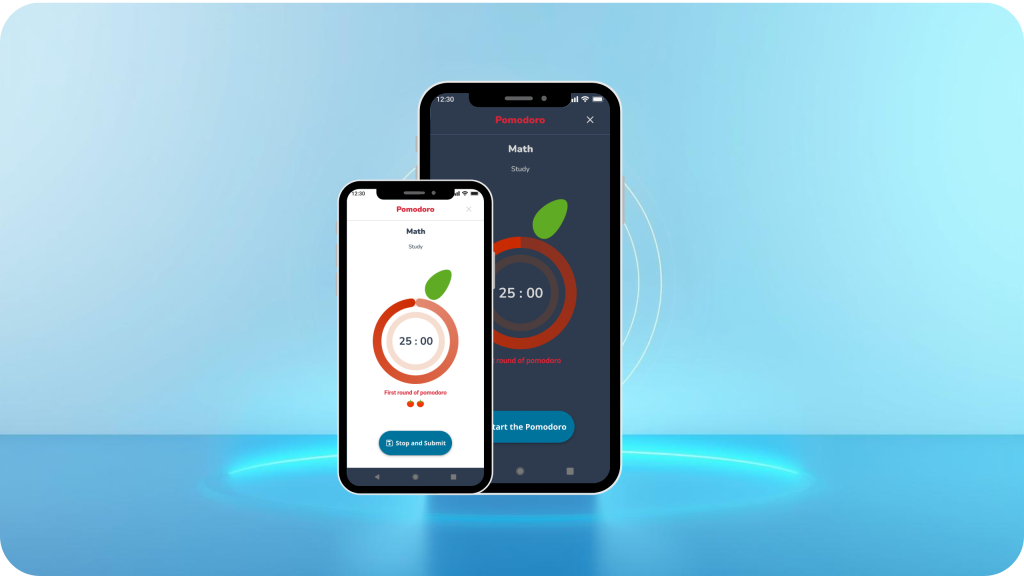
🍅 Structure your time: The Pomodoro Timer in StudyWizardry is perfect for this. It helps you maintain focused sprints and reminds you when it’s time for those scheduled breaks—keeping you on track without needing to watch the clock.
🤔 A Note on Technology: Tools vs. Traps
It’s worth stepping back and asking: is all technology the enemy of focus?
The answer is no. The problem isn’t technology itself—it’s the intent behind it. Some tools are designed to capture your attention and sell it to advertisers (social media, games, entertainment platforms). Others are designed to serve your attention—to help you organize, learn, and create.
StudyWizardry falls into the second category. Its AI Study Planner helps you map out your week. Its Pomodoro Timer structures your focus blocks. Its Flashcards and Quiz Generator turn passive review into active learning. These aren’t distractions—they’re force multipliers for your focus.
The goal isn’t to live without screens. It’s to choose your screens wisely. Keep the tools that serve you. Move the ones that trap you.
📊 What This Looks Like in Practice
Here’s how these strategies come together in a real study block, using StudyWizardry as your focus companion:
| Time | Action | Tool |
|---|---|---|
| 0:00 – 0:02 | Write down everything in your head | Notebook or AI Note Maker |
| 0:02 – 0:05 | Move phone to another room. Open StudyWizardry. Choose ONE task. | StudyWizardry AI Study Planner |
| 0:05 – 0:30 | Focused work on that one task | StudyWizardry Pomodoro Timer |
| 0:30 – 0:35 | Guilt-free phone break | (Phone, then back to other room) |
| 0:35 – 1:00 | Continue or stop—you’ve already won | StudyWizardry tracks your progress |
🎯 The Honest Truth
The students who focus best aren’t the ones with superhuman discipline. They’re the ones who’ve stopped pretending they have it.
They’ve accepted that their attention is under attack. They’ve stopped blaming themselves and started building systems. They put the phone in another room. They schedule their dopamine. They do one thing at a time.
In a world engineered to fragment your attention, this isn’t just nice advice. It’s survival.
Start tomorrow. Pick one strategy from this article. Just one. Implement it. Not all four. Not a perfect system. One small change.
Your brain isn’t broken. It’s just fighting a war it was never designed to win. Stop fighting alone.
References:
-
Mark, G., et al. (2015). “The Cost of Interrupted Work: Speed, Stress, and Productivity.” University of California, Irvine.
-
Leroy, S. (2009). “Why Is It So Hard to Do My Work? The Challenge of Attention Residue when Switching Between Work Tasks.” University of Washington.
📚 Further Reading: Build Your Complete Focus System
📚
Build Your Focus System
The strategies in this article are just the beginning. To build a focus system that actually lasts, explore these essential guides:
Find Your Golden Hours: How Your Chronotype Unlocks Deep Focus
Learn to work with your biology, not against it—discover when your brain is actually ready for deep work.
The Pomodoro Hack: Engineering Your Brain’s ‘Flow State’ On Demand
Master the science of focused sprints and intentional breaks—the foundation of sustainable productivity.
Your Brain’s UI: Designing Flashcards for Your Unique Cognitive Operating System
Turn passive review into active recall with tools designed for how your brain actually works.
✨ These three guides form a complete curriculum for the modern student. Read them in any order—each one will deepen your understanding of how to stay focused in a distracted world.
Real focus produces output. At the end of a focused block, you should be able to explain what you learned, demonstrate a new skill, or show completed work. If you've been "studying" for two hours and have nothing to show for it, you were probably just busy, not productive.
Start smaller. Commit to 10 minutes. Then 15. Focus is a muscle—it builds with consistent practice. The key is removing distractions completely during that time. Phone in another room. All other tabs closed. Just you and one task.
Define what "urgent" actually means—it's almost always less urgent than it feels. Use "Do Not Disturb" with exceptions for specific contacts. Communicate your focus schedule to people who need to reach you. The world doesn't end in 25 minutes.
Then adjust them. Your system should fit you, not the other way around. Maybe you need longer focus blocks (50/10 instead of 25/5). Maybe your peak hours are different. Take what works, leave what doesn't, and iterate.