
Why Memorizing Formulas Never Works (And What to Do Instead)
You know the feeling. You spent an hour memorizing that physics formula. You wrote it ten times. You recited it in your head during lunch. Then the exam asked a question that wasn’t exactly like the practice problems—and your mind went completely blank.
This happens to everyone. But here’s the truth nobody tells you: the problem isn’t your memory. It’s your approach.
Formulas are just tools. Memorizing them without understanding what they actually do is like owning a hammer but having no idea what a nail is. When the problem looks slightly different, you don’t know which tool to pick—or why.
This article is about moving past memorization and actually understanding the material. Not through harder work. Through smarter tools.
🔬 Part 1: Why Memorization Alone Always Fails
Here’s what happens when you memorize a formula without understanding it:
You see a problem. You search your memory for a formula that looks like it fits. You plug in numbers. You get an answer. Sometimes it’s right. Sometimes it’s not. You never really know why.
The problem is that real-world questions—and exam questions—rarely match your memorized examples perfectly. They twist things. They combine concepts. They ask you to apply knowledge, not just recall it.
When you only have formulas in your head, you have no way to adapt. You’re stuck with the exact patterns you memorized, and anything else feels impossible.
The fix: Stop memorizing formulas. Start understanding relationships. Why does this formula work? What would happen if you changed one variable? How does it connect to other concepts you know?
🧠 Part 2: What Real Understanding Looks Like
Here’s how you know you actually understand something—not just memorized it:
- You can explain it to someone else without looking at your notes.
- You can solve problems you’ve never seen before because you recognize the underlying pattern.
- You can connect it to other things you’ve learned.
- When you make a mistake, you know why it’s wrong, not just that it’s wrong.
This isn’t magic. It’s the result of engaging with material in a specific way—not just reading it over and over, but actively working with it until it becomes part of how you think.
📱 Part 3: How Smart Tools Can Help (Without Doing the Work for You)
Here’s where technology actually helps—when it’s used to support understanding, not replace it.
When You’re Stuck on a Problem
Most students do one of two things: grind endlessly (which wastes time) or look up the answer (which teaches nothing).
There’s a better way. When you hit a wall, you need to see the path—not just the destination.
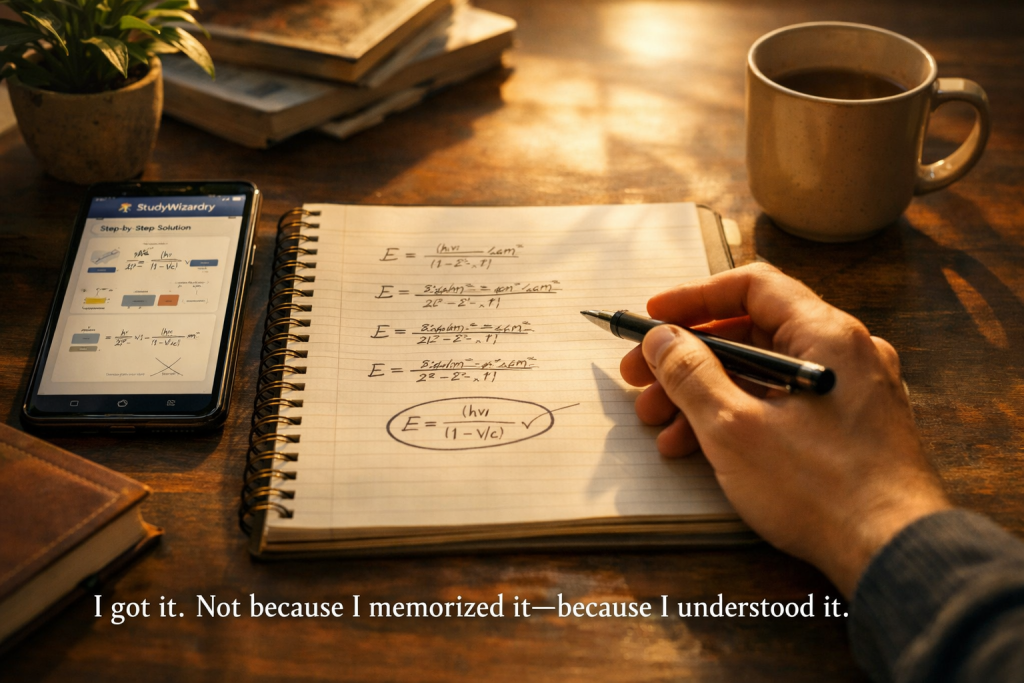
With StudyWizardry, you can take a photo of the problem you’re stuck on. The app doesn’t just hand you the answer. It shows you step-by-step reasoning, pulling from different AI models (Grok, GPT, Gemini) depending on your subject. A physics explanation looks different from a chemistry one. The goal is always the same: help you see the thinking, not just the result.
Then you close the app and explain it back to yourself. If you can’t, you haven’t learned it yet.

After You Understand
Once a concept clicks, you need to lock it in. Not by re-reading—by active recall.
StudyWizardry’s smart flashcards adapt to what you know. They show you harder questions when you’re ready, easier ones when you’re struggling. They’re not just digital index cards. They’re tools for building real fluency.
The quiz feature lets you test yourself on the fly. Create a quick quiz on the topic you just learned. See where you actually stand. The gaps tell you what to review next.
And if you’re the type who learns by talking? The voice-powered AI lets you ask questions out loud and get explanations back. Sometimes hearing it said differently makes all the difference.
📊 Part 4: What This Looks Like for Different Subjects
For Math & Statistics
You don’t need to memorize every formula. You need to understand why they work. When you’re stuck on a proof, seeing one clear step-by-step breakdown can unlock the whole thing. Then practice with flashcards that focus on the process, not just the answer.
For Physics
Physics is about relationships—how force connects to motion, how energy transforms. When a problem feels impossible, it’s often because you’re missing a conceptual link. Seeing the same idea explained from different angles (using different AI models) helps that link click.
For Chemistry
Balancing equations, stoichiometry, reaction mechanisms—chemistry is full of patterns. Once you see the pattern, the problems become manageable. Smart quizzes that adapt to your weak spots help you practice exactly what you need.
For Biology
Biology is less about calculation and more about systems. How does this process connect to that one? Flashcards that ask why something happens, not just what happens, build real understanding.
For Languages & Literature
Understanding a text isn’t about memorizing vocabulary lists. It’s about seeing how words work together, why an author chose that phrase, what the subtext means. Voice-powered AI can help you hear pronunciations and practice speaking in ways that stick.
🛠️ Part 5: A Simple Process That Works
Here’s what I actually do now when learning something new:
- Engage actively. I don’t just read. I ask questions. I try to explain concepts out loud (using voice AI when I’m stuck).
- Get unstuck smartly. When a problem stops me, I use StudyWizardry to see step-by-step reasoning—not the answer, the path.
- Test immediately. After I understand, I create a quick quiz or use smart flashcards to practice retrieval.
- Connect the dots. I ask myself: how does this connect to what I already know? Where else could this apply?
- Review strategically. The app tracks what I’ve learned and reminds me to review before I forget—not after.
This process takes less time than marathon study sessions. And the learning actually sticks.
🎯 The Honest Truth
You don’t need to be a genius to understand difficult material. You don’t need to memorize hundreds of formulas. You need to engage with ideas until they make sense—and have the right tools to help when you get stuck.
The students who succeed aren’t the ones with the best memories. They’re the ones who know how to learn.
Next time you’re staring at something that doesn’t make sense, remember: being confused isn’t failure. It’s the first step to actually understanding. What matters is what you do next.
📚 Further Reading
📄 Your Brain’s UI: Designing Flashcards for Your Unique Cognitive Operating System
How to build flashcards that actually match the way your brain learns.
📄 From Prompts to Progress: Building Your Personalized AI Study System
Move beyond isolated prompts and build a system that adapts to you.
📄 A Physics Student’s Guide to Using an AI Math Solver for Word Problems
How to use AI strategically when physics problems have you stuck.
It depends on how you use it. If you read the explanation and move on, yes—you've avoided thinking. If you use it to understand the process, then close it and explain it back to yourself, you're using it as a tutor. The key is always the step after: active recall.
Try the "teach it" test. Explain the concept to someone who doesn't know it—out loud, in your own words, without looking at notes. If you can do that clearly, you understand it. If you get stuck or vague, you don't.
The app supports physics, biology, chemistry, geometry, math, and more. It pulls from different AI models (Grok, GPT, Gemini) depending on the subject, so explanations adapt to what you're studying.
They track what you know and what you struggle with. Cards you answer correctly appear less often. Cards you miss appear more frequently. It's like having a tutor who knows exactly where your weak spots are and makes you practice them until they're strong.
Yes—the voice-powered AI lets you ask questions out loud and get explanations back. Sometimes hearing something explained differently makes all the difference, especially for language learning or verbal processing.