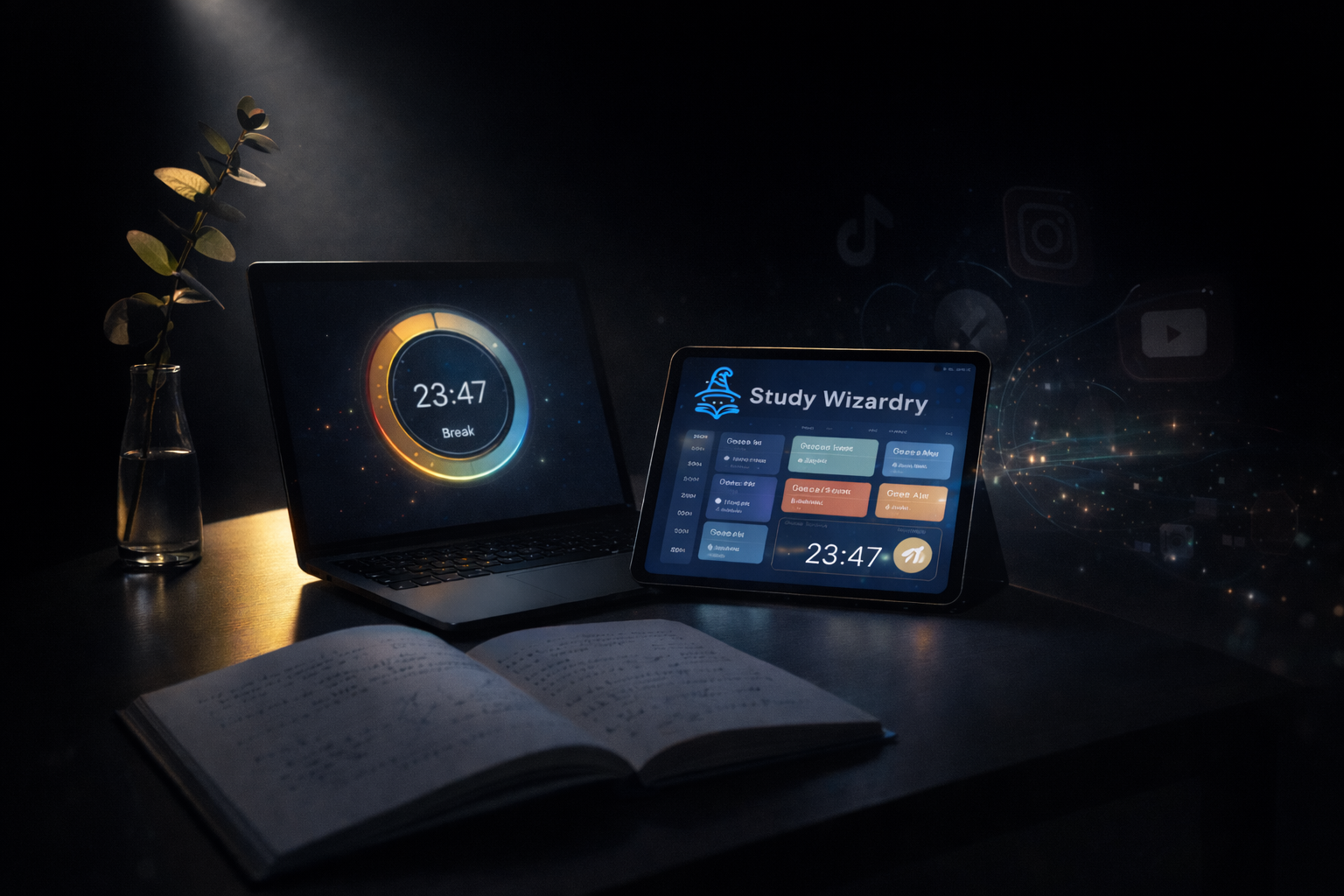
The Paradox of 2026: Using AI to Escape AI
There’s a strange irony defining student life right now.
Every semester, the same scene plays out in dorm rooms and libraries across the country. You open your laptop to study. Within minutes, ChatGPT is summarizing your readings, Grammarly is polishing your sentences, and Quizlet is generating flashcards from your notes. AI has become the ultimate study assistant—efficient, tireless, infinitely patient.
And yet, here’s the confession no one makes: you’re also more distracted than ever.
The same device hosting your AI study tools also hosts TikTok’s infinite scroll, Instagram’s algorithmically engineered rabbit holes, and YouTube’s relentless recommendations. Your phone is both your most powerful academic weapon and your primary source of cognitive chaos .
This is the paradox of 2026. We’re using technology to fix problems that technology created. And for students trying to focus, it feels like running on a treadmill that keeps accelerating.
After three years of experimenting, failing, and finally finding what works, I’ve learned something counterintuitive: the solution isn’t using less AI. It’s using AI differently.
🤖 The Three Mistakes I Made With AI (And You Probably Are Too)
Mistake #1: Treating AI Like a Crutch, Not a Tool
In my first year, I used ChatGPT the way you’d use a tutor who never gets tired. Need an essay outline? ChatGPT. Confused about a concept? ChatGPT. Stuck on a problem set? ChatGPT.
It worked brilliantly—until exam day, when I realized I hadn’t learned anything. The AI had done the thinking, and my brain had checked out.
Mistake #2: Letting AI Tools Multiply Without a System
By sophomore year, I had fourteen different study apps. A flashcard app. A note-taking app. A summarizer. A planner. A timer. Each one promised to fix a specific problem. Together, they created a new one: decision fatigue.
Every study session started with the same exhausting question: which app should I open first? By the time I decided, I’d already checked Instagram twice.
Mistake #3: Believing Willpower Was Enough
I told myself the problem was discipline. If I just tried harder, I could resist the pull of social media. If I just focused more, I wouldn’t need the AI crutch.
This is the lie productivity culture sells you. Willpower isn’t a solution—it’s a finite resource that depletes throughout the day. What I needed wasn’t more discipline. I needed a system that made discipline unnecessary.
🧠 What Actually Works: The AI-Augmented Focus System
After three years of trial and error, here’s the framework that finally stuck. It’s not complicated. It’s not trendy. It just works.
Layer 1: Use AI to Remove Decisions, Not Make Them
The biggest breakthrough came when I stopped asking AI to do my work and started asking it to prepare my work.
Instead of: “Write an essay about climate change.”
I now use: “Summarize this lecture PDF into key concepts and create three practice questions.”
The difference is subtle but profound. The first approach replaces thinking. The second approach prepares me to think.
How I do it: Before every study session, I spend five minutes feeding my materials into StudyWizardry’s AI Note Maker or PDF Summarizer. I walk into the session with clean, organized notes and zero “where do I start” anxiety.
📚 Build your foundation first: This approach works best when you understand your natural energy peaks. Our guide “Find Your Golden Hours: How Your Chronotype Unlocks Deep Focus“ helps you schedule these prep sessions when your brain is ready to absorb.
Layer 2: Build Walls Around Your Focus Windows
Here’s the uncomfortable truth: you cannot trust yourself around your phone. I couldn’t. You probably can’t either. That’s not a character flaw—it’s biology. Apps are engineered to be addictive .
The solution isn’t willpower. It’s pre-commitment.
What changed everything: I started using StudyWizardry’s Pomodoro Timer not as a suggestion, but as a contract. When that timer starts, my phone goes face-down on the other side of the room. No notifications. No quick checks. Nothing.
Twenty-five minutes of locked-in focus. Five minutes of actual break—walking, stretching, looking out a window—not more scrolling.
The science is simple: your brain needs uninterrupted time to enter deep focus. Every notification resets that clock .
🍅 Master the technique: The Pomodoro method is scientifically proven to reduce the “activation energy” required to start. Our complete guide “The Pomodoro Hack: Engineering Your Brain’s ‘Flow State’ On Demand“ explains why 25-minute sprints bypass your brain’s resistance.
Layer 3: Turn Passive Consumption Into Active Recall
This was the game-changer.
Most students use AI to consume information faster. More summaries. Quicker explanations. Shorter videos.
But learning doesn’t happen during consumption. It happens during retrieval—when you force your brain to pull information out of memory.
My new rule: For every hour I spend consuming content (reading, watching, listening), I spend thirty minutes actively retrieving it.
How it works in practice:
-
After reading a chapter, I open StudyWizardry’s Quiz Generator and create a five-question test on the material.
-
I turn key concepts into Flashcards—not just definitions, but application questions.
-
I explain concepts out loud as if teaching someone else.
This shift from passive to active is the difference between recognizing information and actually knowing it.

🧠 Take it deeper: The most effective flashcards match your brain’s natural processing style. Our guide “Your Brain’s UI: Designing Flashcards for Your Unique Cognitive Operating System“ shows you how to build cards that actually stick.
📊 The System in Practice: A Typical Week
| Day | AI Prep (Layer 1) | Focus Block (Layer 2) | Active Recall (Layer 3) |
|---|---|---|---|
| Monday | Summarize bio lecture into key concepts | 2x Pomodoro on the summary | Generate 10 quiz questions |
| Tuesday | Process textbook chapter into bullet points | 3x Pomodoro on problem sets | Create flashcards for missed concepts |
| Wednesday | Condense week’s notes into one-page review | 2x Pomodoro on practice exam | Teaching concepts out loud |
| Thursday | Identify gaps from practice exam | 3x Pomodoro on weak areas | Quiz myself without notes |
| Friday | Plan next week’s study blocks | Light review session | Record key takeaways for future |
🧩 Why This Works When Everything Else Failed
This system works for three reasons:
1. It reduces decisions. Every part of the process is pre-planned. I don’t decide what to study or when—the system decides for me.
2. It works with biology, not against it. Focus blocks are scheduled during my natural energy peaks (afternoons, because I’m a night owl). Prep work happens during low-energy troughs.
3. It measures what matters. I track completed Pomodoros and quiz scores, not hours spent “studying.” Output > input.
🎯 The Honest Truth
I still get distracted sometimes. I still have days when I open Instagram “just for a second” and emerge twenty minutes later. I still procrastinate on hard tasks.
But here’s what changed: the bad days are now exceptions, not the rule.
The students who succeed aren’t the ones with superhuman discipline. They’re the ones who build systems that make discipline optional. They use AI to handle the boring work so their brains can focus on the interesting work. They protect their attention like the finite resource it is .
In 2026, the advantage doesn’t go to students who use AI the most. It goes to students who use AI the smartest.
Start tonight. Pick one layer from this system and implement it tomorrow. Just one. Layer 1, Layer 2, or Layer 3. Commit to it for one week.
You might be surprised how much changes.
The system in this article is just the beginning. To truly harness the power of AI without losing your cognitive edge, dive into these essential guides from the StudyWizardry blog:
From Prompts to Progress: Building Your Personalized AI Study System
You’ve mastered the art of the prompt. Now learn how to weave those powerful prompts into a cohesive, self-reinforcing learning protocol that adapts to you.
Your AI Study Buddy Is Dumb If You Don’t Ask It These 5 Prompts
Staring at a blank document? Discover the five essential prompts that transform your AI from a basic answer engine into a sophisticated thinking partner.
How to Use AI as a Second Brain Without Losing Your Own
Facing information overload? Learn to build an external thinking partner that handles the clutter while preserving your unique cognitive abilities.
✨
These three guides form a complete curriculum for the modern AI-powered student. Read them in any order—each one will deepen your understanding of how to stay human in a machine-assisted world.
Only if you stop at the summary. The key is using AI-generated summaries as a foundation for deeper work, not a replacement for it. When you take those clean notes and turn them into quizzes, flashcards, and self-explanations, you're doing the real cognitive work. The AI just removes the friction of getting started .
Define what "urgent" actually means—it's almost always less urgent than it feels. I use "Do Not Disturb" mode with exceptions for specific contacts (family, close friends). Everyone else can wait 25 minutes. The world doesn't end .
Then adjust it. Your system should fit you, not the other way around. Maybe you need longer focus blocks (50/10 instead of 25/5). Maybe your peak hours are different. Maybe you hate flashcards and prefer verbal explanation. Take what works, leave what doesn't, and iterate .