Why You Forget Everything You Study & How to Actually Remember It
If you’ve ever spent hours studying only to blank on a test, you know the frustration of watching your hard work disappear. You’re not alone, and it’s not your fault. The problem isn’t your memory—it’s your method.
Traditional studying—re-reading, highlighting, cramming—creates the illusion of learning. You recognize information, so you think you know it. But recognition isn’t recall. The real test comes when you need to retrieve information empty-handed during an exam.
The good news? Cognitive science has uncovered exactly how learning works. Here are five evidence-based techniques that will transform how you study and help you actually remember what you learn.
The Science Behind Why Traditional Studying Fails
The Fluency Illusion
When you re-read notes or textbooks, the material feels familiar. This “fluency” tricks your brain into thinking you’ve mastered the content. In reality, you’ve just become good at recognizing information—not recalling it.
Research shows that students who repeatedly read material become overconfident in their knowledge. They score significantly lower than students who use active recall methods, even though they feel more prepared.
The Forgetting Curve
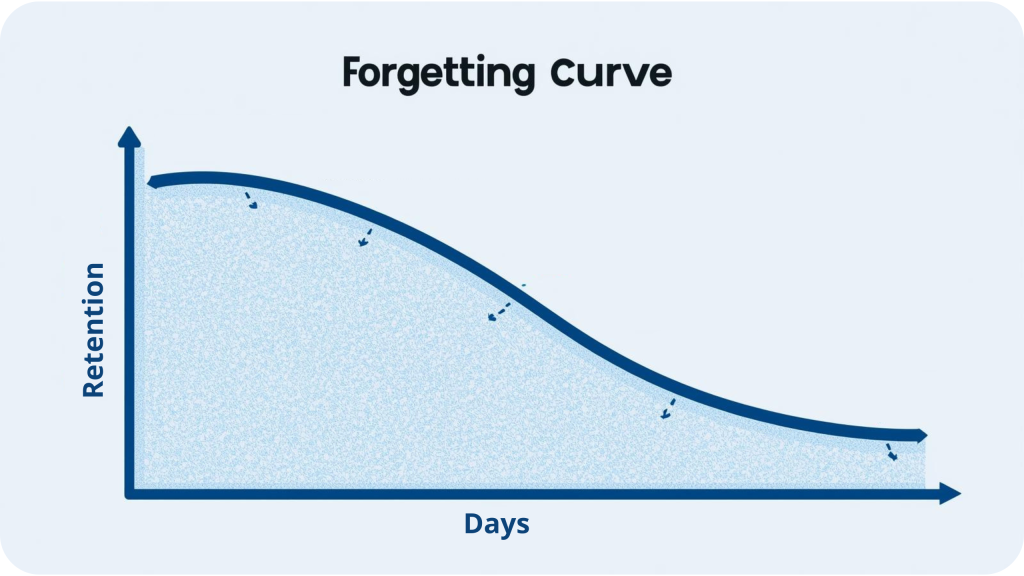
In the 1880s, psychologist Hermann Ebbinghaus discovered that we forget information exponentially. Without reinforcement:
- Within 1 hour: Remember about 44%
- Within 24 hours: Remember about 33%
- Within 1 week: Remember about 21%
This explains why cramming doesn’t work long-term. You might pass tomorrow’s test, but you’ll forget everything by next month.
📉 The Forgetting Curve: Your Brain’s Natural Enemy
For a complete guide to overcoming this challenge, don’t miss our dedicated article: “Mastering Memory: How to Hack the Forgetting Curve for Academic Success” where we break down practical strategies to flatten the curve and make knowledge stick.
Technique 1: Active Recall – The Foundation of Effective Learning
Active recall means actively retrieving information from your memory without looking at the source material. It’s the difference between reading a definition and testing yourself on it.
Why It Works
Every time you successfully recall information, you strengthen the neural pathways to that knowledge. This makes future retrieval easier and more reliable. It’s like building a well-worn path through a forest—the more you walk it, the clearer it becomes.
How to Implement Active Recall
The Question Method:
- After reading a chapter, close the book
- Write down everything you remember
- Create questions for each key concept
- Later, answer those questions without looking at your notes
Practical Example:
Instead of re-reading notes about photosynthesis, write: “Explain the process of photosynthesis in simple terms” and then try to answer from memory.
Digital Tools That Help:
Some students find that using apps with built-in quiz generators saves time. For instance, StudyWizardry’s Quiz/Test Generator can automatically create practice questions from your notes, ensuring you’re testing yourself on the right material.
🧠 Pro Tip: To understand exactly how this forgetting mechanism works and learn practical strategies to counteract it, we highly recommend reading our deep dive: “Your Brain’s Delete Button—And How Active Recall Disables It!” where we explore the neuroscience behind memory decay in detail.
Technique 2: Spaced Repetition – Remembering More by Studying Less
Spaced repetition involves reviewing information at strategically increasing intervals. Instead of cramming, you study briefly but regularly.
Why It Works
This method directly counters the forgetting curve. Each review session strengthens the memory right before you’re likely to forget it. Over time, the intervals between reviews become longer until the knowledge is permanently stored.
How to Implement It
Simple Schedule:
- First review: 1 day after learning
- Second review: 3 days later
- Third review: 1 week later
- Fourth review: 2 weeks later
- Fifth review: 1 month later
Practical Application:
If you learn about the French Revolution on Monday:
- Tuesday: Quick 10-minute review
- Friday: Another 10-minute review
- Next Friday: 15-minute review
- Two weeks later: 10-minute review
Using Technology:
Digital tools can automate this process. Apps like StudyWizardry use algorithms to determine optimal review times based on your performance, taking the guesswork out of scheduling.

Technique 3: Interleaving – Why Mixing Subjects Beats Marathon Sessions
Interleaving means mixing different subjects or topics within a single study session, rather than focusing on one thing for hours (a method called “blocking”).
Why It Works
While blocking creates short-term fluency, interleaving builds long-term understanding. It forces your brain to constantly identify which strategy or knowledge applies to which problem—exactly what you need to do during exams.
Research shows that students who use interleaving perform significantly better on tests weeks later compared to those who use blocking.
How to Implement It
Sample Study Session (90 minutes):
- 30 minutes: Math problems
- 30 minutes: History reading
- 30 minutes: Science concepts
Within a Single Subject:
If studying math, mix:
- Algebra problems
- Geometry proofs
- Statistics questions
Practical Tip:
Start with related topics. Mixing completely unrelated subjects (like chemistry and literature) might be less effective than mixing within a discipline.
🔄 Ready to master interleaving? Dive deeper into practical examples and implementation plans in our dedicated guide: “Interleaving: The Secret to Mastering Multiple Subjects” where we break down exactly how to mix your studies for maximum retention.

Technique 4: The Feynman Technique – True Understanding Through Teaching
Named after Nobel Prize-winning physicist Richard Feynman, this technique involves explaining concepts in simple terms as if teaching someone else.
Why It Works
As Feynman said, “If you can’t explain it simply, you don’t understand it well enough.” The process of simplifying complex ideas reveals gaps in your understanding that you might otherwise miss.
How to Implement It
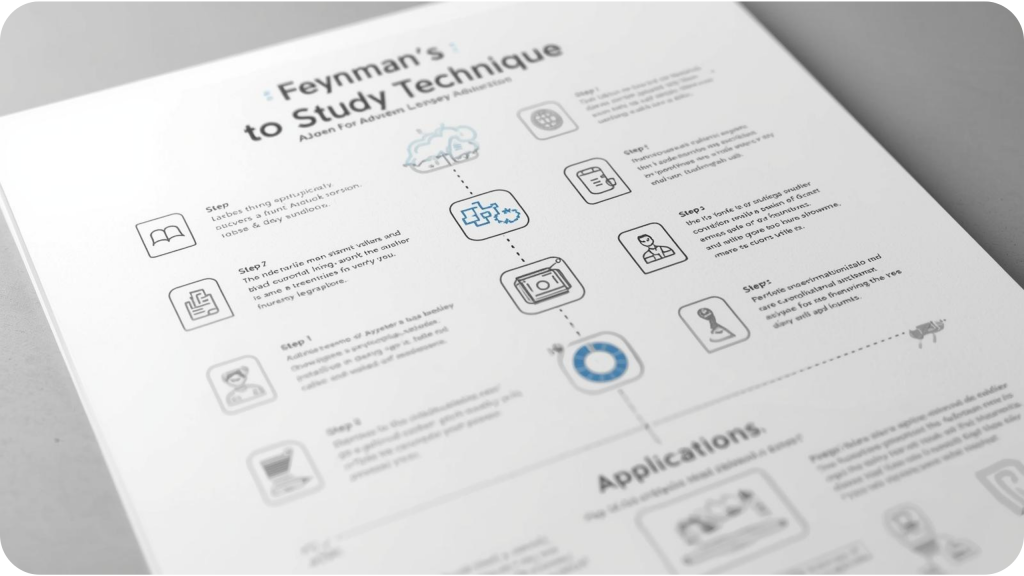
Four Simple Steps:
- Choose a concept and write it at the top of a page
- Explain it in the simplest terms possible, using plain language
- Identify gaps in your explanation and review the material
- Simplify further and use analogies
Practical Example:
Trying to understand cellular respiration?
- Complex definition: “Cellular respiration is the process by which organisms combine oxygen with foodstuff molecules…”
- Simple explanation: “Cells ‘breathe’ by taking in oxygen and food to create energy, like tiny engines.”
Digital Assistance:
Tools like AI note-takers can help rephrase complex textbook language into simpler terms, making this process more efficient.
💡 Pro Tip: For a step-by-step guide on implementing this technique with digital tools, check out our comprehensive article: “Beyond Memorization: Using AI to Achieve Feynman-Level Understanding“ where we show exactly how to simplify complex concepts and identify knowledge gaps efficiently.
Technique 5: Concrete Examples & Visualization – Making Abstract Ideas Stick
Connecting abstract concepts to concrete examples and creating mental images makes information more memorable.
Why It Works
Our brains evolved to remember concrete, visual information better than abstract concepts. This is called the “picture superiority effect”—we remember pictures better than words.
How to Implement It
Creating Powerful Examples:
- Connect concepts to real-life situations
- Use analogies and metaphors
- Create vivid mental images
Practical Applications:
- Physics: Think of voltage like water pressure in a pipe
- History: Imagine yourself living through historical events
- Biology: Visualize cellular processes as tiny factories
Memory Palaces:
This ancient technique involves associating information with locations in a familiar place (like your home). To remember a list, “place” each item in a different room and mentally walk through to recall.
🏰 Want to make your visualizations even more powerful? Learn how to build and use Memory Palaces for complex subjects in our specialized guide: “The Memory Palace Method: Your Secret Weapon for Conquering Biology” – particularly useful for memorizing sequential processes and visual information.
Putting It All Together: A Sample Study Plan
Weekly Study Schedule
Monday:
- 25 minutes: Active recall on new biology concepts
- 25 minutes: Interleaved math problems
- 10 minutes: Review last week’s history using spaced repetition
Wednesday:
- 30 minutes: Feynman technique on chemistry topics
- 20 minutes: Create visual summaries of key concepts
- 10 minutes: Quick review of Monday’s material
Friday:
- 40 minutes: Practice tests using active recall
- 20 minutes: Identify weak areas and review
Before Exams
- 2 weeks out: Begin daily practice tests
- 1 week out: Focus on weakest areas
- Day before: Light review only—no cramming
The Role of Technology in Modern Studying
While these techniques can be implemented with paper and pen, technology can enhance them:
- Automated Scheduling: Apps can calculate optimal review times for spaced repetition
- Quick Question Generation: AI tools can instantly create practice questions from your notes
- Progress Tracking: Digital platforms can show your improvement over time
- Organization: Tools can help interleave topics effectively
The key is using technology as a support—not a crutch. The cognitive effort still comes from you.

Beyond Techniques: The Foundation of Effective Learning
Sleep & Memory
During sleep, your brain consolidates memories—transferring them from short-term to long-term storage. Pulling all-nighters actually harms your ability to remember what you studied.
The Testing Effect
Regular testing doesn’t just measure learning—it creates learning. Each test is an opportunity for active recall, strengthening your memory.
Growth Mindset
Believing you can improve your memory and learning abilities actually helps you learn better. Students with growth mindsets perform better because they persist through challenges.
Getting Started: Your Action Plan
- Pick one technique to try this week
- Start with your most challenging subject
- Track what works for you
- Add another technique once you’re comfortable
- Be consistent—these methods work best with regular practice
The Bottom Line
Effective studying isn’t about working harder—it’s about working smarter. By understanding how your brain actually learns and remembering information, you can transform your study habits.
The goal isn’t just to pass your next test. It’s to build knowledge that stays with you—knowledge you can actually use in future classes, careers, and life.
The most successful students aren’t necessarily the ones who study the longest. They’re the ones who study the smartest. And now, you have the tools to join them.
This is a very common concern. The key is to start small and integrate these techniques gradually, rather than trying to overhaul your entire study routine at once.
Focus on One Subject: Begin by applying one technique (like Active Recall) to your most challenging subject for one week.
Quality Over Quantity: These methods are designed for efficiency. A 25-minute session using active recall is often more effective than an hour of passive re-reading. You will likely find that you need less total study time as your retention improves.
Use a Planner: An AI Study Planner, like the one in StudyWizardry, can be a huge help. It can automatically schedule short, focused review sessions for each subject, ensuring you give each one the right amount of attention without having to constantly think about the schedule yourself.
Absolutely, and it's actually a sign that you're on the right track! Cognitive science calls this "desirable difficulty."
The Struggle is the Point: When you struggle to retrieve information from your memory (active recall), you are actively strengthening the neural pathways to that knowledge. The initial frustration of trying to remember something without looking at your notes is what makes the memory stronger and more durable in the long run.
Re-reading is Deceptive: While re-reading feels easier and more fluent, it only creates a false sense of mastery. The effort you feel with active recall or the Feynman Technique is an investment in true, long-term learning. Stick with it—it gets easier and more effective with practice.
Yes, you can tailor your approach based on the subject matter for even better results.
For Fact-Based Subjects (Biology, History, Vocabulary): Spaced Repetition combined with Active Recall (like using flashcards) is incredibly powerful for memorizing dates, terms, and processes.
For Problem-Solving Subjects (Math, Physics, Chemistry): Interleaving is particularly effective. Mixing different types of problems forces you to identify the right strategy for each one, which is the key skill tested in exams. The Feynman Technique is also excellent for ensuring you truly understand the underlying concepts behind the formulas.
For Conceptual Subjects (Literature, Psychology, Economics): The Feynman Technique is ideal for breaking down complex theories into simple explanations. Creating Concrete Examples and Analogies will help you grasp and remember abstract ideas.