
The Silent Focus Killer: How to Reclaim Your Concentration in the Digital Age
The scene is universally familiar: textbook open, notebook ready, but your mind is wandering somewhere else entirely. Hours pass, and you’re still on the same first page. This daily reality for countless students results in long study hours with disappointing returns, creating a frustrating cycle of effort without achievement.
In reality, most students find their focus fragmenting throughout a study session. The constant battle against both internal thoughts and external notifications means that truly uninterrupted, deep focus is rare—and each interruption carries a hidden cost in time and mental energy.
🧠 Cognitive Neuroscience: How Focus Actually Works
The human brain is a complex system where understanding its workings can help us manage our attention better. Your prefrontal cortex acts as your attention control center, managing your attentional resources like an orchestra conductor directing a symphony of cognitive processes.
Your brain pays attention in three primary ways, each serving different learning purposes:
🎯 Focused Attention
This allows concentration on a single stimulus. When solving a complex math problem, you’re using focused attention. Research shows this type of attention peaks during morning hours when cortisol levels are optimal for deep concentration.
⏳ Sustained Attention
The ability to maintain focus over extended periods. When reading a long history chapter, you’re using sustained attention. Interestingly, the human brain can naturally sustain attention for 90-120 minutes before requiring significant cognitive recovery.
🔄 Divided Attention
This type of attention gives you the ability to focus on multiple stimuli or tasks simultaneously – like listening to a lecture while taking notes, or monitoring several information sources at once.
However, crucial warning: Decades of research in cognitive psychology consistently demonstrate that what we call ‘multitasking’ is actually rapid task-switching. The brain doesn’t process multiple attention-demanding tasks in parallel, but rather switches rapidly between them, creating what researchers call “switch costs” – the time and cognitive resources lost each time we shift attention.
This constant switching substantially reduces efficiency and significantly increases errors compared to focused, single-task work. A study by Rubinstein et al. (2001) found that even brief mental blocks created by shifting between tasks can cost as much as 40 percent of someone’s productive time.

🚫 The Invisible Enemies of Your Concentration
Sometimes the biggest barriers to academic progress are enemies we don’t see! These silent thieves of attention steal your valuable time and energy daily, often without your awareness. Understanding these focus killers is the first step toward building better study habits.
📱 The Digital Invasion: Enemy Number One
Each time your focus is broken by a notification, you lose more than just a few seconds. You lose the ‘flow state’—and it can take several minutes to rebuild that concentration, find your place again, and get back to the same level of understanding you had just moments before.
Practical Solutions:
- Implement digital minimalism during study sessions using app blockers
- Use focus-enhancing tools that minimize digital interruptions
- Schedule specific times for checking messages and social media
- Create physical distance from devices during critical study periods
😵 Cognitive Fatigue: When Your Brain’s Battery Drains
Mental exhaustion directly impacts learning quality. Signs of cognitive fatigue include slower reading speed, reduced comprehension, increased simple errors, and mental burnout that manifests as difficulty recalling recently studied information.
Students who lack adequate rest transfer less information to long-term memory. The solution lies in understanding your cognitive rhythms and respecting your brain’s need for recovery through scheduled breaks and proper sleep hygiene.
🔀 Multitasking: The Silent Productivity Killer
Contrary to popular belief, the human brain cannot truly multitask. What appears as multitasking is actually “rapid attention switching” that wastes significant focused time and drastically reduces productivity while increasing cognitive load and mental exhaustion.

💫 Evidence-Based Strategies to Reclaim Your Focus
Now that you know concentration’s enemies, it’s time to learn your defense weapons. These practical, proven strategies will help strengthen your focus and multiply study productivity through scientifically-validated methods.
🍅 The Pomodoro Technique: Time Management Mastery
Developed in the late 1980s by Francesco Cirillo, this technique remains one of the most effective time management methods for maintaining mental freshness during extended study sessions.
Implementation:
- Choose a specific task with clear objectives
- Set a timer for 25 minutes of undisturbed focus
- Focus exclusively on that task until time ends
- Take a 5-minute break for physical movement
- After four sessions, take a longer 15-30 minute break
Benefits:
- Prevents mental burnout through regular recovery
- Increases motivation through short-term rewards
- Improves time awareness and estimation skills
- Significantly enhances learning quality and retention
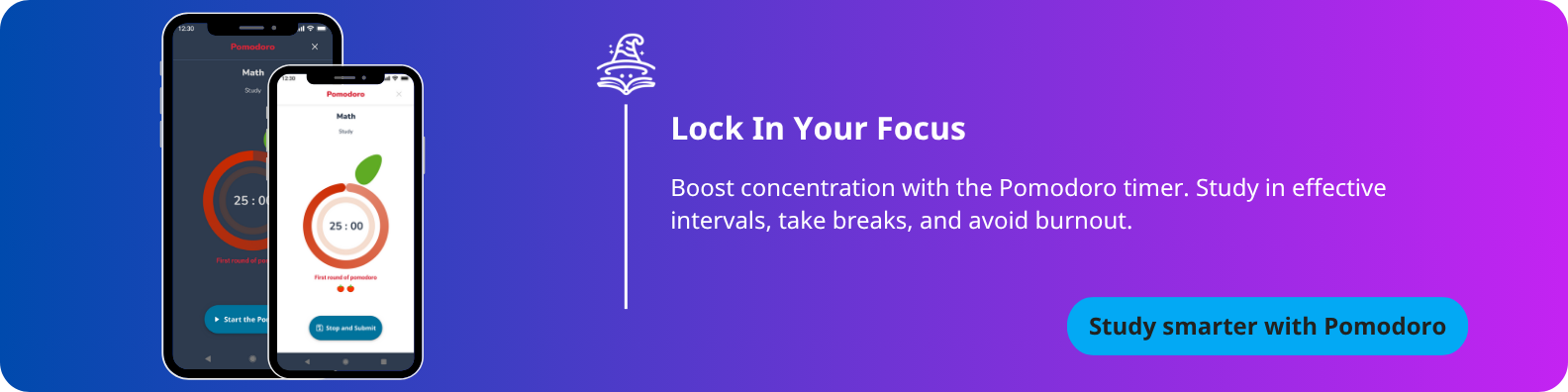
Many students find that using a dedicated study app like StudyWizardry with a smart timer system helps maintain consistency with this method, as it automatically tracks sessions and suggests optimal break times based on individual focus patterns and cognitive load.
Deepen Your Practice: For advanced strategies and scientific insights into customizing Pomodoro for different subjects, explore our comprehensive guide: Master the Pomodoro Technique

🌿 Optimized Study Environment: Designing a Distraction-Free Zone
Your physical environment directly impacts focus quality more than most students realize. Research in environmental psychology consistently shows that factors like lighting, noise, and organization have a significant and measurable impact on concentration and cognitive performance.
For an ideal study space:
-
Lighting: Use natural light when possible. Choose white or yellow desk lamps and avoid harsh fluorescent lighting that causes eye strain and headaches.
-
Workspace Design: Keep your desk organized with only essential materials. Use an ergonomic chair that supports proper posture. Maintain room temperature between 22-24°C (72-75°F). Studies in environmental ergonomics have consistently shown that temperatures outside this comfort zone can significantly impair cognitive performance, increasing mental fatigue and reducing learning efficiency.
-
Noise Control: Use brown noise or instrumental music if background sounds help your concentration, but avoid lyrics that compete for linguistic processing resources.
🧘 Mindfulness Practice: Your Brain’s Gym
Mindfulness exercises strengthen your brain’s ability to control attention through neuroplasticity—the brain’s remarkable capacity to reorganize itself based on repeated experiences and training.
🌬️ Deep Breathing Exercise: Spend 5 minutes daily focusing on your breath. When your mind wanders, gently bring it back without self-criticism. This simple but powerful exercise works by calming the nervous system and reducing beta wave activity in the brain, creating the mental space for deeper focus. Regular practice is shown to significantly improve your ability to regain attention after a distraction.
🔍 Body Scan Practice: Move your attention from head to toe, observing each body part without judgment. Practice for 10 minutes daily. This helps you shift from autopilot to full awareness, training your attention muscle like weightlifting trains physical muscles.
📊 Smart Planning: Your Roadmap to Success
Effective planning has three key elements: realism, specificity, and balance. Your plan should match your capabilities with adequate rest time built into the schedule, not just added as an afterthought.
Goals should be measurable, with specific objectives for each study session that allow for clear progress tracking. Balance different subjects based on difficulty and your personal energy patterns throughout the day, and always include scheduled time for review and consolidation.
Modern study platforms like StudyWizardry incorporate AI-driven planning that adapts to your progress, automatically adjusting schedules based on your actual performance and focus patterns rather than rigid timetables. These systems can identify your most productive hours and suggest optimal study sequences based on subject difficulty and your historical performance data.
🤖 When Technology Becomes Your Focus Ally
In the digital age, technology can be both a focus enemy and ally. Modern educational tools offer specialized features that can transform your device from a source of distraction into a concentration assistant through intentional design and cognitive science principles.
Intelligent Study Systems can help structure your workflow through:
- Smart timer systems that optimize study intervals based on cognitive science research
- Progress tracking that identifies your most productive hours through data analysis over time
- Focus-enhancing environments that minimize digital temptations through interface design
- Adaptive scheduling based on your personal concentration patterns and energy fluctuations
For challenging academic work, platforms like StudyWizardry offer integrated problem-solving tools that provide step-by-step explanations, helping you overcome sticking points without losing focus searching for answers elsewhere. This maintains cognitive flow while ensuring conceptual understanding.
Digital note-taking systems can automatically organize your materials and generate study aids like flashcards and quizzes, saving the mental energy you’d spend on administrative tasks for actual learning. StudyWizardry’s AI Note Maker, for instance, can transform disorganized notes into structured outlines and identify key concepts automatically.
Intelligent study planners like those in StudyWizardry incorporate spaced repetition algorithms that schedule reviews at optimal intervals for long-term retention, eliminating the guesswork from when to revisit material and ensuring maximum efficiency in your study sessions.
🍎 The Foundation: Nutrition and Sleep’s Role in Concentration
Your brain represents only 2% of body weight but consumes 20% of daily energy. Proper brain nutrition requires attention to essential nutrients that support cognitive function and neurotransmitter production.
Omega-3 from fish, walnuts, and flaxseed is crucial for brain cell membrane health and communication. Antioxidants from berries, dark chocolate, and leafy greens protect your brain from oxidative stress. B vitamins from whole grains, eggs, and legumes are vital for brain energy metabolism and neurotransmitter synthesis.

😴 Sleep: The Brain’s Reset Button
Adequate sleep is essential for optimal concentration and memory consolidation. During sleep, your brain processes information from the day, strengthens neural connections, removes waste toxins, and transfers information from hippocampal short-term storage to cortical long-term memory.
Research shows students who get 8-9 hours of quality sleep retain academic material better and show improved problem-solving abilities compared to sleep-deprived peers. Deep sleep stages are particularly important for consolidating declarative memory—the type used for factual recall in most academic subjects.
Some study platforms like StudyWizardry include smart alarm systems that coordinate with your study schedule to ensure consistent sleep patterns, recognizing that rest is just as important as study time for academic success. These systems can analyze your study patterns and suggest optimal bedtime routines to maximize cognitive restoration.
🏁 Conclusion: Yes, You Can Improve Your Focus
Enhanced concentration is an acquired skill that strengthens with practice and persistence, not an innate trait that some possess and others lack. Start today by implementing the Pomodoro technique, optimizing your study environment, practicing daily mindfulness, and creating realistic planning that respects your cognitive limits.
Remember: Quality of study trumps quantity in virtually every learning scenario. Two hours of focused, deliberate study far outweighs six hours of distracted effort in terms of both learning outcomes and mental exhaustion. With consistent practice and scientific strategies, you can significantly improve your concentration and achieve better results while reducing total study time.
The journey to better focus begins with small, consistent steps—perhaps starting with just one Pomodoro session daily or five minutes of mindfulness practice. What matters most is beginning the process and maintaining consistency, allowing your brain’s attention networks to strengthen through repeated exercise.
True productivity isn’t about having more hours; it’s about creating more focused moments within the hours you have. The most successful students aren’t necessarily those who study longest, but those who study smartest—transforming scattered attention into concentrated power that drives meaningful learning and academic achievement.
With regular practice of proper techniques, most students notice significant improvement within 3-4 weeks. The key is consistency and using strategies that match your learning style and personality. Cognitive training requires patience, much like physical exercise produces gradual rather than instantaneous results.
This typically stems from three main factors: cognitive fatigue without adequate rest, study environments full of distractions, and poorly structured planning that lacks balance between study and recovery. Many students also underestimate the impact of poor sleep, nutrition, and hydration on attention capabilities.
When used intentionally, yes. The right tools can provide structure through focused timing systems, intelligent planning based on your energy patterns, detailed progress analytics, and environments designed to minimize distractions while maximizing learning efficiency through organized materials and adaptive practice systems. Platforms like StudyWizardry are specifically designed to enhance rather than disrupt concentration through features that reduce cognitive load and automate administrative tasks.
StudyWizardry incorporates multiple focus-enhancing features including smart Pomodoro timers that adapt to your concentration span, AI-powered study planning that prevents cognitive overload, progress analytics that identify your most productive patterns, and integrated tools that reduce context-switching between different study resources. The system is designed to create an ecosystem where technology supports rather than interrupts deep work.