Your AI Study Buddy Is Dumb If You Don’t Ask It These 5 Prompts
You’re staring at a blank document, the clock is ticking, and your 2000-word essay is due tomorrow. In a moment of desperation, you open your AI study app, type in your essay prompt, and hit enter. The response is… fine. It’s generic, surface-level, and reads like a slightly polished Wikipedia summary. A sinking feeling sets in. You have access to one of the most powerful learning tools ever created, yet you’re still stuck.
Here’s the insight you need: Your AI study buddy isn’t limited—your questions might be.
Treating advanced AI like a simple Google search bar is the most common mistake students make. The real power isn’t just in the tool itself; it’s in the instructions you give it. These instructions are called “prompts,” and crafting a powerful prompt is the difference between getting a robotic, mediocre answer and unlocking a personalized, master-level tutoring session that can transform your understanding and grades.
Think of it like this: you wouldn’t hand a master chef a single, unpeeled potato and expect a gourmet meal. You need to provide a recipe, the right ingredients, and clear guidance. Your AI is that chef. A vague question is the potato. A strategic prompt is the full recipe for success.
The following five prompts are strategic frameworks designed to unlock the full potential of tools like our Homework Solver and Advanced Math Solver. They will teach you how to command your AI, turning it from a basic answer-bot into a critical thinking partner, a logic debugger, and an exam-strategy powerhouse. Stop settling for less. Start commanding more.
Prompt 1: The “Deconstruct & Conquer” Framework
(For: Mastering Complex Word Problems in Math, Physics, & Engineering)
❌ The Ineffective Ask: “Solve this calculus problem.”
(You’ll get a raw answer with no insight, leaving you helpless on the next, slightly different problem.)
✅ The Genius Prompt:
**”Act as an expert [Subject, e.g., Physics] tutor. I am a beginner struggling with the underlying concepts. For the following problem: ‘[Paste Problem]’, please do NOT give me the final answer immediately. Instead:
Break the problem down into 3-4 fundamental conceptual or procedural steps.
For each step, explain the core principle or rule we are applying and why it’s the logical next step.
Guide me through solving the first step completely.
Then, ask me a leading question to prompt me to attempt the next step myself.”**
Why This is a Game-Changer:
This prompt uses the powerful “Act as an expert [role]” primer, which shifts the AI’s mindset from an answer-generator to a teacher. By forbidding the final answer, you force the process of learning. The AI will mimic Socratic dialogue, making you an active participant. This is crucial for subjects where the methodology is everything. You’re not just getting the “what,” you’re mastering the “how” and “why,” building a mental framework you can apply to any future problem.
*Pro Tip: Use this with our Advanced Math Solver on a challenging integration-by-parts problem. Watch it identify the choice of ‘u’ and ‘dv’ as Step 1, explain the ILATE rule as the ‘why,’ and then patiently walk you through the differentiation and integration. It’s like having office hours on demand.*

Prompt 2: The “Explain It To Me & A 5th Grader” Framework
(For: Conquering Dense Concepts in Biology, History, Economics, or Literature)
❌ The Ineffective Ask: “Explain the Krebs Cycle.”
(You’ll get the same textbook definition you’ve already glossed over three times.)
✅ The Genius Prompt:
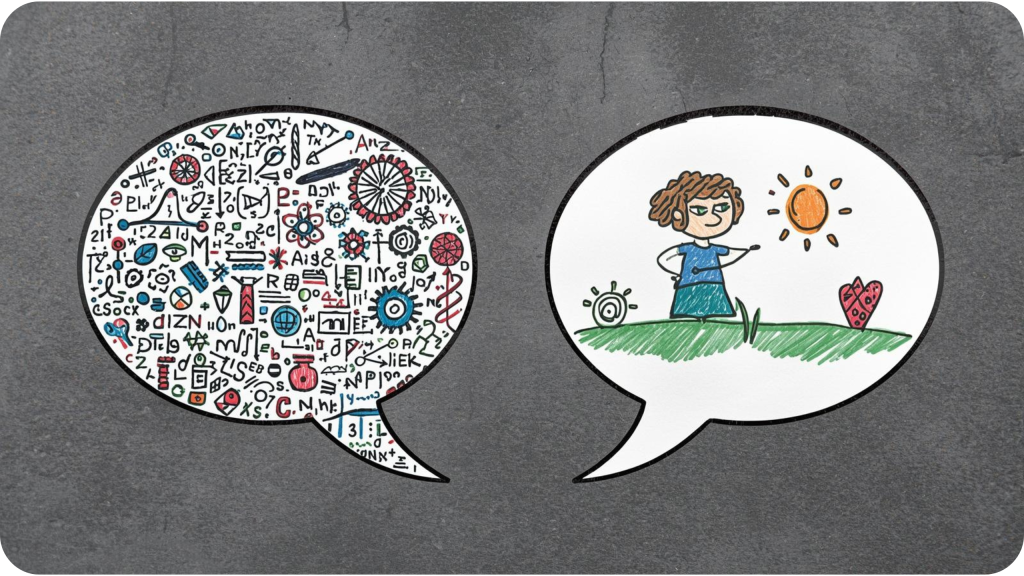
“Explain the concept of ‘[Complex Concept, e.g., Quantum Entanglement]’ on two distinct levels.
Level 1 (The Exam): Provide a detailed, comprehensive explanation suitable for a college-level exam, including key terminology, mechanisms, and theorists.
Level 2 (The 5th Grader): Immediately after, re-explain the same concept as if you are talking to a curious, smart 10-year-old. Use a simple, vivid analogy (e.g., ‘It’s like two magical dice that always show the same number, no matter how far apart they are…’).
Finally, based on both explanations, generate one multiple-choice question to test my factual recall and one short-answer question to test my conceptual understanding.”
Why This is a Game-Changer:
This prompt operationalizes the Feynman Technique, one of the most revered learning methods globally. True mastery is proven by the ability to simplify. The dual-layer explanation ensures you grasp both the nuanced details for your grade and the foundational, intuitive “big picture” for true comprehension. The AI-generated questions then serve as instant, targeted retrieval practice, cementing the knowledge.
Pro Tip: After receiving the explanation, take the core analogy to our Flashcards feature and prompt: “Create 3 flashcards using cloze deletion based on the ‘5th Grader’ explanation of [Concept].” This bridges understanding to memorization perfectly.
Prompt 3: The “From Blank Page to A+ Outline” Framework
(For: Architecting Essays, Research Papers, and Capstone Projects)
❌ The Ineffective Ask: “Help me write an essay about post-colonial theory.”
(You’ll risk a generic, potentially plagiarized-sounding paragraph that lacks your voice or critical thought.)
✅ The Genius Prompt:
**”I need to write a [Type: e.g., Argumentative Essay] on the topic ‘[Your Topic]’. My tentative thesis statement is: ‘[Your Working Thesis]’.
Act as my brainstorming partner and editorial advisor.
Generate a detailed, logical outline with Roman numerals (I, II, III) for main arguments and capital letters (A, B, C) for sub-points and evidence.
For at least two of the sub-points, suggest one potential piece of scholarly evidence (a study, theorist, or historical example) I could research.
Most importantly: Critique the outline you just provided. Identify one potential weakness in the logical flow or one counter-argument that a reader might raise. Suggest how I could strengthen that section.”**
Why This is a Game-Changer:
This prompt establishes you as the project leader and the AI as your strategic consultant. By providing your thesis, you maintain intellectual ownership and creativity. The AI’s job is to provide the scaffolding and, crucially, to stress-test it. This moves you beyond structure into critical analysis before you write a single full sentence, saving you hours of rewriting. It turns your AI Note Maker into a powerful ideation engine.
Prompt 4: The “Find My Fatal Flaw” Framework
(For: Debugging Your Drafts Before Submission)
❌ The Ineffective Ask: “Check my paper for grammar and spelling.”
(You’ll get a surface-level edit that misses the deeper, more costly flaws in logic and argument.)
✅ The Genius Prompt:
**”You are now a harsh but fair professor grading my [Assignment Type: e.g., Philosophy Argument Paper]. Please perform a ‘Devil’s Advocate’ review of the following draft: ‘[Paste Your Draft]’.
Ignore minor grammatical errors for now. Focus exclusively on the strength of the argument:
Identify the single weakest link in my logical chain and explain why it is vulnerable.
Point out one place where I have made an unwarranted logical leap or assumption.
Pose the most potent counter-argument a knowledgeable peer might raise against my central thesis.
Finally, assess whether my conclusion actually follows strongly from the evidence I presented, or if it feels rushed or under-supported.”**
Why This is a Game-Changer:
This is critical thinking training wheels. It explicitly tells the AI to ignore low-order concerns and attack the substance of your work—the very thing your professor will do. It simulates the peer-review process, exposing weaknesses while you still have time to fix them. Using this prompt consistently trains you to anticipate criticism and build more robust, persuasive arguments, which is the hallmark of A+ work.
*Pro Tip: After revising your draft with this feedback, go to your Quiz/Test Generator and prompt: “Based on this revised paper on [Topic], generate 2 potential exam questions that test application of its core ideas to a new scenario.” You’ve just predicted part of your exam.*
Prompt 5: The “Connect the Dots” Synthesis Framework
(For: Final Exam Prep & Advanced Topic Integration)
❌ The Ineffective Ask: “Summarize the causes of World War I.”
(You’ll get an isolated list, disconnected from the broader themes of your history course.)
✅ The Genius Prompt:
**”I am studying for a comprehensive final exam. Act as an expert examiner.
Here is core information on Topic A: [Paste/Summarize Notes on Topic A].
Here is core information on Topic B: [Paste/Summarize Notes on Topic B].
First, create a comparative table highlighting 3 key thematic parallels and 3 significant divergences between these two topics.
Next, synthesize this information: Generate one complex, integrative essay question that requires the use of concepts from both Topic A and Topic B to answer effectively.
Finally, provide a brief scoring rubric for that essay question, outlining what an ‘A’ response would need to include.”**
Why This is a Game-Changer:
Professors don’t just test facts; they test connections. This prompt forces the AI to perform the high-level cognitive work of synthesis for you, modeling how to think like an expert. The resulting comparative table and, especially, the predicted integrative essay question are pure academic gold. This prompt doesn’t just help you study; it helps you study strategically, focusing your precious revision time on the higher-order thinking that wins top marks.
Conclusion: Stop Asking, Start Strategizing
The shift from a passive user to a strategic “AI conductor” is the defining study skill of this decade. These five prompts are your blueprint. They move you beyond treating AI as a crutch for answers and towards leveraging it as a gym for your mind—a space to train logic, clarity, synthesis, and self-critique.
The goal is not to let the AI think for you, but to use it to think better than you ever have on your own. It amplifies your effort, providing structure, immediate feedback, and perspective that was once only available through expensive tutors or inaccessible professors.
Your Action Step: Open your StudyWizardry app right now. Choose the prompt that addresses your most immediate academic pain point. Execute it with your actual material. Witness the qualitative leap in the output. That leap is the sound of your potential being unlocked.
The tools are here. The power is in your prompts. Take command.
About StudyWizardry
Our mission is to transform passive studying into active mastery. The AI tools in our app—like the Homework Solver, Advanced Math Solver, and AI Note Maker—are built not just to give answers, but to build deep understanding. These prompts are designed based on proven learning science to help you leverage that technology to its fullest, turning study time into a strategic, efficient, and deeply effective journey toward academic excellence.
Absolutely not, if used correctly. These prompts are designed to teach you, not to do the work for you. They force explanation, breakdown, and critique—active cognitive processes. You are using AI as a interactive simulator for expert tutoring, which enhances your own understanding and skill development. It’s the difference between watching a master solve a puzzle (passive) versus having the master guide your hands while explaining each move (active learning). Always submit work that is ultimately your own, informed and improved by this process.
This is where iteration comes in. Treat the first output as a draft. You can engage in a dialogue:
Refine: “Your explanation for Step 2 is still too technical. Can you use an even simpler analogy?”
Challenge: “The counter-argument you suggested is weak. What would be a stronger challenge to my thesis?”
Redirect: “You’re focusing on X, but I’m more confused about Y. Shift focus to Y.”
This iterative dialogue is where true mastery happens, mimicking a real-time tutoring session.
Not at all. The framework is universal.
For Languages: Use Prompt #2 to explain a complex grammar rule, then have it generate example sentences with blanks for you to fill.
For Art History: Use Prompt #5 to connect the artistic techniques of the Renaissance to those of the Baroque period.
For Programming: Use Prompt #1 to deconstruct a complex algorithm or debug error messages.
The core principle—priming the AI with a specific role, a clear task, and a focus on process—applies to every field of study.