
The Planning Trap: Why Your To-Do List Fails and How the AI Study Planner Fixes It
You know the ritual. Sunday evening, a clean page, a sense of control. You write: “Read Biology Chapter 5,” “Start history essay,” “Review calculus problems.” It feels productive. Organized. Like you’ve already done the work. But by Wednesday, that list has become a silent source of guilt—a monument to your ambition, mocking your reality. You complete tasks, yet the mountain never shrinks. You feel busy, but not effective.
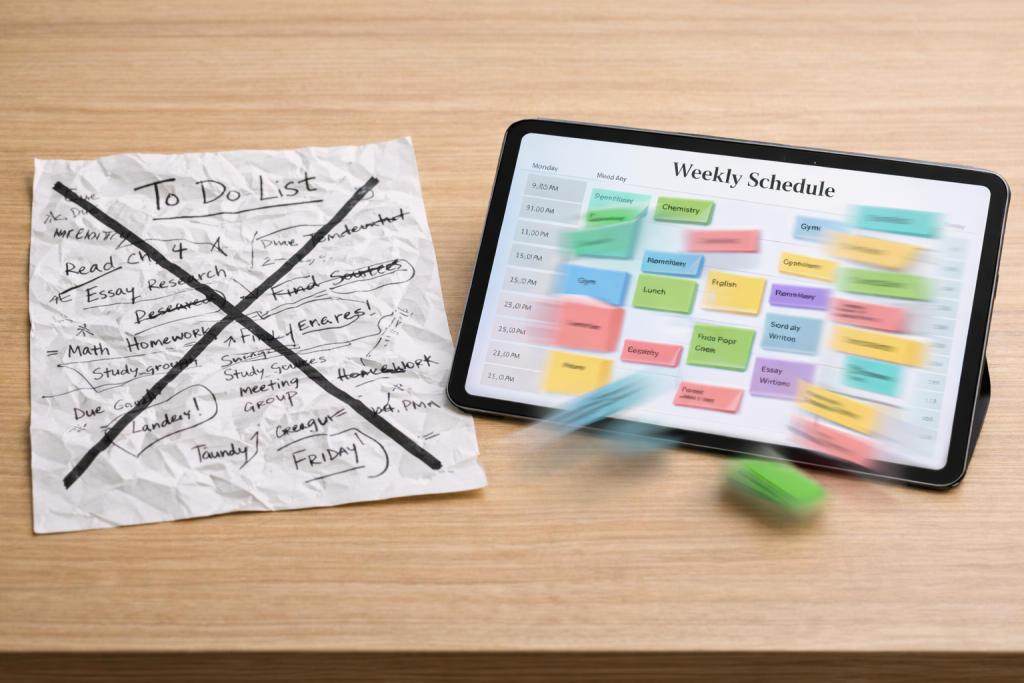
This is The Planning Trap. It’s not a failure of your willpower; it’s a failure of your system. The traditional to-do list is a relic for a simpler time, utterly unequipped for the complex, cognitive marathon of modern learning. It captures the what but ignores the when, the how long, and the crushing weight of your cognitive limits. This article dismantles the myth of the simple list and introduces the engineered solution: moving from a passive catalog of wishes to an intelligent, adaptive Cognitive Project Plan.
The First Flaw: The Tyranny of the “What” (Ignoring Time and Energy)
Your to-do list treats “Read 30 pages of Neuroscience” and “Email professor” as cognitive equals. It’s a flat landscape. But your brain isn’t flat. It runs on cycles of energy, focus, and context. A task’s true cost isn’t in its description, but in the cognitive currency it demands.
A list item like “Write essay” is a black box. It doesn’t account for the 20 minutes of “warm-up” staring at a blank page, the mental exhaustion after 45 minutes of deep writing, or the fact that you’re a night owl trying to do analytical work at 8 AM. This flaw creates planning fallacy—our universal tendency to underestimate how long tasks will take. The list promises a feasible day, but your brain knows it’s a lie, creating immediate psychological resistance.
The AI Planner Fix: From Tasks to Time-Boxed Sessions
An intelligent planner doesn’t let you just list tasks; it forces you to schedule them. It asks the critical questions a list ignores: “How long will this truly take?” and “When are you best equipped to do it?”
-
Action: Instead of writing “Study Chemistry,” you task the AI Study Planner with: “Master Chemical Bonding concepts.” The planner, referencing past session data or common benchmarks, suggests a realistic 90-minute block. It then guides you to place this block during your diagnosed peak focus time (e.g., late morning).
-
Outcome: Your plan is no longer a wish list. It’s a realistic simulation of your day. You see the true opportunity cost: choosing to schedule that 90-minute chemistry block means you cannot also schedule a 2-hour movie. This creates honesty with yourself and reduces anxiety.
🧠 The Planning Fallacy: Your Brain’s Built-In Optimism Bias
Coined by psychologists Daniel Kahneman and Amos Tversky, the Planning Fallacy is our predictable tendency to underestimate the time, costs, and risks of future tasks, while overestimating the benefits. We plan based on a “best-case scenario” narrative, ignoring past data and potential obstacles. This is why your “3-hour to-do list” routinely takes 6 hours. An AI-driven system counteracts this by using data—either from your own history or aggregate student data—to provide realistic time estimates, grounding your optimism in reality.
The Second Flaw: It’s Dumb (No Memory, No Adaptation)
Your paper list has no memory. It doesn’t remember that “Review Spanish vocab” took you 40 minutes last Tuesday because you were tired. It doesn’t adapt when your 10 AM class gets cancelled, freeing up a golden hour. It’s static in a dynamic life. This forces you to constantly replan, re-prioritize, and make decisions—a constant drain of mental energy that should be spent on actual learning.
Every time you look at your list and think, “What should I do next?” you waste focus. This is decision fatigue, and it makes you more likely to choose the easiest, least important task just to feel progress.
The AI Planner Fix: A Dynamic, Learning System
The AI Study Planner is built to learn and adapt. It’s your cognitive project manager, handling logistics so your prefrontal cortex can handle the deep work.
-
Action: You log a completed session on “Organic Chemistry Mechanisms.” The planner logs the duration and your self-rated difficulty. Over time, it learns your personal pace. Next time you schedule a similar topic, its time estimate is more accurate, personalized to you.
-
Action: Your friend proposes an unexpected study group. Instead of derailing your entire plan, you open the planner, drag your “Read History Chapter” block to a new time slot, and the system automatically adjusts the rest of your day’s flow.
-
Outcome: Your plan is resilient and personal. It reduces daily decision-making to near zero. You open the app and it tells you, “Your next scheduled task is a 50-minute Focus Sprint on Physics Problem Set 3, starting in 5 minutes.” The barrier to starting evaporates.
The Third Flaw: It Demotivates (The Zeigarnik Effect & Missing Rewards)
The to-do list is a master of guilt but a miser with rewards. It screams about what’s undone (thanks to the Zeigarnik Effect—our mind’s tendency to cling to unfinished tasks) but stays silent on your wins. Checking off “Do laundry” feels trivial; it doesn’t reflect that you just completed three hours of intense, focused study. This lack of positive reinforcement drains motivation over time, making the list itself a symbol of burden.
The AI Planner Fix: Visual Progress and Gamified Momentum
Intelligent planning transforms completion from a checkbox into a visual narrative of progress. It turns the grind into a game you can win.
-
Action: You complete your scheduled blocks. The planner’s Progress Reports generate charts—time invested per subject, consistency streaks, tasks completed. You don’t just feel productive; you see the data.
-
Action: The integrated Leaderboard and achievement systems add a layer of friendly social accountability and intrinsic reward. Completing your daily plan isn’t just done; it’s a “Daily Quest” accomplished.
-
Outcome: Motivation shifts from external (the scary list) to internal (the satisfying growth shown in your data and the thrill of maintaining a streak). You’re not running from guilt; you’re running toward a visible, rewarding version of your academic self.
⚡ Cognitive Triage: Why Your Brain Loves a Smart Schedule
In emergency medicine, triage is the process of deciding the order of treatment based on urgency. Your brain performs constant cognitive triage. An overwhelming, unsorted to-do list forces it to triage under stress, wasting energy. A smart schedule performs triage *for* your brain, in advance. By making strategic decisions about priority, sequence, and duration beforehand, you pre-empt decision fatigue. When it’s time to work, your brain’s directive is simple: execute the next item on the pre-approved, logically-sequenced plan. This preserves willpower for the hard work of learning itself.
Case Study: From List Manager to Project Architect
Alex, a second-year pre-med student, lived and died by his color-coded to-do lists. Yet, he was chronically behind, pulling all-nighters before exams. His lists were full, but his understanding was shallow.
The Shift: He replaced his list with the AI Study Planner.
-
Week 1: He used the Smart Scheduling to block out his fixed commitments (classes, lab). Then, he added his goal: “Prepare for Midterms in 3 weeks.” The planner automatically suggested a daily study schedule, distributing Biology, Chemistry, and Physics review evenly.
-
Week 2: After a few sessions, he rated “Biochemistry pathways” as very difficult. The planner automatically adjusted, allocating more review time to that topic in the following week and suggesting linked Flashcard sessions.
-
Week 3: Instead of a frantic, anxious cram, Alex followed his adaptive plan. His Progress Dashboard showed 40+ hours of deliberate practice. He walked into exams not with a checked-off list, but with the confidence of a project completed.
Conclusion: Upgrade Your Planning Operating System
The to-do list is a tool for recording intentions. The AI Study Planner is a system for engineering accomplishment. It replaces the three fatal flaws—timelessness, stupidity, and demotivation—with structure, intelligence, and reinforcement.
This isn’t about working harder; it’s about planning with the grain of your cognitive psychology. It’s about outsourcing the job of project manager to an intelligent system so you can focus on being the expert learner.
Your first migration step is simple: For one day, do not write a to-do list. Instead, open the AI Study Planner. Take just one major goal, break it into 2-3 key actions, and schedule them as specific time blocks in your calendar. Execute. At the day’s end, review your progress. Feel the difference between checking a box and completing a planned, respected appointment with your own success. This is the foundation upon which academic mastery is built.
This is a key misunderstanding. Rigidity is the flaw of the brittle to-do list that shatters when life happens. The AI Planner is the opposite—it's flexible by design. When a spontaneous event occurs, you can easily drag and drop your scheduled blocks to a new time. The system automatically handles the ripple effects, preserving your plan's integrity. It brings order, not rigidity, allowing for intelligent adaptation.
A calendar is a great place to put a smart plan, but it doesn't create the plan. You still face the planning fallacy alone. The AI Planner is the strategic layer atop your calendar. It helps you decide what to put where, for how long, based on your goals, past performance, and cognitive patterns. It's the difference between having a blank canvas and having a smart architectural assistant for building your week.
Absolutely. In fact, it's better for visual learners. The transformation from a linear, text-based list to a color-coded, visual timeline in the planner is a massive upgrade. You see your week as a balanced landscape of work and rest, your progress as growing charts, and your priorities via color. It translates the abstract pressure of a list into a concrete, manageable map.