
Last-Minute Exam Prep AI: The Ultimate 24-Hour Rescue Plan
The clock is ticking. A cold wave of dread washes over you as you stare at the mountain of untouched textbooks, a semester’s worth of lectures crammed into disorganized notes, and the stark reality of an exam that begins in just one day. The all-nighter, fueled by panic and caffeine, looms—a ritual known for its high stress and notoriously low return on investment.
But what if you could approach these 24 hours differently? What if, instead of chaotic, passive rereading, you launched a precise, tactical rescue mission for your grade? The secret lies in deploying strategic, AI-powered protocols designed for extreme time constraints. This isn’t about learning everything; it’s about strategically securing enough points to pass, and even excel.
Your goal shifts from “knowing all the material” to “maximizing the points I can grab.” Here are three AI-fueled game plans to execute in your final hours.
🎯 Game Plan 1: The Targeted Flashcard Blitz – Find and Fix the Leaks
Passively rereading your entire syllabus is the greatest trap of last-minute studying. The Targeted Flashcard Blitz bypasses this by forcing active recall—the single most effective way to strengthen learning under pressure.
The 3-Step Blitz Protocol:
-
Diagnose & Extract (The 60-Minute Triage): Use an AI-powered tool like the AI Note Maker or PDF Summarizer in StudyWizardry to perform emergency triage. Use a smart command like:
*”Scan the attached lecture notes for Chapter 5 on [Topic]. Identify and list only the 15-20 most crucial definitions, formulas, dates, or key concept names.”*
In minutes, you have a distilled list of high-yield targets. -
Create & Engage (The Core Attack): Feed that list into an AI Flashcard Generator. A platform like StudyWizardry can turn your list into study cards with a smart prompt:
“Create concise flashcards from this list. For each term, generate a question that tests application, not just rote memory. For ‘Photosynthesis,’ ask: ‘What would be the immediate consequence on glucose production if the light-independent reactions were blocked?'”
This forces you to think about how concepts work. -
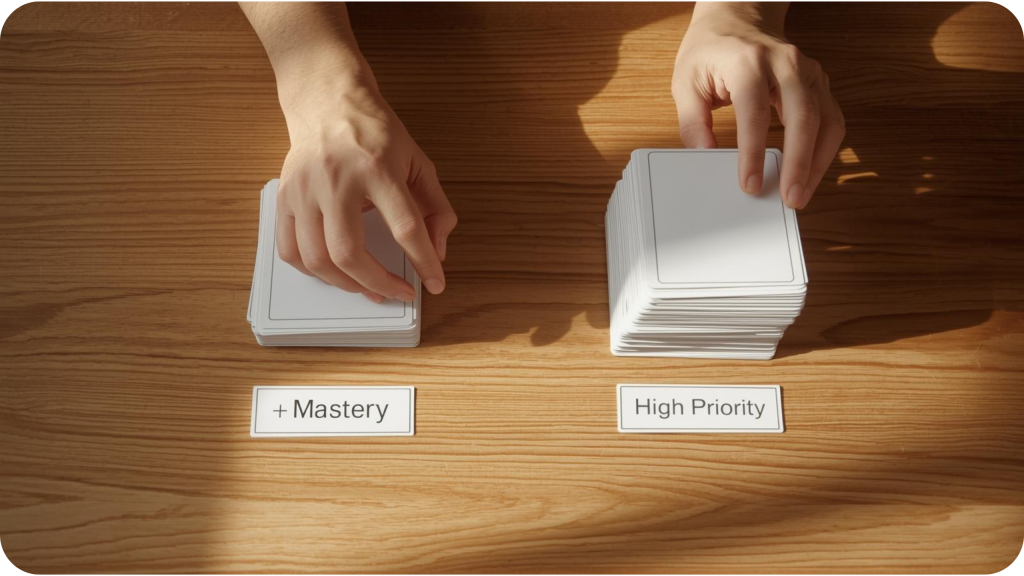
The Brutally Efficient Review Cycle: Run through flashcards using the Pomodoro Technique (25 min on, 5 off). Sort cards into two piles:
-
✅ Mastered
-
🔥 High-Priority (for hesitant or wrong answers)
Focus 80% of your remaining time on the High-Priority pile. This system auto-targets your weak points.🎯 Deepen Your Flashcard Strategy! Mastered the Flashcard Blitz? For a targeted guide on using these techniques to ace exams like the IELTS, explore our full resource: Build Your IELTS Vocabulary with Smart Flashcards.
-
📝 Game Plan 2: The Predictive Exam Simulator – Practice Under Real Conditions
The pressure and format of an exam can unravel anyone. This plan removes the surprise factor by having you practice the exact cognitive actions you’ll need.
How to Build Your Simulation:
-
Source Your “Question Bank”: Gather past quizzes, chapter summaries, and slide decks. Use an AI Quiz Generator, such as the one in StudyWizardry, with a command like:
*”Analyze the attached materials on ‘Macroeconomics Policy.’ Generate a 20-question practice exam with 10 MCQs on definitions, 5 short-answer questions comparing concepts, and 5 calculation problems. Provide a separate answer key.”*
Instantly, you have a tailored practice test. -
Execute Under Exam Conditions: This is non-negotiable. Set a timer for the actual exam’s duration. Silence your phone. Take the full test in one sitting to condition your brain for the marathon.
-
Analyze, Don’t Just Grade: For every mistake, ask: “Why did I get this wrong?”
-
🧠 Knowledge Gap: Didn’t know the fact. → Return to Game Plan 1 for this concept.
-
❓ Misunderstood Question: Misread the prompt. → Practice parsing keywords (“contrast” vs. “describe”).
-
⚙️ Process Error: Careless mistake. → Note to double-check steps under pressure.
This turns every wrong answer into a precise action item.
-
🗺️ Game Plan 3: The Conceptual Map Sprint – See the Big Picture in Minutes
For exams testing interconnected ideas (humanities, social sciences), you need to see how concepts fit together. This plan builds a visual “cheat sheet for the mind.”
The Rapid Mapping Protocol:
-
Feed the AI Your Chaos: Take messy notes and feed them into an AI Note Maker. Using a tool like StudyWizardry’s note maker with a synthesis prompt can work wonders:
*”I have disjointed notes on [The Causes of the French Revolution]. Synthesize them into a hierarchical outline. Identify 3-5 main overarching themes and list 3-4 sub-points for each.”*
-
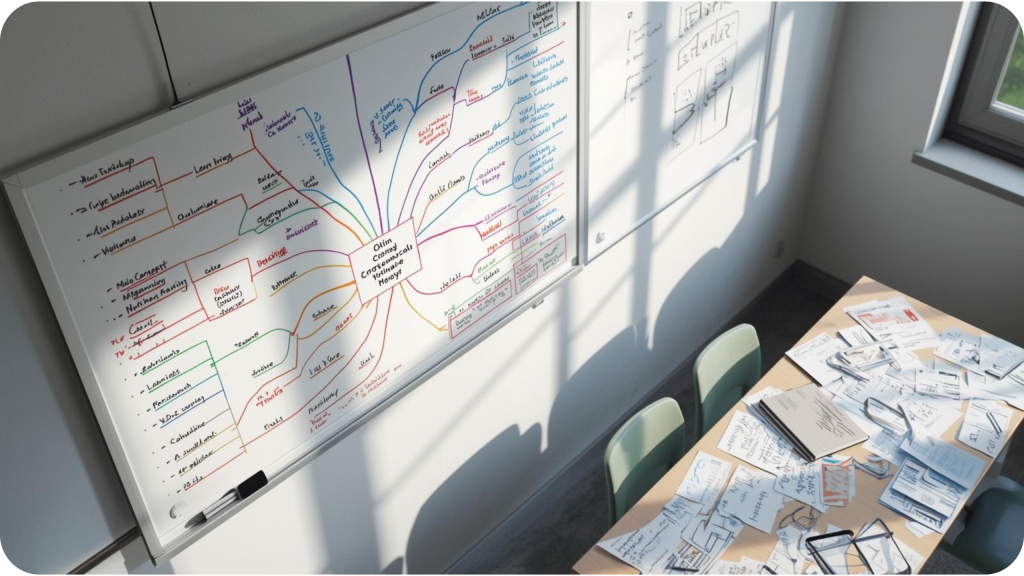
From Outline to Visual Map: Transform that outline into a mind map. Place main themes in the center, draw branches to sub-points, and use different colors. Creating this spatial layout yourself is a powerful memory encoder.
-
Narrate the Story: Perform a narrative recall. Using your map, explain the entire topic out loud as if to a friend. This Feynman Technique-style narration proves you understand relationships, not just facts—the exact skill needed for essay questions.
🔀 Choosing Your Mission: Build Your Hybrid Plan
Not all exams are equal. Choose and combine your primary game plan based on the test format.
| Exam Type & Subjects | Primary Game Plan | Key Support Tool & Tactic |
|---|---|---|
| Fact/Formula-Based (Biology, History, Chemistry) |
Game Plan 1: Flashcard Blitz | Game Plan 2: Use StudyWizardry’s Quiz Generator for question recognition practice. |
| Problem-Solving (Math, Physics, Engineering) |
Game Plan 2: Exam Simulator | Use StudyWizardry’s Advanced Math Solver in “step-by-step tutorial” mode to deconstruct problems you get stuck on. |
| Essay & Conceptual (Literature, Philosophy, Sociology) |
Game Plan 3: Conceptual Map Sprint | Game Plan 2: Practice outlining essays against the clock using your maps as a framework. |
Your 24-Hour Tactical Schedule:
This step-by-step roadmap breaks down your mission into manageable hourly blocks. Follow this structure to transform panic into confidence and ensure no critical review task is left to chance.
| Block | Activity | Key Action |
|---|---|---|
| Hour 1-3 | Triage & Prep | Run AI summarization; generate flashcards/practice questions. |
| Hour 4-9 | Core First Review | Execute your primary Game Plan in focused Pomodoro blocks. |
| Hour 10-12 | Break & Sleep | Non-negotiable. 4-5 hours for memory consolidation. |
| Hour 13-20 | Targeted Second Review | Attack weak points; run a final practice exam/simulation. |
| Hour 21-23 | Big Picture Review | Review conceptual maps; narrate key stories; hit the “High-Priority” flashcard pile. |
| Final Hour | Relax & Trust | Do nothing new. Hydrate, breathe, trust your system. |
💡 Conclusion: From Panic to Protocol
The night before an exam doesn’t have to be a testament to regret. By reframing it as a limited-resource tactical operation, you reclaim agency. Artificial Intelligence, used strategically, becomes your force multiplier—rapidly distilling chaos into targets, generating focused practice, and building cognitive scaffolds at speed.
The true victory is the lesson in meta-learning: discovering how to learn efficiently under constraints. These protocols prove that understanding how to strategically deploy focus and tools is more powerful than simply having more time.
So, take a deep breath, choose your game plan, and begin your rescue mission. You have 24 hours. Make each one count.
✨ Pro Tip: While perfect for last-minute reviews, these AI-powered tactics are even more powerful when built into a long-term routine. Explore using a smart AI Study Planner that incorporates spaced repetition and progress tracking to turn effective cramming into lasting mastery and make “night-before” crises a thing of the past.
🚀 Ready to Build a Proactive AI Study System?
Mastered last-minute strategy? The real power of AI lies in building a proactive, personalized learning system. Discover how to weave intelligent prompts into a seamless study engine in our guide: From Prompts to Progress: Building Your Personalized AI Study System. To start, first master the art of the prompt with our foundational article: Your AI Study Buddy Is Dumb If You Don’t Ask It These 5 Prompts.
Absolutely. The goal isn't to learn everything, but to strategically maximize the points you can secure. By focusing on high-yield targets through active recall (Flashcard Blitz), exam simulation, and big-picture mapping, you work with your brain's last-minute capabilities to significantly boost your confidence and performance.
our primary plan should match your exam's format. Use the "Choosing Your Mission" table in the article as your guide: start with the Flashcard Blitz for fact-based tests, the Exam Simulator for problem-solving, or the Conceptual Map Sprint for essay-based exams. You can always blend techniques from other plans during your review cycles.
The break and sleep block (Hours 10-12) is non-negotiable. Sleep is critical for memory consolidation; it transforms the information you've just reviewed from fragile to stable in your brain. Sacrificing sleep will severely reduce the effectiveness of all your studying.