How to Study for 4 Hours Straight Without Distractions: The Deep Work Protocol
This article presents a radical shift: moving from hoping for concentration to engineering it. We are not discussing tips. We are building a repeatable, science-backed protocol—a “Focus Engine”—that transforms vague ambition into tangible intellectual output. This is your blueprint for constructing four-hour blocks of deep work that don’t just feel productive but demonstrably elevate your mastery.
Part 1: Cognitive Architecture – Designing Your Fortress of Focus
The battle for focus is lost or won before you read the first sentence. Your environment is not a backdrop; it’s the user interface for your brain. A cluttered space equals a cluttered prefrontal cortex—the brain’s CEO responsible for deep work. The goal of Phase 1 is to offload every possible decision and distraction to external systems, freeing 100% of your cognitive bandwidth for learning.
Protocol 1.1: The Manual Digital Lockdown
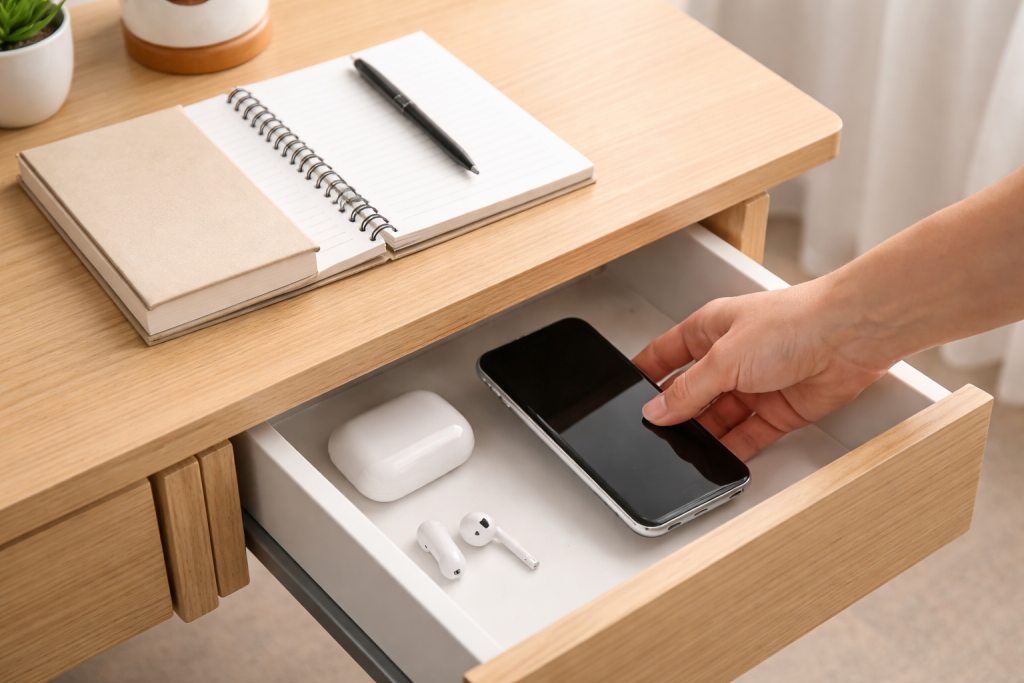
Your smartphone is not a tool during deep work; it is a rival cognitive system. Merely silencing it is insufficient. You must execute a deliberate, pre-session protocol to redesign its relationship to your attention.
Action: Perform a Manual Digital Lockdown ritual before starting your timer:
- Enable “Do Not Disturb” or Airplane Mode: This is your baseline treaty. It silences the audible and visual pulses begging for your attention.
- Pre-Empt Social Access: For added strength, manually log out of social media and news apps, or use your device’s built-in screen time settings to temporarily block access to them. This removes the option to scroll, eliminating willpower drain.
- Manage Expectations Proactively: If necessary, set a status or send a quick message to key contacts: “In deep work until [time]. Will respond afterwards.” This psychologically closes the loop, freeing you from the anxiety of being unavailable.
Advanced Tactic: Pair this digital ritual with a physical displacement action. Place your phone in another room, inside a drawer, or simply face-down and out of arm’s reach. This creates decisive physical friction, making mindless checking a conscious act and solidifying the boundary between your focus space and the digital world.
Protocol 1.2: Pre-Session Load-Locking with the AI Study Planner
“Decision fatigue” drains willpower before you begin. The question “What should I do?” is a focus killer. Your session’s structure must be decided in advance.
-
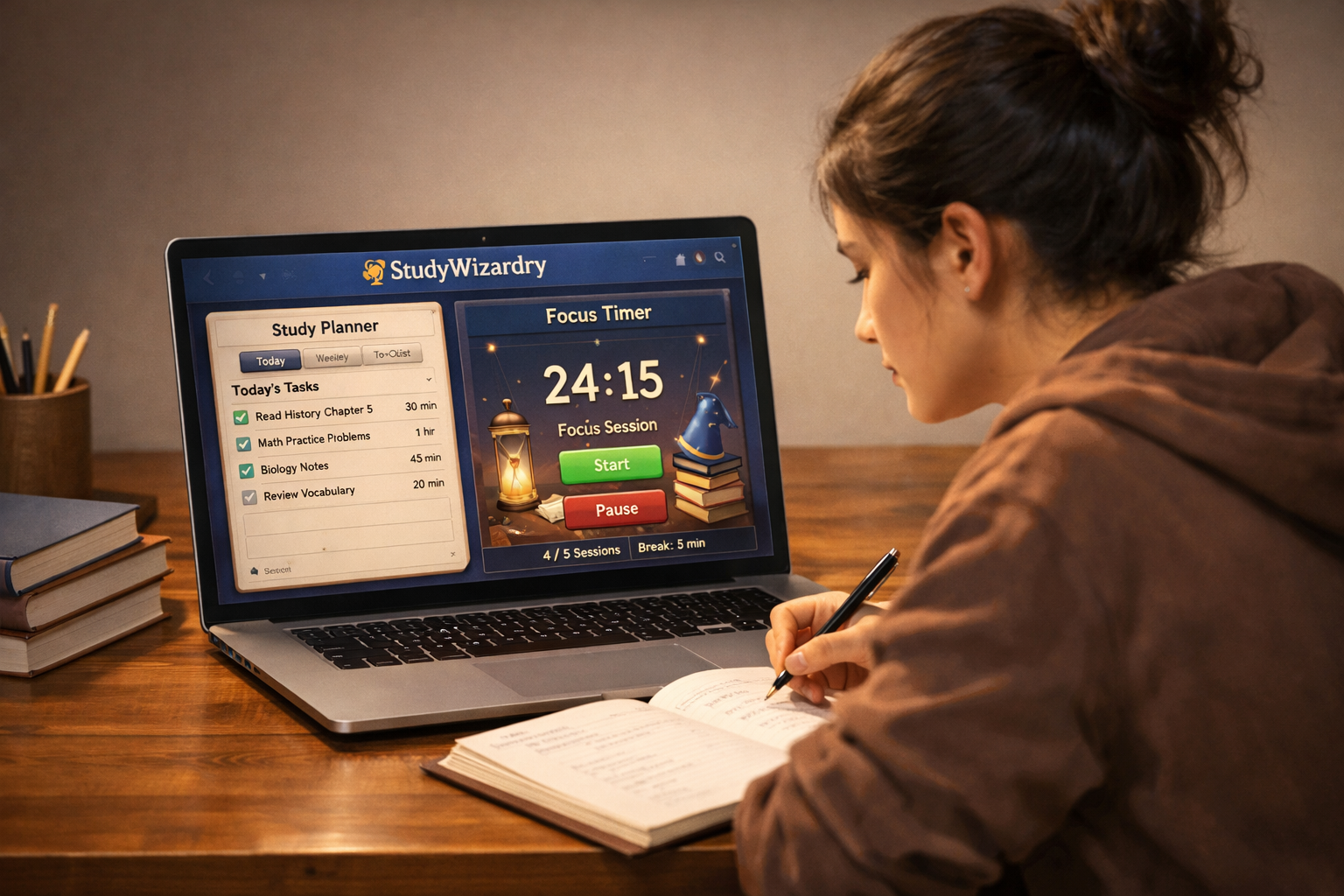
Action: 60 minutes before your session, open your AI Study Planner. Your task is not to list subjects, but to define Specific, Atomic Missions.
-
Poor: “Study Biology.”
-
Superior: “Using the PDF Summarizer on Chapter 7, create 12 flashcards on cellular respiration stages. Then, complete 15 practice problems from the ‘Krebs Cycle’ quiz set generated last week.”
-
-
Why This Works: This level of specificity eliminates ambiguity. Your brain is not deciding; it is executing a pre-loaded mission, allowing you to enter a state of flow almost immediately.
Protocol 1.3: The Ritual of Context Priming
The brain craves ritual. Consistent pre-work signals tell it, “It is time for deep focus now.”
-
Action: Develop a 5-minute, non-negotiable priming ritual. Example:
- Clear your physical desk entirely. Only the tools for your first Atomic Mission remain.
- Pour a glass of water.
- Open StudyWizardry to your planned session.
- Put on noise-cancelling headphones with a consistent “deep focus” soundscape (white noise, ambient sound).
- Start the Pomodoro Timer.
-
The Neuroscience: Rituals reduce anxiety and activate the brain’s centers associated with predictability and control, creating an optimal state for concentration.
Part 2: Neural Ignition – Activating the Flow State Sequence
You cannot command focus; you must beckon it. The transition from a scattered, “shallow” mind to a deep “flow state” requires a deliberate neurological ramp-up. This phase bridges the gap between intention and immersion.
Protocol 2.1: The Victory Sprint
Willpower is a terrible starter motor. Motivation is built through action, not the other way around. Begin with a task that guarantees a quick, tangible win.
-
Action: Schedule the first 25-minute Pomodoro of your session for a review-based, high-confidence task. This could be:
-
Reviewing 20 Smart Flashcards you already know well.
-
Summarizing, in your own words, a concept you grasped yesterday using the AI Note Maker.
-
-
The Psychological Payoff: Success in this first sprint triggers a release of dopamine. This neurotransmitter is not just about pleasure; it’s the brain’s motivational signal, reinforcing the behavior and fueling your desire to continue.
🧠 The Science of Flow: A Primer for the Amateur
A “flow state” (or being “in the zone”) isn’t mystical. It’s a measurable neurobiological condition characterized by: * Complete absorption in the task at hand. * The merging of action and awareness (you stop thinking about doing and just do). * Altered sense of time (hours feel like minutes).
Neuroscientists find that flow is achieved when the challenge of a task slightly exceeds your current skill level, forcing full engagement. It is facilitated by a quieting of the prefrontal cortex’s self-critical “inner voice.” Our protocols—rituals, clear goals, immediate feedback—are designed to create the precise conditions for flow to emerge.
Protocol 2.2: The Intrusion Capture System
The enemy of flow is the “Zeigarnik Effect“—the brain’s tendency to cling to unfinished tasks, popping them into consciousness at the worst times. Fighting these intrusions is exhausting. Capturing them is liberating.
-
Action: Keep a dedicated notepad titled “Open Loops” on your desk. The moment a distracting thought arises (“I need to email my professor,” “I should check that due date”), you have one instruction: Write it down, verbatim, in under 5 seconds. Do not judge it, do not act on it. The act of externalizing the thought closes the cognitive loop, telling your brain, “It is safely stored. You can release it now.”
Part 3: Sustained Deep Work – Navigating the Concentration Arc
Deep work is not a flat line; it is an arc with peaks, plateaus, and natural decline. The master student does not fight this arc but orchestrates it, using strategic variation to maintain peak cognitive performance.
Protocol 3.1: Strategic Interleaving & Thematic Blocks
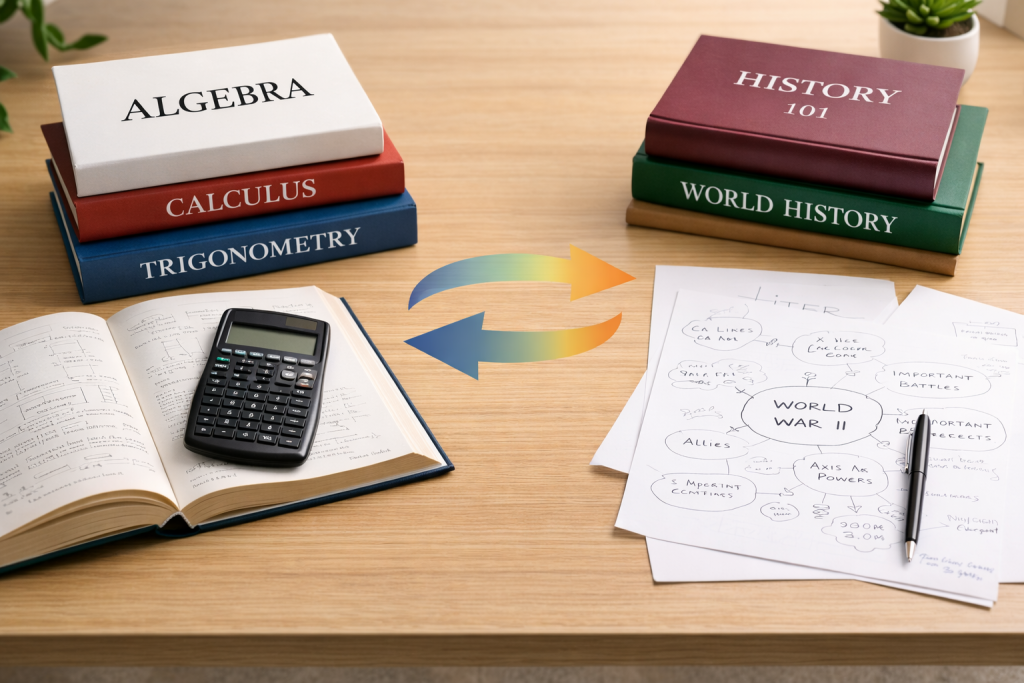
Monotony is the catalyst for mind-wandering. Studying one subject for four hours is neurologically inefficient. The solution is interleaving—mixing different but related topics or skills within a single session.
-
Action: Structure your four hours into two 90-minute “Thematic Blocks,” each with a distinct cognitive profile, separated by a full 30-minute break.
-
Block A (Analytical): Mathematics problem-solving using the Advanced Math Solver to deconstruct solutions, followed by physics derivations.
-
Break (30 min): Complete detachment. Walk, eat, stare out a window. No screens.
-
Block B (Synthetic): History reading, using the AI Note Maker to create a timeline and argument map, followed by crafting essay outlines.
-
-
Why It Works: This switching engages different neural networks, preventing fatigue in any single region of the brain. The desirable difficulty of switching strengthens long-term retention and conceptual flexibility.
Protocol 3.2: The Feedback Immediacy Principle
Passive reading creates an illusion of competence. You recognize information, mistaking familiarity for mastery. True learning is exposed and solidified only under the pressure of retrieval.
-
Action: At the conclusion of each Thematic Block, impose a mandatory 10-minute Retrieval Sprint.
-
Close all books and notes.
-
Use StudyWizardry’s Quiz Generator on the material you just covered. Prompt: “Create 5 challenging application questions from [topic].”
-
Take the quiz immediately. The struggle to recall is where learning is cemented.
-
-
The Data Advantage: Your performance data feeds into the Spaced Repetition System for your Smart Flashcards, automatically scheduling your next optimal review. You’re not just studying; you’re building a personalized, data-driven memory system.
📊 Cognitive Load Theory: Why Your Brain Gets “Full”
Think of your working memory—your mental workspace—as having very limited space. Cognitive Load Theory explains that this space can be overloaded by: 1. Intrinsic Load: The inherent difficulty of the material (e.g., understanding quantum mechanics). 2. Extraneous Load: How the information is presented (poorly organized textbooks, distracting environment). 3. Germane Load: The effort of creating lasting schemas (mental models) in long-term memory.
Our protocol minimizes extraneous load (through Focus Mode and clear planning) to free up space to handle the intrinsic load, so all your energy can go into the germane load—the deep, constructive work of actual learning.
Part 4: The Masterful Shutdown – Encoding and Integration
A chaotic end to a session scatters the fragile neural patterns you’ve just formed. A strategic shutdown, however, actively curates and stores the day’s learning. This phase is what transforms a study session into a permanent upgrade to your knowledge base.
Protocol 4.1: The Synthesis Scan
In the final 15 minutes, shift from input to output and connection.
-
Action: Perform a “Synthesis Scan”:
-
Review the “Open Loops” notepad and quickly schedule or discard items.
-
Open a new note in the AI Note Maker and command: “Synthesize the key relationships between [Topic A] and [Topic B] that I studied today into three bullet points.”
-
Skim the flashcards and quizzes you created, not to re-learn, but to admire the architecture of knowledge you built.
-
Protocol 4.2: The Progress Ceremony & Forward Promise
Motivation is sustained by a sense of trajectory. Conclude by anchoring your progress and gifting your future self a decision-free start.
-
Action:
-
Open your Progress Reports. Do not just glance. Analyze the 4-hour block as data. Acknowledge the focused time as a completed contract with yourself. This act builds an identity of reliability.
-
In your AI Study Planner, set the first, tiny Atomic Mission for your next study session. Example: “Re-test myself on the 5 flashcards I rated ‘Hard’ today.” This creates closure for today and momentum for tomorrow.
-
Conclusion: The Compound Interest of Cognitive Capital
The 4-Hour Deep Work Protocol is not a one-time stunt. It is the foundational practice for building cognitive capital—the compound interest of your invested focus. Each session structured this way does more than teach you a subject; it makes you a more capable learner.
StudyWizardry is the integrated workshop for this practice. The AI Planner is your blueprint, Focus Mode your shield, the Quiz Generator your stress-test, and the Progress Reports your ledger. Your role is not to grind, but to orchestrate: to set the conditions, initiate the protocols, and interpret the feedback.
Your first engineering assignment: Tonight, execute only Protocol 1.2: Pre-Session Load-Locking. Use the AI Study Planner to define tomorrow’s Atomic Missions with ruthless specificity. Experience the liberation of starting a session without a single decision to make. Master that. Then add the next protocol. Build your Focus Engine one precision part at a time.
The protocol provides the scaffolding, not the content. Creativity and spontaneity flourish within constraints, not in chaos. The rigidity is applied to the protection of your time and attention (the environment, the schedule). What you do with that protected time—the connections you make, the insights you have—is where your unique creativity shines. This system doesn't cage creativity; it guards it from interruption.
Then your Thematic Block is 45 minutes. The unit is irrelevant; the principle is paramount. The protocol is based on your personal concentration arc. Use your Progress Reports to find your natural limit. Perhaps your rhythm is 45 minutes of deep work followed by a 20-minute break. The system adapts to your neurology. The goal is to maximize the quality of your focus cycles, not to fit a preconceived duration.
This is the critical investment. This "meta-work" (planning, reviewing, synthesizing) is what psychologists call deliberate practice—the active, conscious engagement with the process of learning. It is what separates experts from amateurs. Spending 20% of your time on meta-work improves the ROI of the other 80% by over 300%. It is the highest-leverage study activity you can perform.