
Your Brain’s Delete Button—And How Active Recall Disables It!
It’s 2 AM. The library is silent, except for the frantic flipping of pages. Your textbook is a sea of fluorescent highlights, and your notes feel familiar. Yet, a sinking feeling tells you that by tomorrow’s exam, it will all have vanished. You’ve spent hours “studying,” but have you actually learned anything?
For decades, students have relied on study methods that feel productive but are scientifically proven to be woefully inefficient. Passive review—like re-reading and highlighting—creates an illusion of knowledge, a comforting familiarity that masks a startling lack of recall. But what does the science of learning actually recommend?
This comprehensive guide isn’t just another list of study tips. It’s a deep dive into Active Recall, the powerful, evidence-based learning technique rooted in neuroscience that can fundamentally transform how you learn and remember. We’ll explore the robust research behind it, provide a clear, step-by-step guide to implementation, and show you how to make it the core of your academic success.
🧠 Part 1: The Science of Learning: Why Your Brain Learns Best Through Struggle
When you re-read your notes, you’re engaging in a passive cognitive process known as recognition. Your brain sees the information and thinks, Ah, I know this. This feeling of familiarity is seductive, but it’s a trap psychologists call the illusion of competence.
Recognition is a low-level cognitive task. It’s the difference between seeing a multiple-choice answer and knowing it’s correct versus having to write that same answer on a completely blank page. The latter, known as recall, is an active, effortful process that is infinitely more effective for building strong, long-lasting memories.
📉 The Forgetting Curve: Your Brain’s Natural Enemy
In the 1880s, German psychologist Hermann Ebbinghaus made a groundbreaking discovery that would change our understanding of memory forever. Through meticulous research, he identified the Forgetting Curve, a model that demonstrates how information is lost over time when there is no attempt to retain it.
His research revealed we can forget up to 50% of new information within an hour and up to 70% within 24 hours. This natural memory decay explains why cramming the night before an exam leads to poor long-term retention. The information might be temporarily accessible, but it will quickly disappear from your memory.
Passive re-reading does very little to flatten this curve. It might briefly nudge information back into your short-term memory, but without a strategy to combat this natural decay, you’re fighting a losing battle. Your hours of studying are, in effect, just a slow-motion version of forgetting.

💪 Part 2: What is Active Recall? The Mental Weightlifting for Your Mind
Active Recall is the practice of actively stimulating your memory during the learning process. Instead of passively inputting information through re-reading, you force your brain to output it through recall. It’s the cognitive equivalent of weightlifting—the mental strain is what makes your memory stronger.
When you engage in Active Recall, you’re essentially telling your brain: This information is important. I need to retrieve it multiple times. This process strengthens the neural connections associated with that information, making it easier to access in the future.
🔬 The Neuroscience Behind the Magic: Why Retrieval Strengthens Memory
Why is this mental strain so beneficial? The answer lies in how our brains process and store information. Each time you successfully recall a piece of information, you trigger a process called memory consolidation, where the brain reinforces the neural pathways associated with that memory.
A pivotal 2011 study by Karpicke and Blunt in the journal Science provided powerful evidence for Active Recall’s effectiveness. They divided students into four groups with different study methods:
- Group 1: Studied the material once
- Group 2: Studied the material in multiple repeated sessions
- Group 3: Created concept maps while studying
- Group 4: Practiced retrieving the information through self-testing
The results were striking: students who used recall-based strategies by testing themselves significantly outperformed all other groups. Notably, these students weren’t just better at memorizing facts; they demonstrated deeper, more flexible understanding of the concepts, showing better performance on complex inference questions.
🛠️ Part 3: How to Implement Active Recall: A Step-by-Step Guide
📄 Method 1: The Blank Page Technique
This is one of the most potent and straightforward Active Recall methods available to students.
How it works in practice:
After reading a chapter or watching a lecture, close the book or video. Take a blank sheet of paper and write down everything you can remember. Resist the urge to peek at your source material. Organize the concepts in your own words, draw diagrams from memory, and connect related ideas.

Why this method works so effectively:
It forces you to reconstruct your knowledge from scratch, immediately revealing gaps in your understanding that passive re-reading would have concealed. The act of organizing information without referring to source material strengthens your conceptual understanding and improves your ability to retrieve information in exam settings.
Pro Tip: After completing your blank page session, use StudyWizardry’s AI Note Maker to digitize and organize your handwritten notes. The AI can help identify any key concepts you might have missed and structure your self-generated content for future review sessions.
📝 Method 2: Self-Quizzing & The Power of Flashcards
Transforming your study materials into test questions is a fundamental Active Recall strategy.
Implementation guide:
Before you even feel ready to be tested, use practice problems, end-of-chapter questions, or create your own flashcards. The critical element is testing yourself before you review the answers. For digital flashcards, ensure you actively attempt to recall the answer before flipping the card.
Advanced flashcard techniques:
- Create questions that require application, not just recall
- Include image-based cards for visual subjects
- Add context to definitions to enhance understanding
- Use the Leitner system or spaced repetition software to optimize review timing
Leveraging Technology:
While physical flashcards work, digital tools can supercharge this process. Instead of spending hours creating cards, you can use StudyWizardry’s AI Flashcard generator. Simply upload your notes, and the AI instantly creates a comprehensive deck of flashcards for you to practice active recall, saving you precious time and ensuring you cover all key concepts. The app’s built-in spaced repetition algorithm then automatically schedules your reviews at optimal intervals.
👨🏫 Method 3: The Feynman Technique
Named after the Nobel Prize-winning physicist Richard Feynman, this technique leverages the power of explanation to expose knowledge gaps.
Step-by-step process:
Choose a concept you’re trying to learn. Explain it out loud, in simple terms, as if you were teaching it to a complete novice. Avoid using technical jargon or complex terminology. When you encounter areas where your explanation becomes convoluted or you struggle to simplify the concept, you’ve identified a weakness in your understanding.

Why explanation enhances learning:
To explain something simply, you must understand it deeply. The act of articulating the concept in your own words requires retrieval and reorganization of information, strengthening neural pathways and improving long-term retention.
Tech Enhancement: Use StudyWizardry’s AI Note Maker to record and transcribe your explanations. The AI can help identify areas where your explanation lacks clarity and suggest improvements, acting as your personal teaching assistant.
❓ Method 4: Create Your Own Questions
Shifting from being a test-taker to a test-maker transforms your relationship with the material.
Effective question creation strategies:
While studying, consistently ask yourself: “How could I be tested on this concept?” Write down potential exam questions as you encounter key information. Leave these questions for a day or two, then return to answer them without consulting your notes.
Types of questions to create:
- Definition and terminology questions
- Application and problem-solving questions
- Comparison and contrast questions
- Scenario-based questions that test conceptual understanding
Automate the Process: StudyWizardry’s Quiz Generator can create practice tests and questions directly from your notes, giving you instant material for active recall practice. This saves you time while ensuring you’re testing yourself on the most relevant content.
⚡ Part 4: Supercharging Your Learning: Combine Active Recall with Spaced Repetition
While Active Recall is powerful on its own, its effects are magnified exponentially when combined with Spaced Repetition. Spaced Repetition is a learning technique that involves reviewing information at systematically increasing intervals. Instead of cramming, you review material after one day, then three days, then a week, then three weeks, and so on.
This combination creates the ultimate recipe for long-term mastery. Active Recall is the what—the action of retrieving information—and Spaced Repetition is the when—the optimal schedule for that retrieval. By practicing recall right at the moment you are about to forget something (as dictated by the Forgetting Curve), you dramatically slow down memory decay, cementing knowledge into your long-term memory.
🔄 Implementing the Combined Approach
Managing this schedule manually for all your subjects can feel like a full-time job. This is where technology transforms from being a distraction to your greatest academic ally.
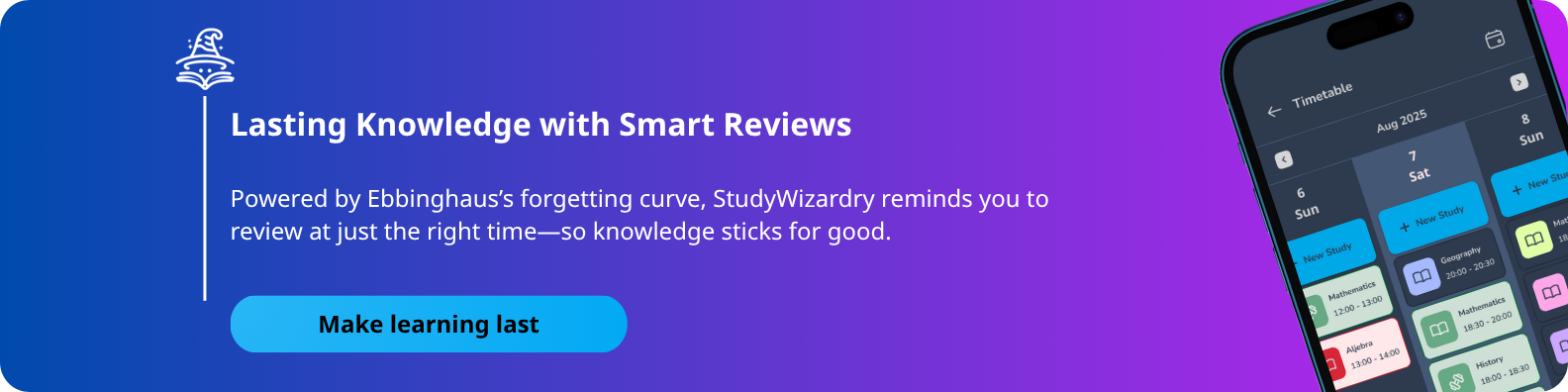
StudyWizardry’s AI Study Planner automates this process completely. It analyzes your syllabus, deadlines, and—most importantly—your performance data from quizzes and flashcards. The AI then automatically schedules your review sessions using optimized spaced repetition intervals. It tells you exactly what to review and when, ensuring you combat the Forgetting Curve with scientific precision without the mental overhead of manual scheduling.
📊 Part 5: Measuring Your Progress and Optimizing Your Approach
Implementing Active Recall requires monitoring your progress to ensure the methods are working effectively. Keep a study journal where you note:
- Which Active Recall methods work best for different subjects
- How long you can retain information using various techniques
- Which types of information are most challenging to recall
- Your performance on practice tests before and after implementation
StudyWizardry’s progress tracking features automatically monitor your performance across different subjects and question types, giving you data-driven insights into which areas need more focus and which techniques are working best for you.
🔧 Troubleshooting Common Challenges
Many students encounter obstacles when first implementing Active Recall. Here are solutions to common problems:
Challenge: Feeling frustrated by initial difficulty
Solution: Recognize that struggle is part of the process. The initial difficulty indicates you’re building stronger neural pathways.
Challenge: Not knowing how to create effective questions
Solution: Start with textbook questions, then gradually create your own. StudyWizardry’s AI Quiz Generator can help you understand what makes a good question by providing examples tailored to your study material.
Challenge: Time management with Active Recall
Solution: While Active Recall takes more initial effort, it reduces total study time needed for long-term retention. Let StudyWizardry handle the scheduling and organization, so you can focus on the actual learning.

🎯 Conclusion: The Paradigm Shift from Studying Hard to Studying Smart
The educational landscape is undergoing a fundamental shift. The students who will thrive are not those who can cram the longest, but those who leverage proven learning science to study smarter.
Active Recall is not a magic pill, but it is the closest thing we have to a scientific guarantee for improved learning. It requires more initial effort than passively re-reading notes, but the return on that investment—in the form of deeper understanding, higher grades, and lasting knowledge—is immense.
The evidence is clear: methods that feel easy and comfortable, like re-reading and highlighting, create the illusion of learning without the substance. Methods that feel challenging, like Active Recall, create durable, flexible knowledge that stands the test of time.
It’s time to close the textbook, put down the highlighter, and pick up the blank sheet of paper. Embrace the struggle of recall, because that is where true, durable learning is born.
Your Action Plan:
- Choose one Active Recall method to implement in your next study session
- Schedule regular review sessions using Spaced Repetition principles
- Explore how StudyWizardry can automate and optimize both Active Recall practice and Spaced Repetition scheduling
- Track your progress and adjust your methods as needed
- Share these techniques with study partners to enhance group learning
Ready to master your memory? Start your next study session with the Blank Page Method and experience the difference. To take it a step further, discover how StudyWizardry’s AI-powered features can automate your path to academic mastery—transforming these evidence-based techniques from theoretical concepts into your daily study reality.
Not at all! Think of it like using a calculator for math—it doesn't replace your understanding, but it handles the tedious work so you can focus on deeper learning. StudyWizardry doesn't learn for you; it optimizes the process of learning by automating flashcard creation, scheduling reviews, and generating practice questions. The mental effort of recall still entirely depends on you.
It feels like more work initially, but it's actually a huge time-saver in the long run. Passive rereading creates the "illusion of knowledge," leading to cramming and quickly forgetting. Active Recall builds durable memory, meaning you'll spend less time relearning before exams. Plus, tools like StudyWizardry eliminate the hours you'd spend making flashcards and schedules, making the entire process far more efficient.
Absolutely. While they are famously effective for fact-based subjects like history or biology, they are equally powerful for conceptual subjects like math and physics. The key is in the application: for math, use Active Recall to reproduce the steps of solving a problem on a blank page; for literature, recall themes and character analyses. StudyWizardry's AI adapts to different subjects, generating relevant question types and study materials for each.