
3 Science-Backed Study Hacks That Actually Work
We’ve all seen them: the viral social media posts promising “Get Straight A’s with This One Simple Trick!” or “Study for Only 1 Hour a Day and Ace Your Exams!” In a world where students are busier and more stressed than ever, the allure of a quick fix is powerful.
But here’s the uncomfortable truth: most of these so-called “study hacks” are ineffective at best, and can be seriously detrimental to your long-term learning at worst. They create an illusion of productivity while often bypassing the very cognitive processes that make knowledge stick.
At StudyWizardry, we believe in empowering students with tools that work with your brain, not against it. So, let’s pull back the curtain on why these popular hacks fail and replace them with the three evidence-based techniques that truly deliver results.
Why Flashy “Study Hacks” Fail: The Science of Learning
The reason most shortcuts fail lies in a concept called cognitive effort. Lasting learning is hard work because it requires your brain to build and strengthen neural pathways. Many hacks trick you into feeling productive while avoiding this essential, effortful process.
1. The “Miracle Shortcut” Hack (e.g., “Learn While You Sleep!”)
-
Why It Doesn’t Work: While there is some research on memory consolidation during sleep, the idea that you can learn complex, new material by playing recordings while you sleep is a myth. Sleep helps solidify what you’ve already actively learned, but it can’t teach you new concepts from scratch. Relying on this wastes precious time and replaces active study sessions.
-
The Ethical Takeaway: Sleep is non-negotiable for memory, but it’s a supporter of learning, not the main event.
2. The “Passive Engagement” Hack (e.g., Highlighting & Re-reading)
-
Why It Doesn’t Work: This is the grand illusion of studying. Passively highlighting text or re-reading notes makes you familiar with the material, but it doesn’t create the strong recall pathways needed for an exam. Your brain isn’t being challenged to retrieve the information, leading to what’s known as the “illusion of competence.” You recognize the information, but you can’t reproduce it without cues.
-
The Ethical Takeaway: Familiarity is not fluency. Just because the page looks colorful and the notes feel familiar doesn’t mean you know it.
3. The “Cramming” Hack
-
Why It Doesn’t Work: Cramming forces information into your short-term memory. It might get you through a test the next morning, but the “forgetting curve” is steep. The knowledge is rapidly lost, meaning you have to start from square one for the final exam or future courses. This is an incredibly inefficient way to learn over the long term.
-
The Ethical Takeaway: Learning is like building a muscle; it requires consistent repetition over time, not one marathon session.

The 3 Evidence-Based Techniques That Actually Work
Real learning strategies aren’t always engaging, but they are powerful because they are rooted in decades of cognitive science research. They embrace desirable difficulty, making your brain work harder in the short term for vastly superior long-term retention.
1. Active Recall: The King of All Techniques
What it is: Actively retrieving information from your brain without looking at your notes or the source material. It’s the opposite of passive re-reading.
Why it works: Every time you force your brain to recall a piece of information, you strengthen the neural pathway to that knowledge, making it easier to access next time. It exposes what you don’t know, so you can focus your energy there.
How to do it:
- After reading a chapter, close the book and write down everything you can remember.
- Use flashcards, but discipline yourself to try to recall the answer before flipping the card.
- Practice with past papers or problem sets under timed conditions.
How StudyWizardry Helps: Our Flashcards and Quiz/Test Generator are built specifically for this. They force you to actively retrieve information, turning passive review into an active, effortful learning session.
2. Spaced Repetition: The Anti-Cramming
What it is: Reviewing information at increasing intervals over time. Instead of studying something for five hours in one day, you study it for one hour today, then again in two days, then a week, then two weeks later.
Why it works: It directly fights the “Forgetting Curve” by revisiting information just as you’re about to forget it. This process signals to your brain that the information is important, moving it from short-term to long-term memory.
How to do it:
- Use a digital flashcard app with a built-in spaced repetition algorithm (SRS).
- Plan your study schedule to regularly review topics from previous weeks and months.
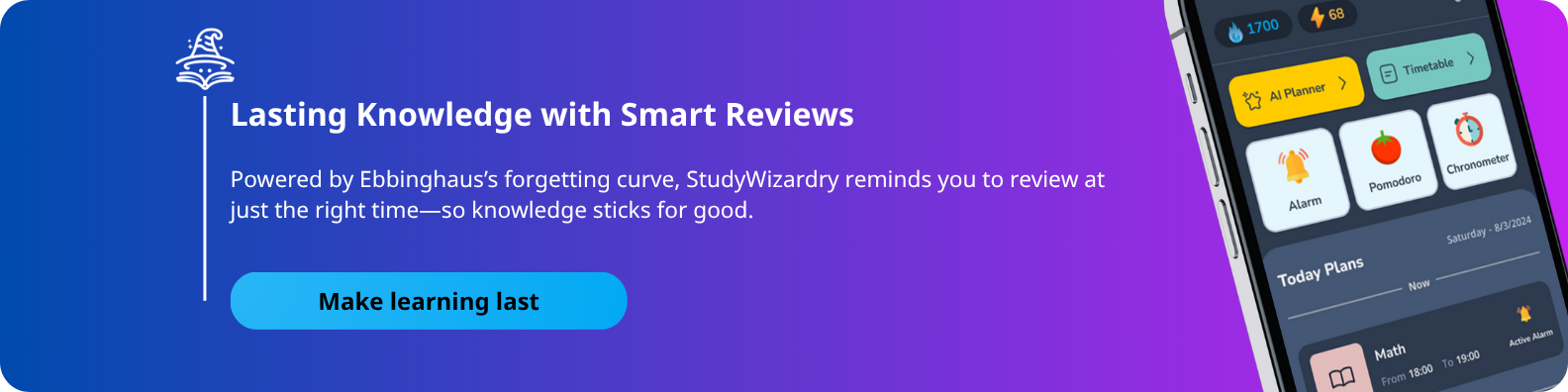
How StudyWizardry Helps: Our AI Study Planner integrates spaced repetition principles directly into your schedule. It automatically schedules review sessions for older material, ensuring you never forget what you’ve learned.

The Science Behind the System: Hacking the Forgetting Curve
The Ultimate Synergy: Active Recall + Spaced Repetition
While we’ve introduced Spaced Repetition and Active Recall as separate techniques, their true power is unleashed when they are combined. Spaced Repetition answers the critical question: “When is the best time to review?” And Active Recall provides the most effective answer to: “How should I review?”
This powerful combination directly targets one of the most fundamental concepts in memory science: The Forgetting Curve.
What is the Forgetting Curve?
Pioneered by psychologist Hermann Ebbinghaus in the 1880s, the Forgetting Curve demonstrates a simple but brutal truth: we forget information at an exponential rate without deliberate effort to retain it.
- Memory retention can plummet to around 34% within just 24 hours.
- Without strategic review, you might retain only about 20-25% of what you learned after a week.
The solution? Each timely review flattens the curve. Subsequent reviews make the memory decline progressively slower, until the knowledge is securely lodged in your long-term memory.
Putting It All Together:
Instead of passively re-reading your notes on a schedule, you should actively test yourself (Active Recall) at those critical, spaced intervals (Spaced Repetition). This “desirable difficulty” of struggling to retrieve information just as you’re about to forget it is what solidifies memory most effectively.
To dive deeper into the science of when to study and learn how to systematically defeat forgetting, read our detailed guide: Mastering Memory: How to Hack the Forgetting Curve for Academic Success.
How StudyWizardry Helps: This is where our AI Study Planner truly shines. It automates this powerful combination. The planner uses the principles of the Forgetting Curve to schedule your study sessions, and then our Flashcards and Quiz Generator provide the perfect tools for the Active Recall practice you need to do in those sessions. The app tells you what to review, when to review it, and how to practice most effectively.
3. Elaboration and Interleaving: Building Deep Understanding
What it is:
-
Elaboration: Connecting new information to what you already know. Explain it in your own words, ask “why” and “how,” and create analogies.
-
Interleaving: Mixing up different topics or types of problems within a single study session instead of blocking one topic at a time (e.g., doing a math problem, then a history question, then a chemistry equation).
Why it works: Elaboration creates a rich web of connections around a fact, making it easier to retrieve. Interleaving forces your brain to constantly identify which strategy to use for each problem, building flexible and robust problem-solving skills.
How to do it:
- When taking notes, don’t just copy; write brief explanations in the margins in your own words.
- When doing practice problems, switch between different chapters or problem types.
How StudyWizardry Helps: Our AI Note Maker encourages elaboration by helping you transform dense lecture material into clear, conceptual summaries. Furthermore, our Quiz Generator can create mixed-topic tests to facilitate effective interleaving practice.

Mastering the Mix: Why Your Brain Thrives on Variety
The techniques of Elaboration and Interleaving are powerful because they both force your brain to do deeper, more flexible work. While Elaboration builds rich webs of understanding within a topic, Interleaving trains your brain to switch contexts and apply the right knowledge across topics.
This “desirable difficulty” is what builds true mastery, moving you beyond memorization to adaptable problem-solving. If you want to dive deeper into how to strategically mix subjects to dramatically boost your long-term retention and exam performance, our dedicated guide breaks it down:
Interleaving: The Secret to Mastering Multiple Subjects
The Bottom Line
There is no magic bullet for learning. The most effective path is to replace the seductive but empty “hacks” with strategies that respect how your brain actually works. It requires more initial effort, but the payoff is a deeper, more durable understanding that will serve you far beyond your next exam.
Embrace the effort. It’s where real learning happens.
Want to implement these techniques effortlessly? Explore StudyWizardry’s AI Study Planner and Flashcard Hub to build these powerful, science-backed methods into your daily routine.
It feels that way at first! Cramming feels productive in the short term, but it's a cycle of wasting time re-learning what you forgot. While these techniques require more initial effort, they save you enormous time and stress in the long run. By studying smarter, you actually retain information, meaning you spend less time studying for finals and future courses. Our AI Study Planner is specifically designed to make this efficient process effortless for you.
Absolutely. Whether you're studying history, math, medicine, or law, the fundamental way your brain learns and retains information remains the same. Active Recall is perfect for definitions and concepts, Spaced Repetition is essential for any subject with cumulative knowledge, and Interleaving is especially powerful for subjects like math and science where you need to choose the right strategy from a toolkit of methods.
Many apps focus on just one thing, like flashcards. StudyWizardry is built as an integrated learning system. We don't just give you isolated tools; we connect them based on cognitive science. Our AI Study Planner tells you when to study using Spaced Repetition, and then seamlessly directs you to our Flashcards and Quiz Generator to tell you how to study using Active Recall and Interleaving. It’s a holistic approach that automates the science of learning for you.