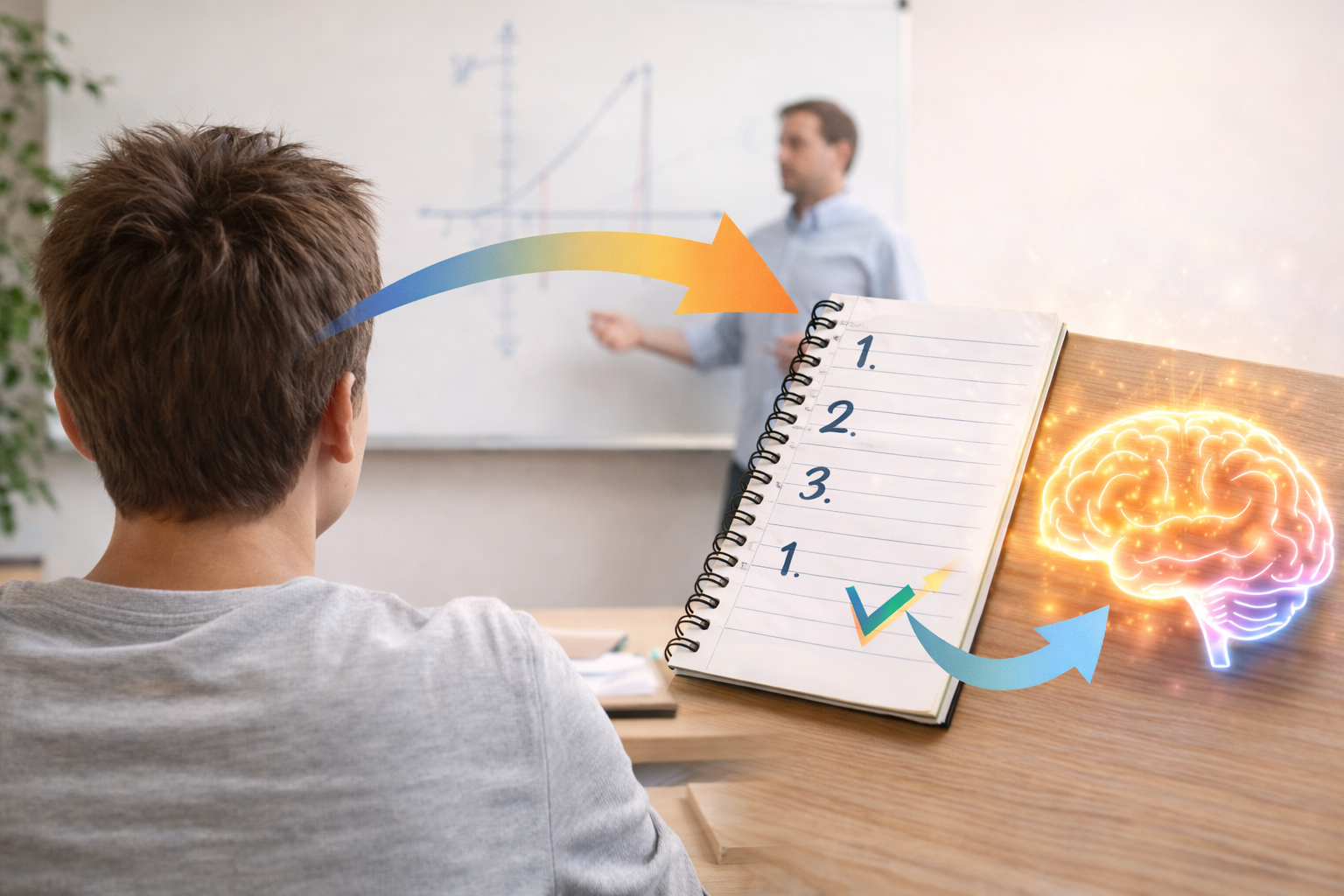
The 3-Step Mastery Loop: Transform Lectures into Lasting Knowledge
You sit through the lecture. You scribble pages of notes. You leave class feeling informed. But a week later, when you open your notebook to study, it’s as if you’re seeing the material for the first time. The information feels distant, fragmented, and strangely not your own.
This universal student experience has a simple cause: you captured the lecture, but you didn’t process it. Learning isn’t a one-time event of consumption; it’s a three-phase cycle of encoding, consolidation, and integration. This article introduces “The Mastery Loop”—a practical, non-negotiable 3-step system you apply immediately after any lecture or study session to transform raw information into personal, retrievable mastery.
The Flaw in Linear Learning: Why Note-Taking Isn’t Enough
Traditional studying follows a linear model: Attend → Record (notes) → Store (notebook) → Cram before exam. This model ignores how your brain actually builds memory. Neuroscientists compare it to cooking: attending a lecture is merely gathering ingredients. Without the crucial steps of prepping, cooking, and plating, you’ll never have a meal. The Mastery Loop is your recipe for cooking knowledge so your brain can properly digest and store it.
🧠 The Science of the “Loop”: From Working Memory to Long-Term Storage
When you first hear information, it resides in your working memory—a temporary, fragile holding space that can only keep a few items for about 20-30 minutes. To prevent this information from decaying (a process masterfully described by the Ebbinghaus Forgetting Curve), it must be actively moved to your long-term memory. This transfer, called consolidation, doesn’t happen automatically through passive listening. It requires active, effortful manipulation of the material. The Mastery Loop is a deliberate protocol designed to trigger this exact consolidation process.
Step 1: The 10-Minute Synthesis (The “Encode” Phase)
When: Immediately after the lecture ends, or within one hour.
Goal: To convert the lecturer’s narrative into your conceptual framework.
Action – The “Question & Cluster” Method:
-
Take a blank sheet of paper or open a new note.
-
Without looking at your detailed notes, write down the one big question the entire lecture was trying to answer (e.g., “How do cells convert glucose into energy?”).
-
Now, from memory, cluster every piece of information you recall under 3-5 sub-headings that answer that big question. Use arrows, circles, and simple diagrams. Resist the urge to transcribe.
Why It Works: This forces active recall at the moment of highest memory freshness, battling the steepest part of the Forgetting Curve. By organizing information around a central question, you are encoding it semantically (by meaning), not sequentially (by the order it was presented), which dramatically improves later retrieval.
📚 Go Deeper: This step is the practical application of moving beyond passive recognition. For a full breakdown of why active recall is the foundation of effective learning, revisit our cornerstone guide: Why You Forget Everything You Study & How to Actually Remember It.
Step 2: The Strategic Gap Analysis (The “Challenge” Phase)
When: Within 24 hours of the lecture.
Goal: To identify and attack the weakest links in your understanding before they become permanent gaps.
Action – The “Feynman Check”:
-
Open your synthesized note from Step 1 and your original lecture notes.
-
For each of your 3-5 sub-headings, try to explain the concept out loud in the simplest terms possible, as if teaching a middle-school student.
-
The moment you stumble, generalize, or rely on jargon, you’ve found a gap. Mark it clearly.
Why It Works: This leverages the Feynman Technique, exposing the difference between recognizing a term and truly understanding it. The discomfort of not being able to explain simply is your brain signaling an unconsolidated memory.
Bridging the Gap with AI: This is where intelligent tools shift from luxury to necessity. For the concepts you couldn’t explain:
-
Use the AI Note Maker on a confusing paragraph from your textbook to generate a plain-language summary.
-
Input your shaky concept into the Quiz Generator and command: “Create 3 application questions to test understanding of [concept].” Struggling to answer these questions confirms the gap and provides immediate practice.
🎯 Design Your Defenses: The gaps you find often align with your brain’s default “Operating System.” Learn how to tailor your study materials—like the flashcards you’ll create next—to your cognitive style in our guide: Your Brain’s UI: Designing Flashcards for Your Unique Cognitive “Operating System”.
Step 3: The Active Integration (The “Anchor” Phase)
When: Within 48 hours of the lecture.
Goal: To anchor the new knowledge to your existing mental models and prepare it for long-term review.
Action – The “Bridge & Card” Protocol:
-
Build One Bridge: Ask, “How does this new concept relate to something I already know from a previous lecture or course?” Write down this connection (e.g., “This new process in cellular respiration directly uses the enzyme I learned about last week in the metabolism chapter”).
-
Create Two “Master” Flashcards: Using the gaps from Step 2 and the bridge from Step 3, create only 2-3 high-impact flashcards. Ditch simple definitions. Use formats like:
-
The Application Card: “If the enzyme from last week’s lecture was inhibited, how would it specifically affect Step 2 of the process we learned today?”
-
The Comparison Card: “Compare and contrast Process A (today) with Process B (two weeks ago) in terms of their inputs and efficiency.”
-
Why It Works: Building a bridge creates a neural pathway between new and old knowledge, integrating it into your web of understanding. Creating minimal, high-quality cards targets your precise weak points for efficient future review via spaced repetition.
Systematize Your Review: Don’t leave these cards in a random pile. Input them into your StudyWizardry Smart Flashcards deck. The Spaced Repetition System (SRS) will then automatically schedule your reviews at scientifically optimal intervals, ensuring this hard-won knowledge is permanently etched into your long-term memory.
⚠️ Avoid the Trap: It’s tempting to make dozens of detailed cards. But as we’ve exposed before, quantity often undermines quality and leads to shallow recognition, not deep understanding. Revisit the philosophy of strategic card creation in: The Flashcard Lie: Is Your “Perfect” Study Habit Making You a Worse Thinker?.
Putting It All Together: Your Weekly Mastery Loop Schedule
| Day | Loop Phase | Time Needed | Tool Emphasis |
|---|---|---|---|
| Mon (After Lecture) | Step 1: 10-Minute Synthesis | 10-15 min | Blank paper, active recall. |
| Tue | Step 2: Gap Analysis | 20-30 min | AI Note Maker, Quiz Generator, Feynman Check. |
| Wed | Step 3: Active Integration | 15-20 min | Smart Flashcards, bridge-building. |
| Thu-Sun | System-Guided Review | As scheduled by app | Spaced Repetition System reviews the cards for you. |
Conclusion: From Consumer to Architect of Your Knowledge
The Mastery Loop is a commitment to processing over collecting. It replaces the passive hope that “it will stick” with the active certainty that you made it stick. By investing 45-60 intentional minutes over three days, you save countless hours of futile re-learning before exams.
This loop turns your learning from a series of disconnected events into a self-reinforcing system. The output of one cycle (mastered concepts) becomes the stable foundation for the next. You stop feeling like you’re constantly trying to catch up and start feeling like you’re strategically building.
Your challenge for the next week: Apply the full 3-Step Mastery Loop to just one of your lectures. Do not skip a step. Experience the profound difference between having notes and owning knowledge. This isn’t just another study tip—it’s the operating system for becoming a master learner.
The "immediately after" window is ideally within the hour. If pressed, even a 5-minute version is transformative: as you walk to your next class, mentally articulate the lecture's central question and its 2-3 key answers. The physical act of writing the full synthesis should then happen at your first break. The key is the active mental summary before the memory fully decays.
It is an investment, but it's the highest-return investment you can make in your learning. A professor provides information; learning happens inside your mind through the act of manipulation. Creating questions and bridges is that act—it's the mental "workout" that strengthens understanding. It shifts your role from a passive consumer to an active architect of your knowledge.
Absolutely. The Mastery Loop is content-agnostic. Simply define your "lecture" as a focused, uninterrupted study session on a specific chapter or video module. Apply Step 1 as soon as you finish the session. The principles of immediate synthesis, gap analysis, and active integration remain exactly the same and are perhaps even more critical without the structure of a live class.